At first glance, the new FAW J7 looks like another premium long-haul truck. But this isn’t just a new truck. It’s the Chinese truck that wants to change everything…
Chinese truck manufacturers have spent years building market share in South Africa by competing aggressively on price. Now, however, the strategy appears to be changing. With the launch of the new J7 flagship, FAW Trucks Southern Africa is making a far more ambitious move – directly targeting the premium long-haul segment traditionally dominated by European brands.
Moving beyond value-for-money
For years, FAW built its reputation locally around durability, simplicity and relatively low operating costs. The JH6, in particular, helped establish the brand as a serious contender in South Africa’s extra-heavy truck market. The new J7, on the other hand, represents a significant shift upwards.
The truck’s specifications place it squarely in premium territory. Power comes from a 12.52-litre turbocharged diesel engine producing 407kW and 2,600Nm of torque, paired with a ZF 12-speed automated manual transmission with integrated intarder.
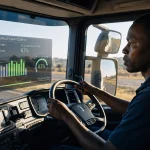
The cabin specification also reflects changing expectations in long-haul transport. Features include a flat-floor sleeper cab, automatic climate control, integrated fridge, LED lighting and an extra-wide bunk designed to improve driver comfort on long-distance routes.
Safety systems such as autonomous emergency braking, electronic stability control, lane departure warning and tyre pressure monitoring are now standard. These are no longer features associated only with premium European trucks.
The total cost equation
While the J7 clearly aims to compete on specification, the real battleground remains total cost of ownership. This is where Chinese manufacturers believe they can disrupt the market.
South African operators continue to face severe pressure from fuel prices, rising maintenance costs and shrinking margins. Against that backdrop, many fleets are becoming increasingly willing to evaluate alternatives to traditional premium brands.
FAW says that the J7 has been engineered specifically to reduce running costs through its improved fuel efficiency and reduced maintenance requirements. The truck also features dual fuel tanks with a combined 1,200-litre capacity, allowing operators to maximise range on long-haul corridors between major freight hubs.
Challenging perceptions
Perhaps the biggest hurdle facing the J7 is not technical capability, but perception. European truck brands still enjoy enormous credibility in South Africa, particularly among large fleets operating on demanding cross-border routes. Reliability, resale value, dealer support and uptime remain critical decision-making factors. However, Chinese brands are steadily reshaping those perceptions.
Recent naamsa figures already show Chinese manufacturers occupying increasingly strong positions in South Africa’s extra-heavy commercial vehicle market. Operators are clearly becoming more comfortable with Chinese products than they were a decade ago. The J7 appears designed to accelerate that shift further.
FAW says the truck is manufactured in a dedicated state-of-the-art facility in China built exclusively for the J7 programme, with a claimed B10 service life of 1.5 million kilometres. That places the conversation firmly in premium territory.
A changing market
The launch of the J7 also reflects broader global trends within the truck industry. Chinese manufacturers are no longer competing solely on affordability. Increasingly, they are investing heavily in technology, safety, comfort and efficiency while maintaining pricing advantages over established European rivals. That combination could prove particularly disruptive in cost-sensitive markets such as South Africa.
European OEMs still retain major advantages in areas such as aftersales support, fleet integration, telematics and long-established customer relationships. But the gap is narrowing. The J7 may not immediately dethrone Europe’s premium heavyweights – trust in the trucking industry is built over years, not months. But it does signal something important: Chinese truck manufacturers are no longer merely targeting the bottom end of the market. They are now coming directly for the premium segment as well.