The five-minute fix that could transform trucking
The five-minute fix that could transform trucking
As electric freight transport gathers momentum globally, CHARLEEN CLARKE reports that a growing number of researchers and logistics companies believe battery swapping could solve one of the industry’s biggest operational challenges – time.
Before sunrise on the outskirts of Berlin, a truck rolls into a logistics yard. It does not queue, idle or connect to a charging cable. Instead, machinery beneath the vehicle comes alive. Within minutes, the depleted battery is removed and replaced with a fully charged unit. The truck immediately returns to the road.
While the process may sound futuristic, battery swapping is not a radical new concept. Versions of the idea have been explored for years in countries including China, Israel, Taiwan and parts of Europe. What has changed is the growing urgency surrounding freight electrification and the operational realities facing logistics companies.
A new white paper by the Fraunhofer Institute for Material Flow and Logistics (IML), developed in collaboration with Germany’s DSLV Bundesverband Spedition und Logistik and major logistics operators, argues that battery swapping may become an important part of the solution for electrifying heavy freight transport.
The report concludes that under certain operating conditions, swapping batteries can offer a faster and more practical alternative to conventional charging systems. The debate is no longer about whether battery swapping works. The real question is whether the logistics industry is ready to embrace it at scale.
Logistics cannot afford downtime
Modern freight logistics depends on speed, reliability and precision. Delays affect far more than individual deliveries; they disrupt production schedules, supply chains, ports and retail operations.
Electrification introduces a new challenge to this environment: charging time. Even advanced fast-charging systems can require heavy electric trucks to remain stationary for extended periods. For logistics operations built around continuous movement, that downtime becomes a major operational problem.
Battery swapping attempts to eliminate this issue entirely. Instead of waiting for electricity to recharge a battery, the battery itself is exchanged for a fully charged unit. The process can take only a few minutes, returning the truck to service almost immediately.
According to the Fraunhofer white paper, the greatest operational benefits are likely to emerge in highly structured transport environments such as hub-to-hub routes, shuttle operations, mining logistics and multi-shift industrial transport systems. These are sectors where every minute matters. As the report notes, “Battery swapping can contribute to increasing vehicle availability. Particularly in predictable, time-critical operations, battery replacement can ease operational bottlenecks.”
Infrastructure remains a major challenge
The transition to electric freight transport is often presented as a technological challenge. In reality, infrastructure may prove to be an even greater obstacle. Heavy-duty electric charging requires vast amounts of energy and large physical charging areas. Building charging parks capable of supporting heavy commercial vehicles is both expensive and technically complex.
Grid capacity also becomes a concern, particularly in countries where electricity infrastructure is already strained. Battery swapping changes the equation. Swap stations can charge batteries gradually over time, reducing peak electricity demand while storing energy for later use. This approach allows electricity consumption to be managed more flexibly and reduces pressure on the grid. The white paper also points out that automated swapping stations require significantly less space than large heavy-truck charging parks.
These advantages may become increasingly important in dense logistics zones where both land availability and electricity supply are limited.
What of South Africa?
Although the white paper focuses primarily on Europe, many of its findings resonate strongly with South African realities, such as long-distance freight corridors, concentrated industrial hubs, port congestion and ongoing electricity constraints. Electrifying freight transport within such conditions presents obvious challenges.
Expanding large-scale charging infrastructure across major transport routes would require enormous investment, while potentially placing further pressure on an already constrained power grid. Battery swapping offers a more targeted alternative. Instead of deploying charging infrastructure everywhere, swap stations could be concentrated along strategic freight corridors connecting ports, logistics hubs, mining operations and industrial centres.
In sectors such as mining logistics, container transport and regional distribution, minimising downtime remains critical. “Electric trucks do not just need power,” the report notes. “They need time – and time is exactly what logistics cannot spare.” South Africa’s freight industry may therefore find itself watching developments particularly closely.
Standardisation remains the biggest obstacle
Despite growing interest in battery swapping, one major challenge still limits wider adoption: standardisation. Truck manufacturers currently design vehicles, batteries and systems according to their own technical specifications. Without common standards, batteries cannot easily be exchanged between different manufacturers – battery swapping depends entirely on compatibility.
The Fraunhofer white paper identifies this lack of interoperability as one of the largest barriers facing the industry. Mechanical interfaces, communication systems, safety requirements and battery dimensions all need to align across manufacturers. This creates a difficult strategic challenge in an industry traditionally driven by competition.
The report argues that manufacturers, battery producers and logistics operators will need to collaborate if battery swapping is to expand successfully. “Vehicle manufacturers and battery producers must develop common standards for vehicles and batteries,” state the researchers. Without those standards, battery swapping remains limited to closed ecosystems where a single manufacturer controls the entire operation.
Ownership and liability questions
Battery swapping also introduces a new business model that challenges traditional ownership structures. Under conventional systems, the battery belongs to the truck owner. In a swapping network, batteries effectively become part of a shared energy pool. That leads to several challenging questions. Who owns the battery? Who pays for degradation? Who is responsible if a battery fails?
The white paper suggests that future models may increasingly involve battery manufacturers operating swap infrastructure themselves and leasing battery access to logistics companies. Such an approach could reduce upfront capital costs for transport operators, while centralising technical responsibility.
According to the report, this may also make the economics of battery swapping more attractive. “Battery manufacturers investing directly in swap stations could reduce capital commitment for logistics operators,” it states. This concept is already being explored in parts of Asia, where battery-swapping infrastructure for commercial vehicles has expanded rapidly in recent years.
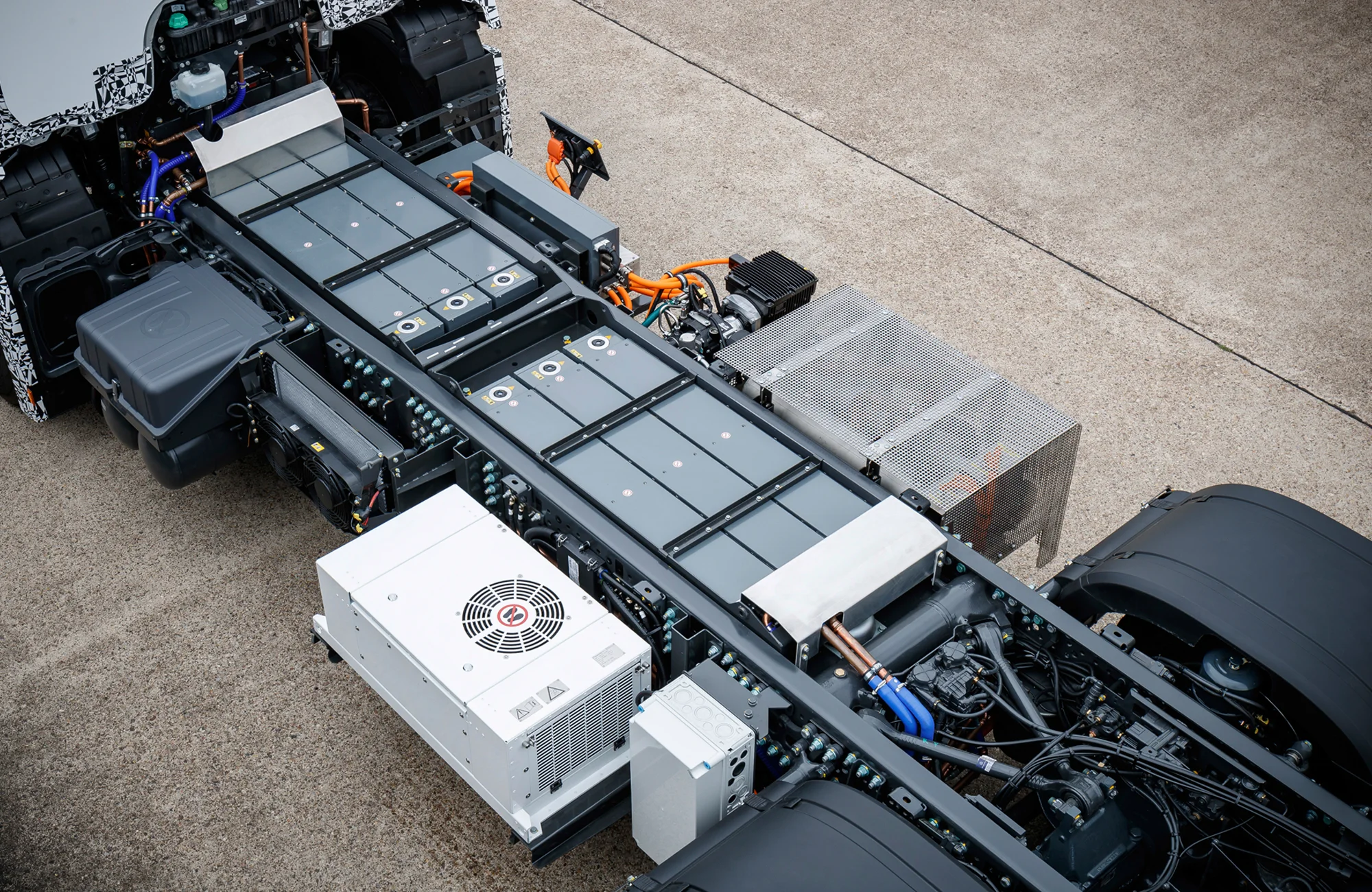
Europe races to catch up
One of the clearest themes emerging from the white paper is growing concern that Europe risks falling behind global developments. China, in particular, has moved aggressively into battery-swapping technology for commercial vehicles. The rapid pace of development is increasing pressure on European industries to accelerate research, pilot programmes and standardisation efforts.
Fraunhofer IML director Professor Uwe Clausen has warned that international developments are increasing the urgency for Europe to act, noting: “The international developments, especially in Asia, are increasing the pressure to introduce European requirements into research, pilot projects and standardisation at an early stage.”
For emerging markets such as South Africa, this presents both risks and opportunities. There is an opportunity to learn from early adopters and avoid costly mistakes. However, there is also a risk that countries slow to adapt could eventually struggle to integrate into future freight systems built around evolving standards.
Economics will decide the outcome
Ultimately, the success of battery swapping will depend less on engineering and more on economics. Building automated swapping stations, maintaining battery inventories and supporting the required infrastructure demands major investment. The technology only becomes viable if the operational gains outweigh those costs.
According to the white paper, battery swapping appears to be most economically attractive in high-utilisation environments where vehicles operate continuously on predictable routes. In these scenarios, reducing downtime can significantly improve productivity and fleet utilisation.
For logistics companies operating around the clock, keeping trucks moving may become more valuable than minimising infrastructure investment. The economics of waiting, in other words, may become more expensive than the economics of swapping.
The human factor
Technology alone does not determine whether systems succeed. Battery swapping also requires operational and cultural change. Drivers, fleet managers, workshop staff and logistics planners all need to adapt to new systems and procedures. Operators must trust that the technology is reliable, safe and financially sustainable. Without that confidence, adoption will remain limited. The transition therefore becomes not only technical, but behavioural. This may prove especially important in industries where reliability and predictability are essential.
A future built around flexibility
Battery swapping is unlikely to become the single solution for freight electrification. Fast-charging technology continues to improve, while hydrogen and other alternative energy systems remain under consideration.
The future freight landscape will probably involve multiple technologies operating simultaneously across different applications. The Fraunhofer white paper does not present battery swapping as a universal answer. Instead, it positions the concept as a targeted solution suited to specific operational environments. That distinction matters.
In logistics, there is rarely one perfect system for every application. Success often depends on matching the right technology to the right operation. Battery swapping may therefore become one important piece within a much broader electrification puzzle.
Standing still is expensive
As the electric truck outside Berlin disappears into the morning traffic after a battery swap lasting only minutes, it offers a glimpse into what freight logistics could become: a system where vehicles spend less time waiting; a system where energy is managed more intelligently; a system designed around movement rather than delay.
For South Africa, the lesson may not be about copying European models exactly. It may instead be about understanding the broader shift taking place within global logistics. Electrification is no longer simply about replacing diesel engines with batteries. It is about redesigning freight systems to operate under entirely new constraints.
Battery swapping does not solve every challenge facing logistics. But it addresses one of the most important – the cost of standing still. In an industry built entirely on movement, that could change everything.
Europe’s first automated battery swap station completes pilot phase
The Berlin-based eHaul research project has completed a successful two-year pilot phase involving Europe’s first fully automated battery-swapping station for heavy-duty electric trucks. Since late November 2023, the station in Lübbenau, Brandenburg, has operated within real-world logistics conditions using two 40-tonne electric trucks.
According to the project partners, the pilot demonstrated that fully automated battery swaps can be completed within just a few minutes – significantly faster than conventional heavy-duty DC fast-charging systems.
One of the project’s key advantages is that battery swapping reduces dependence on ultra-heavy grid connections, which remain unavailable in many locations. Originally planned as a one-year field test, the project was voluntarily extended for an additional year to collect further operational data. The lessons learned are now feeding directly into a follow-up initiative known as UniSwapHD.
Working alongside European truck manufacturers, the project aims to develop standardised battery-swapping systems and has already initiated a DIN specification process under DIN SPEC 91533.
The next development phase aims to reduce swap times to under five minutes, potentially making the process faster than many conventional diesel refuelling stops. Future systems are expected to perform swaps from underneath vehicles rather than from the side – improving speed, reliability and compatibility.
The initiative will now be driven commercially through the spin-off company E-HAUL GmbH.
Battery swapping in South Africa
Battery swapping is emerging as a practical solution for the electrification of South Africa’s heavy freight and mining sectors. Early deployments of SANY electric heavy trucks, particularly in mining and side-tipping applications, are said to have demonstrated significant operational and financial benefits when compared with conventional diesel vehicles.
Operators are now reporting energy cost reductions of between 60 and 70%, translating into savings of well over R1 million per truck each year. Maintenance costs have also fallen sharply – in some cases by as much as 50% – because electric trucks eliminate many of the moving parts associated with diesel engines. These lower operating costs are enabling some fleet owners to achieve a full return on investment in under 18 months.
A major advantage of the technology is SANY’s battery-swapping system. Instead of waiting hours for charging, depleted batteries can be exchanged robotically in less than five minutes, minimising downtime and keeping vehicles in continuous operation.
To support long-haul freight corridors such as the N3 between Johannesburg and Durban, renewable-energy-powered charging and battery-swapping networks are being developed in partnership with logistics and energy companies. Off-grid infrastructure is expected to play an important role in overcoming South Africa’s electricity constraints while supporting lower-emission transport.
Published by

Focus on Transport


focusmagsa