Charging ahead: SA home to SANY’s first EV bus
After two decades on South African soil, a construction machinery giant did something it’s never done anywhere else in the world: it built an e-bus. JULIA TEW spoke to Avinash Singh, business development head at General Heavy Motor (GHM), a SANY distributor, about the debut of SANY’s first electric commuter bus.
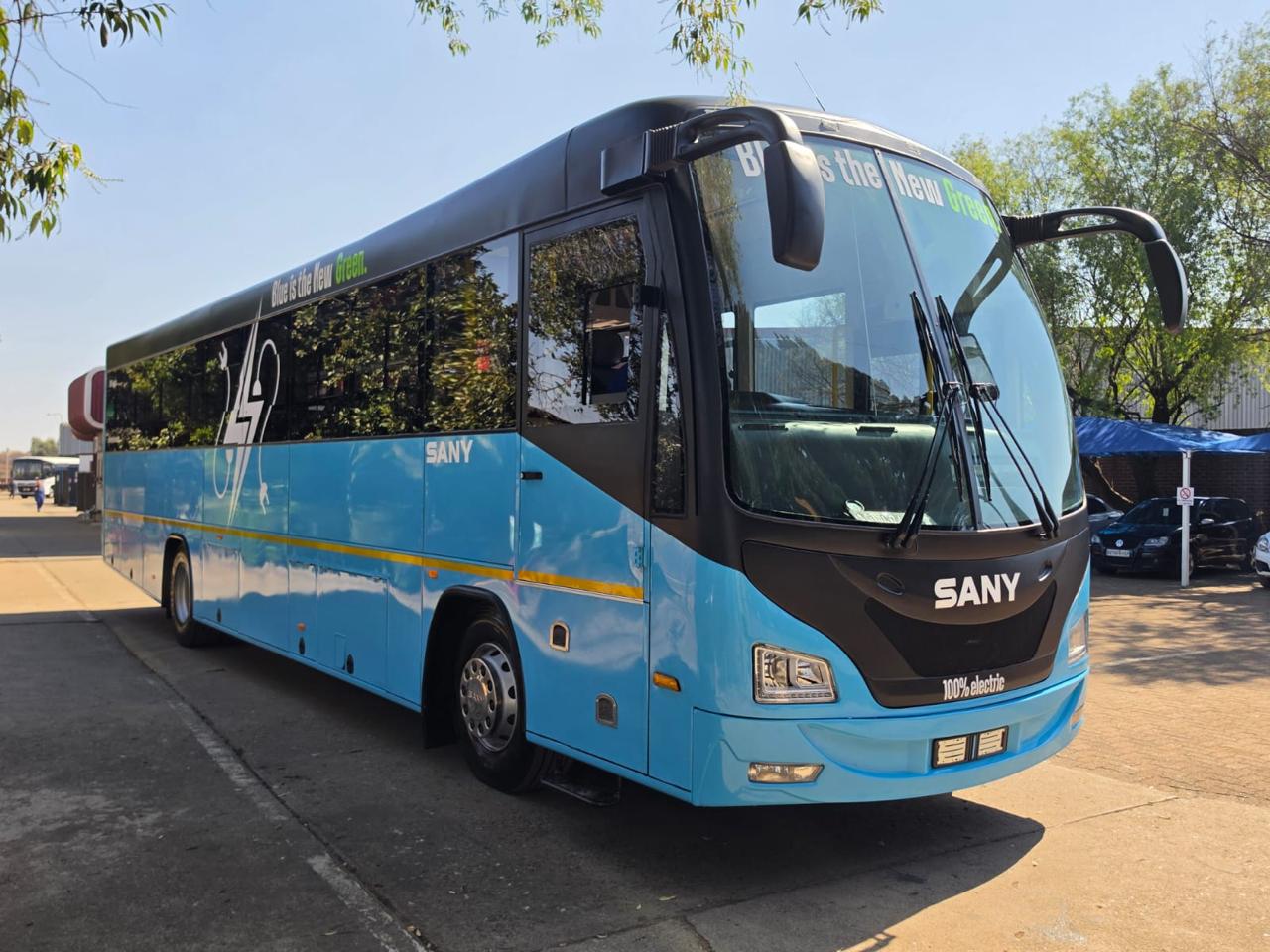
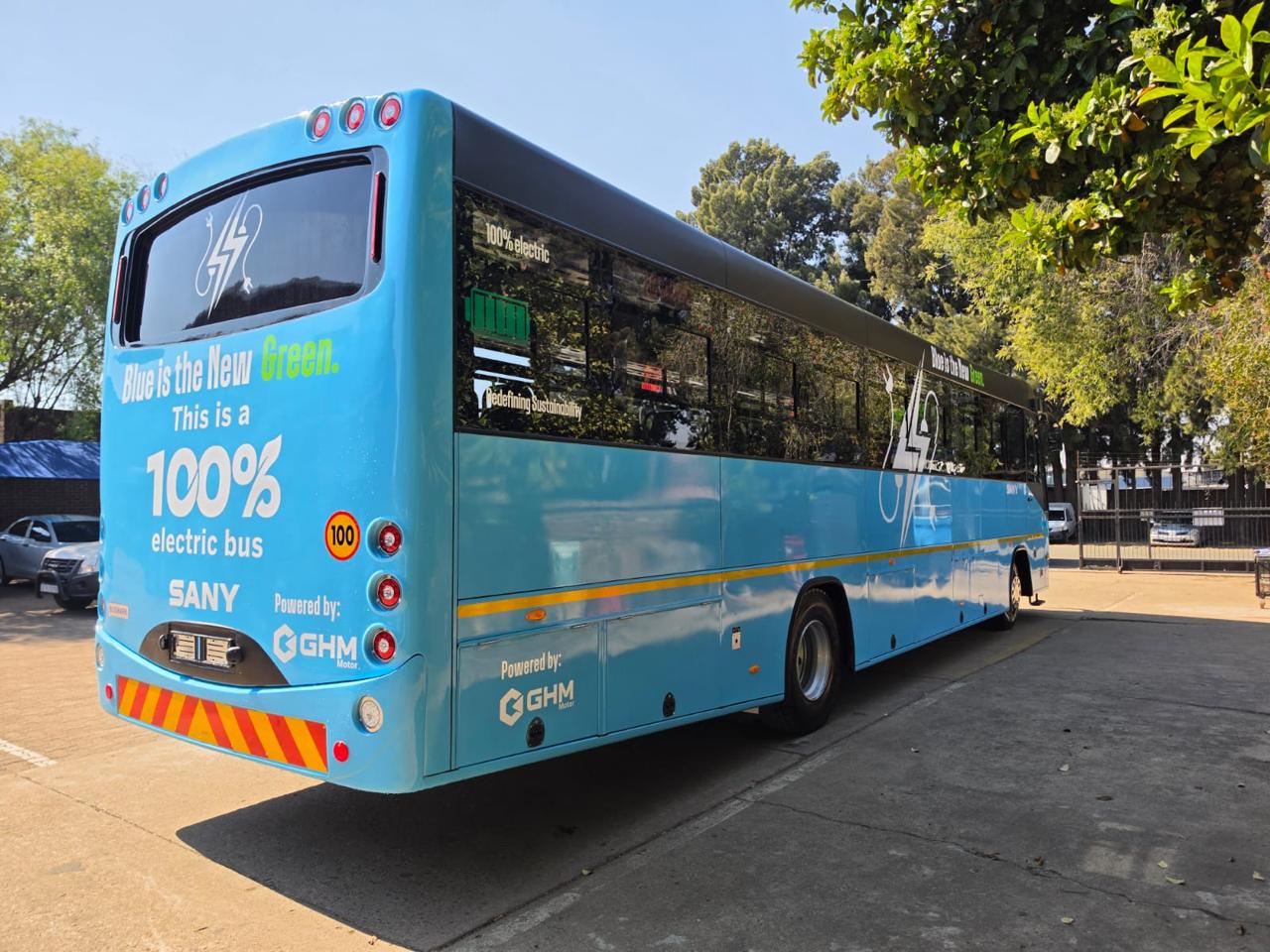
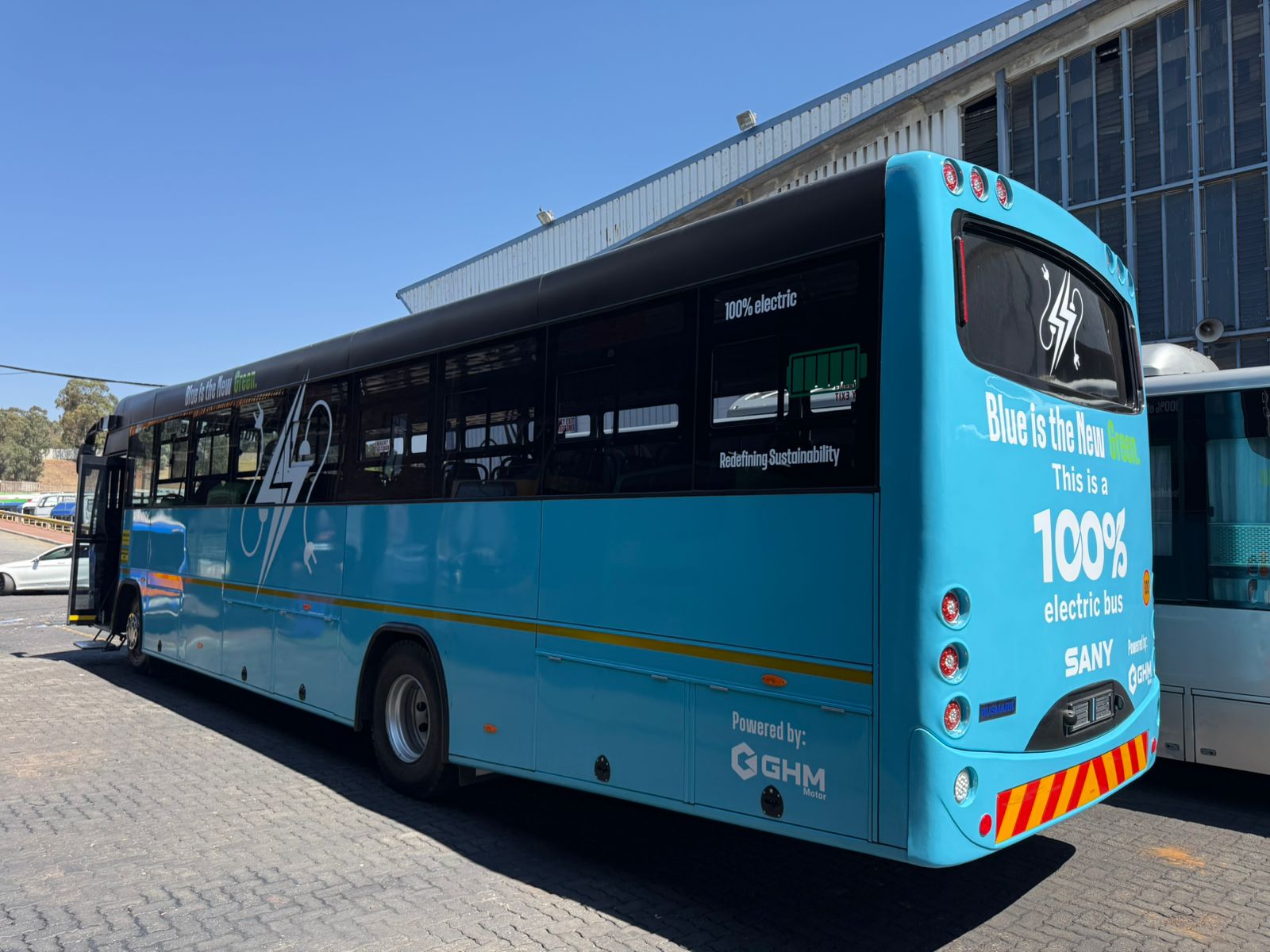
For a company best known in this country for yellow earthmoving equipment and, more recently, electric trucks, SANY’s foray into the bus segment might appear to be a natural extension of its product line. However, the new 65-seater electric commuter bus unveiled at the SABOA Conference is not a rebadged diesel bus repackaged as an electric vehicle (EV): it was engineered from the ground up as a purpose-built electric platform. It is, by SANY’s own account, the first bus the company has ever developed for production anywhere in the world – and it was designed, engineered and built specifically for South African roads, regulations and passengers.
SANY has operated in South Africa for 20 years, historically as a mining and earthmoving equipment brand. Its truck business, despite only being launched locally in 2025, has grown quickly: SANY has held the position of the country’s top-selling EV truck OEM by volume since launch (a position it also holds globally). When its electric trucks began finding traction among mining customers from the first quarter of 2025, enquiries started to grow from those same customers – many of them under pressure to meet ESG and green-mining targets – regarding the possibility of SANY building them a bus as well.
Fortunately, South Africa has a mature, decades-old bus-bodybuilding sector, populated by specialists who understand exactly what a commuter bus needs to survive local conditions. SANY went looking for a partner willing to take on the cost and risk of developing a purpose-built EV platform from scratch, rather than adapting an existing diesel body. Busmark, a bodybuilder with more than 10,000 buses to its name in South Africa, agreed to commit to the project.
Not a copy-and-paste job
Singh makes it clear that the bus is not simply a diesel body dropped onto an electric chassis. Weight distribution, rollover stability and braking performance all had to be engineered from the ground up for a passenger vehicle. Braking regulations for buses are considerably stricter than those for trucks, and the finished vehicle had to pass the M3 brake test required for passenger safety.
The development process ran for close to two years and involved SANY engineers travelling repeatedly between China and South Africa to work alongside Busmark and local customers, refining details as specific as door dimensions suited to local passengers, and building a chassis robust enough for South African road conditions – many of which, Singh admits, are far from ideal. The result is what the industry classifies as a high-floor commuter-spec bus – the format still used by thousands of buses around the country.
The bus was ready in time for the 2026 SABOA conference, where it was shown publicly for the first time. “This hasn’t been done anywhere else in the world yet,” Singh says. “The first SANY electric bus worldwide, number one of one, exists in South Africa and was designed and developed here. We’re quite proud of that.”
Local content, local jobs
Questions of localisation inevitably follow any EV launch, and Singh addresses them directly. The prototype chassis is fully imported, but SANY has invested more than R350 million in a local assembly plant in Boksburg, where it already assembles its yellow mining equipment. Bus-chassis assembly at the plant was delayed because the chassis needed to be secured early in the project, before the facility was ready. However, with the plant now operational, SANY expects to begin local chassis assembly – using imported CKD kits supplemented by local sourcing of items such as tyres, glass and wiring harnesses – within the first quarter of next year.
Crucially, the bus body itself – the largest single component of the vehicle – is already built entirely from scratch in South Africa. Even with an imported chassis, Singh estimates local content is close to the 60% mark already, a figure that will rise further once chassis assembly moves to Boksburg.
This local manufacturing footprint comes with a training commitment attached: SANY has established a dedicated truck training academy at its South African head office, complete with a lecture facility, and is pursuing SETA accreditation. The intention is to train not only drivers and technicians but apprentices too, with particular emphasis on EV and battery technology – an area Singh describes as highly specialised.

The 800-V difference
The bus’s battery is arguably its headline technical feature. It is, says Singh, the first 800-V EV battery architecture in the country, at a time when competitor systems typically operate between 400 and 600V. In practical terms, that translates into significantly faster charging: a 10-minute top-up adds around 100km of range, and even a five-minute opportunity charge is worth roughly 50km. Base range on a full charge sits between 300 and 400km.
For now, batteries are imported, given the technology is next-generation, but SANY has a phased plan to localise assembly of battery packs from imported cells – partly for servicing reasons and partly to manage the batteries’ long lifespan responsibly. Each battery is rated for a 16-year design life or 6,000 cycles, and SANY is already looking ahead to second-life applications: repurposing retired EV batteries into static storage systems for applications such as loadshedding backup and household energy security, in partnership with local battery specialists.
Green premium a thing of the past
Perhaps the most striking part of the conversation concerns cost. Electric trucks and buses have historically carried what Singh calls a “green premium” – often three to four times the price of an equivalent diesel vehicle. SANY’s pitch is that this equation has flipped for its bus. Singh believes the electric bus will be priced at around one-and-a-half times the cost of an equivalent 65-seater diesel commuter bus, largely because SANY’s global EV truck volumes bring the economies of scale needed to close the price gap on the passenger side. Singh cites total production north of 70,000 units worldwide, with monthly sales alone reportedly outpacing some competitors’ entire cumulative EV truck sales to date.
Where the numbers really shift, he argues, is in running costs. Assuming typical energy consumption of 1kWh/km, a bus doing 200km a day on standard Eskom Megaflex tariffs would cost in the region of R400/day to run, against roughly R2,460/day for a comparable diesel bus consuming around 41 litres/100km at current diesel prices. Over a year, Singh calculates that gap at close to R750,000 in an operator’s favour – enough, using his figures, to recover the price premium of the electric bus within 12 to 18 months, and considerably faster for higher-mileage operations such as some mining shuttle routes.
SANY also offers a path to even cheaper running costs through its Silicon Energy division, which can design and build solar microgrids and offer power purchase agreements with no capital outlay required – locking in energy pricing and insulating operators from grid tariff increases while charging their EV fleets on clean power. The company has already deployed a 20-MW off-grid solar system in Zambia and is working with local partners to bring similar projects to South Africa.
Maintenance is the other side of the total cost of ownership (TCO) argument. With no engine, gearbox or prop shaft, and a regenerative braking system that means the physical brakes are barely used outside of standstill situations, Singh describes the maintenance curve as essentially flat over a driveline rated for two million kilometres. This is in contrast to the steep, exponential maintenance costs that tend to set in on diesel buses after three to five years of service.
Built for the road and to look the part
The mining sector sparked the original request, but Singh is clear that SANY’s target market extends well beyond it: any operator, public or private, running a high-floor commuter-spec bus is a potential customer. The truck-derived chassis gives the bus off-road and gravel capability for mining and rural applications, while the body has been designed for comfortable on-road service too.
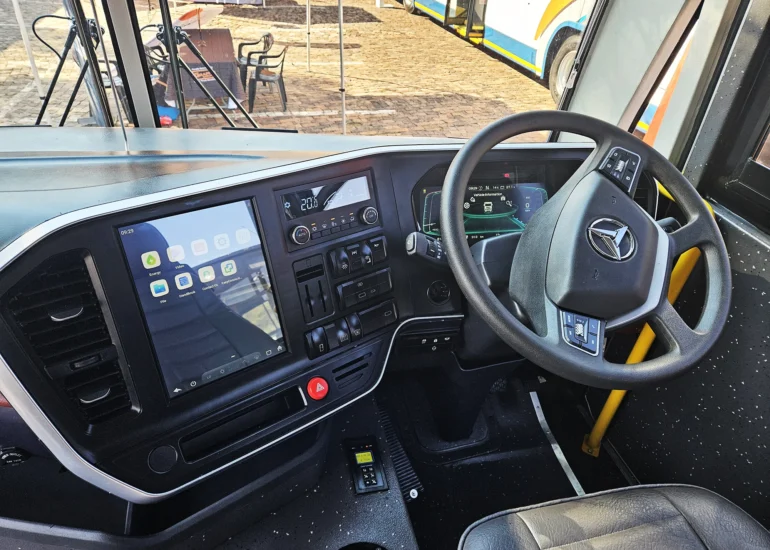
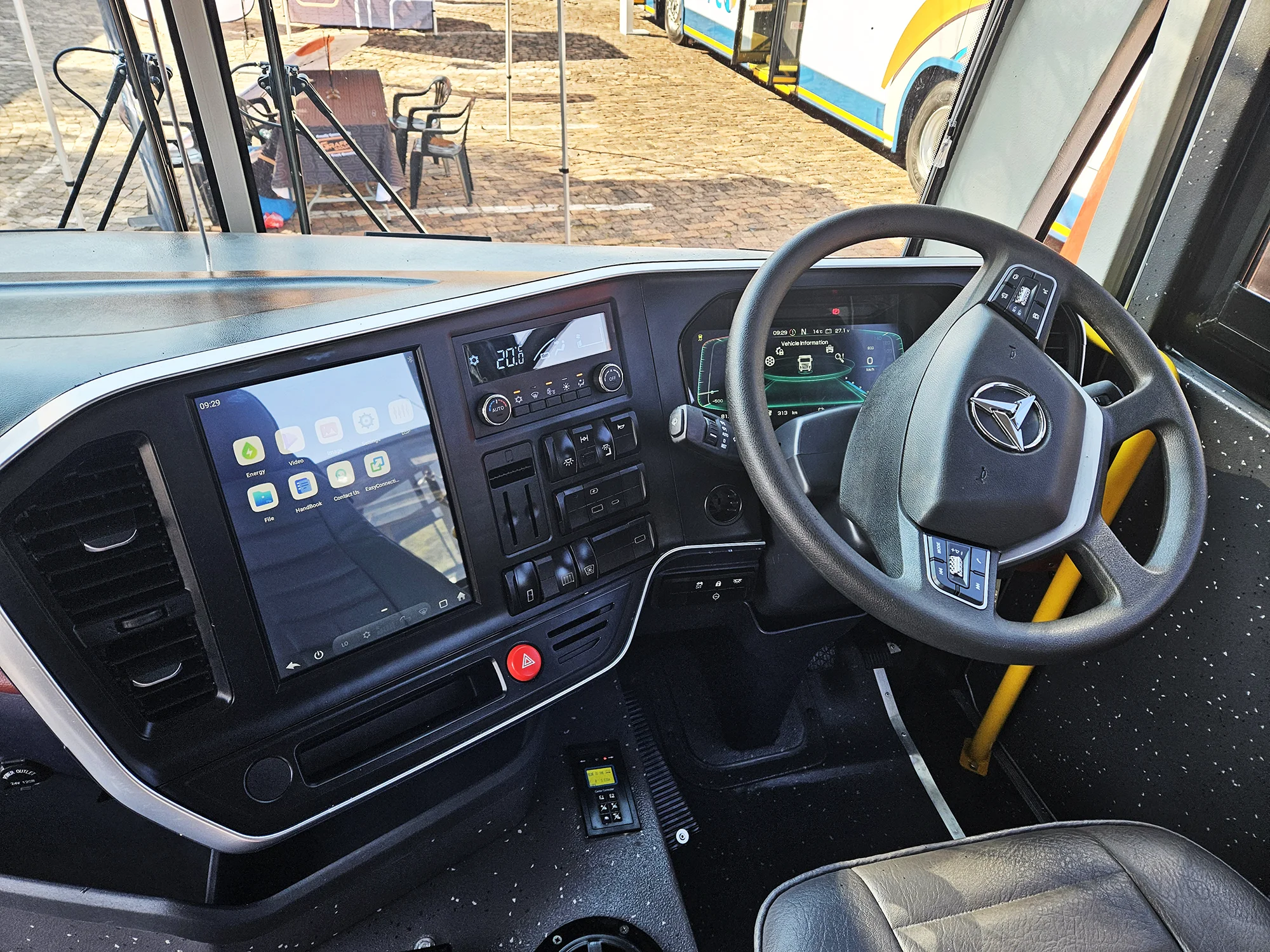
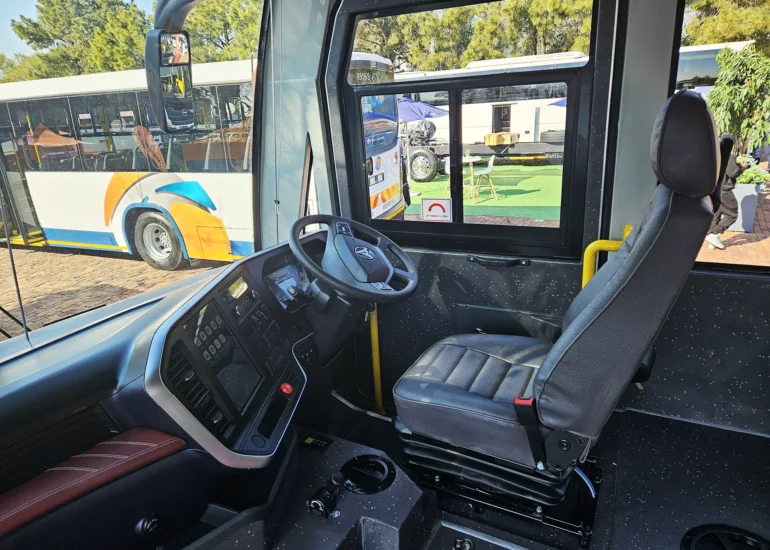
Because the electric motor sits at the rear axle, there is no engine bay to accommodate at the front – freeing up space for an additional row of seats. SANY says this makes it the only 70-seat high-floor commuter bus available in the country. The specification list includes forward collision warning, lane departure monitoring, ABS, EBD, ESP, traction control, an air-suspended driver’s seat, air conditioning, a digital instrument cluster and infotainment system. SANY’s own in-house telematics platform, MySANY, is offered free of charge alongside integration options for operators with existing telematics systems.
What’s next
The showcase bus at SABOA is the first unit off SANY’s production line, and Singh says homologation is largely a formality at this stage. The vehicle has already passed the M3 brake test and rollover testing, with remaining items such as headlight testing and electromagnetic interference compliance expected to be completed within weeks, ahead of final sign-off through the National Regulator for Compulsory Specifications (NRCS). SANY is targeting licensing by the end of September, after which the bus is set to join a City of Johannesburg pilot programme under Metrobus’s Rea Vaya service, alongside other OEMs taking part in the city’s EV bus trial.
With 10 SANY South Africa branches, three GHM branches and a growing dealer network, backed by the same 24-hour, on-site support model SANY applies to its mining equipment customers, the company is positioning itself for a long game – one it believes will be decided as much on aftersales support and TCO as on the novelty of being first on the scene.
Published by
Focus on Transport
focusmagsa