Regulations and definitions used as references extracted from the National Road Traffic Act, Act 93 of 1996 as amended, and published by Lexis Nexis as at issue 66 updated to 1 December 2023
Regulation 247: Circumstances under which persons may be carried on goods vehicle
No person shall operate on a public road a goods vehicle conveying persons unless that portion of the vehicle in which such persons are being conveyed is enclosed to a height of –
- at least 350 millimetres above the surface upon which such person is seated; or
- at least 900 millimetres above the surface on which such person is standing,
in a manner and with a material of sufficient strength to prevent such person from falling from such vehicle when it is in motion.
Provided that no person shall be conveyed in the goods compartment together with any tools or goods, except their personal effects, unless that portion in which such persons are being conveyed is separated by means of a partition, from the portion in which such goods are being conveyed.
Regulation 250: School children and persons not to be conveyed in goods compartment of a motor vehicle for reward
- No person shall on a public road convey school children in the goods compartment of a motor for reward.
- No person shall convey any other person in the goods compartment of a motor vehicle for reward: Provided that the provisions of this sub-regulation shall not apply in respect of a vehicle which complies with the provisions of the NLTA.
Definitions
“goods” means any movable property;
“goods vehicle” means a motor vehicle, other than a motorcycle, motor tricycle, motor car, minibus or bus, designed or adapted for the conveyance of goods on a public road and includes a truck-tractor, haulage tractor, adaptor dolly, converter dolly and breakdown vehicle;
“motor vehicle” means any self-propelled vehicle and includes –
- a trailer; and
- a vehicle having pedals and an engine or an electric motor as an integral part thereof or attached thereto and which is designed or adapted to be propelled by means of such pedals, engine or motor, or both such pedals and engine or motor, but does not include –
- any vehicle propelled by electrical power derived from storage batteries and which is controlled by a pedestrian; or
- any vehicle with a mass not exceeding 230 kilograms and specially designed and constructed, and not merely adapted, for the use of any person suffering from some physical defect or disability and used solely by such person;
“public road” means any road, street or thoroughfare or any other place (whether a thoroughfare or not) which is commonly used by the public or any section thereof or to which the public or any section thereof as a right of access, and includes –
- the verge of any such road, street or thoroughfare;
- any bridge, ferry or drift traversed by any such road, street or thoroughfare; and
- any other work or object forming part of or connected with or belonging to such road, street or thoroughfare.
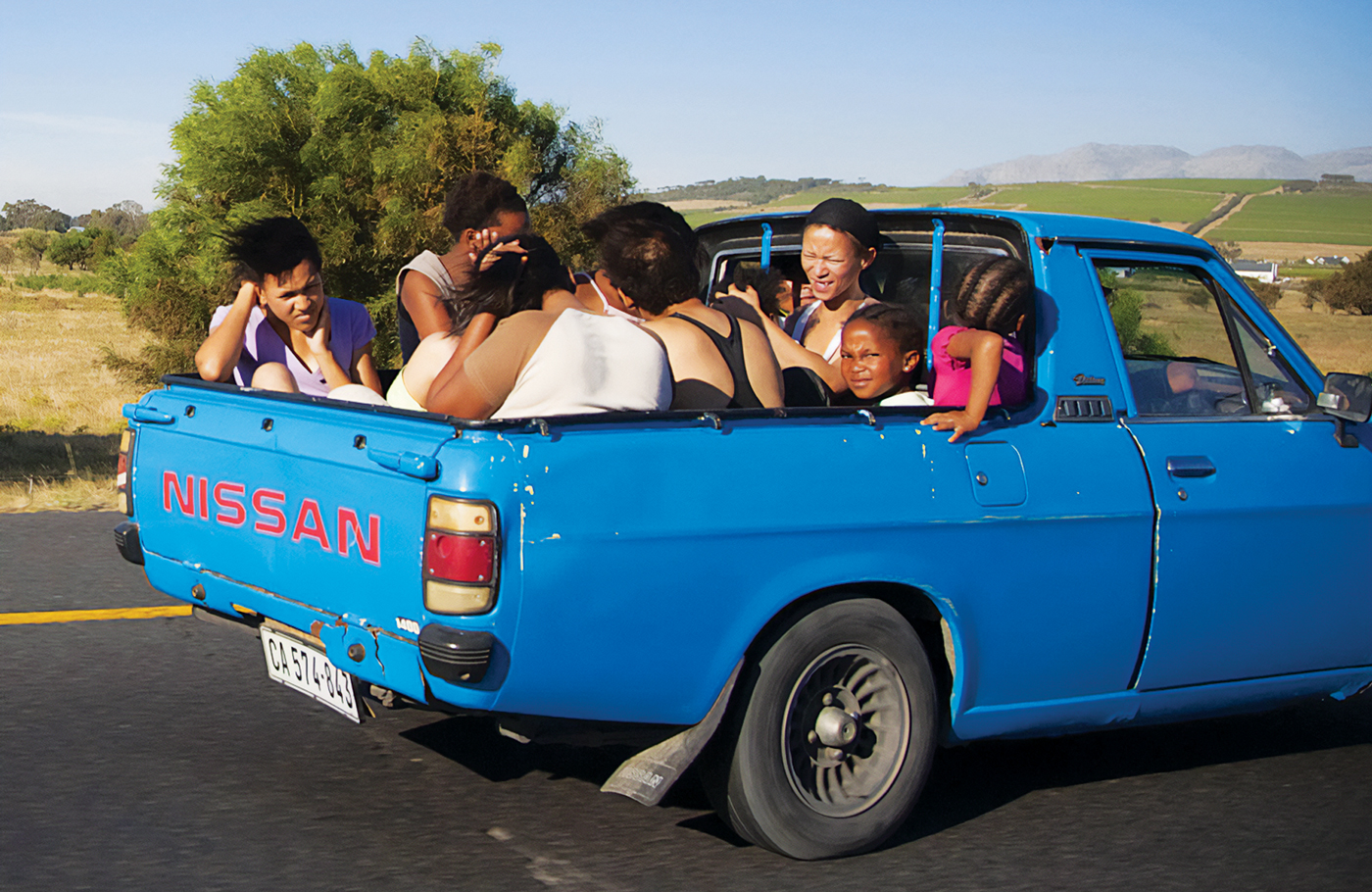






I can understand this regulation if it pertains to contractors etc. I am an ordinary homeowner with a small gutter problem. I took my bakkie, borrowed a ladder and a laborer to repair my guttering problem. My bakkie is a 1 ton Toyota Hilux with a canopy. I put the ladder in the back of the bakkie, and the laborer got in and held the ladder for the 5km from where I borrowed the ladder to where my house is. Guess what? In that 5km stretch I got pulled over by JMPD officers who informed me that I am not allowed to have a ladder and a person in the back of my vehicle without a partitioning between the person and the ladder…and fined me R750,00. I was in no way a danger to any other road user, I was sober, I travelled at the speed limit, my vehicle is roadworthy, and I’m not a contractor. I just needed to get a borrowed ladder and an assistant to help me re-align a piece of guttering by my house’s back door. And for that I was fined R750,00??? How did fining me improved the dangerous road conditions of South Africa? Some of our traffic regulations just don’t make any sense.