IToY turns 50: 1982 to 1986’s winners
IToY turns 50: 1982 to 1986’s winners
The International Truck of the Year (IToY) is 50 years old! In celebration of this, RICHARD STANIER is paying tribute to all the winners over the years.
We kicked off the tribute in FOCUS March 2026, with the first five winners (1977 to 1981). Here are the next five, from 1982 to 1986.
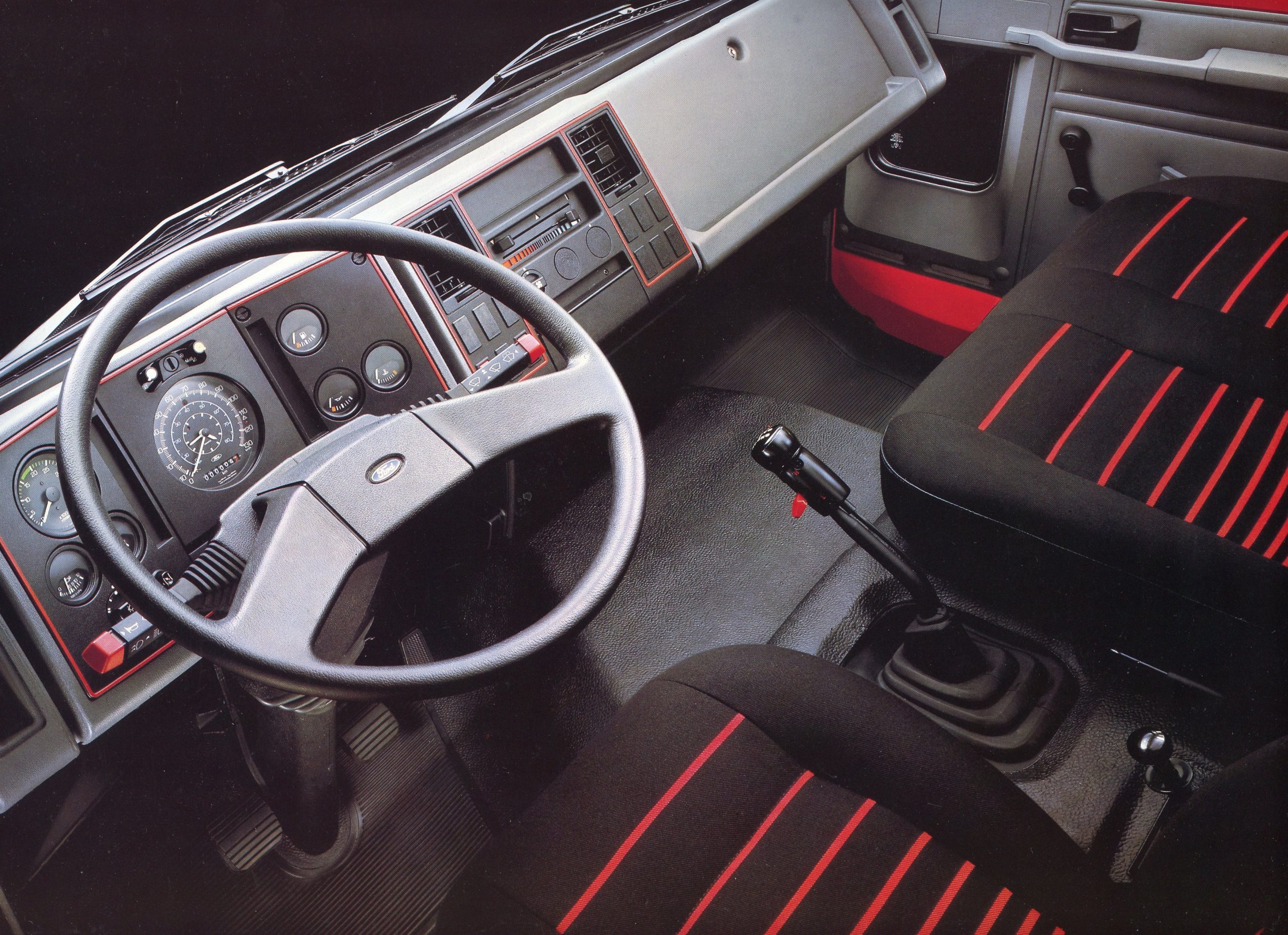
1982: Ford Cargo
For 1982, two more judges – and they were now regarded as judges as opposed to the “jurors” of earlier years – were added from Finland and Switzerland to complete the 12-country voting block of Western European nations.
The shortlist was drawn up at 1981’s Frankfurt Show, and the Cargo achieved a convincing victory, securing 50 votes against Scania’s GPR “2-Series” (with 34) and Mercedes-Benz’s turbocharged 19.33 and 19.38 (with 31). The Ford Motor Company was presented with the trophy at the Geneva Show on 21 January 1982.
The Cargo was the first vehicle to achieve a win as an entire range and – in a remarkable feat of engineering coordination – the entire D Series line-up ceased production on New Year’s Eve 1980, to be replaced with Cargos spanning 6 to 28.5 tonnes.
The Ford D Series was a hard act to follow, being Britain’s market leader since 1977 with over 540,000 examples built, and Ford invested £150 million (about R3.37 billion) into the Cargo. Development work had started in 1976 under the Delta code name, but this was swapped to Cargo when Dennis adopted the Delta tag for its own 16-tonner.
Of particular interest to judges was the fact that Cargos were basically engineered for each European market from the outset, with 2.3m-wide Swiss models, high-powered Norwegian variants and well-trimmed models designed for Germany all included in the original programme. The range’s flexibility also appealed greatly, although the flexibility of the high-tensile alloy steel chassis, which required flexible front body mountings, was a feature of which some early operators and ministry inspectors were wary.
The very modern cab design, good turning circle, quality ride, stability and handling and serviceability all scored in the Cargo’s favour, as did the reduced scheduled downtime, but the most popular aspect amongst judges was the way in which the wide range of specification options in the modular system could effectively produce the ideal vehicle for an operator in this class.
When launched, the Cargo was powered by Ford’s own Dorset engine range, comprising a naturally aspirated four-cylinder, and a six- and 6.2-litre straight-six, with a six-litre 150-hp (112-kW) turbocharged engine at the top end of the in-house power range. These engines were carried over from the D Series and had received substantial re-engineering in 1979. For heavier trucks, the Perkins V8.540 or Cummins V8.504 were offered, rated at 180hp (134kW) or 186hp (139kW) respectively.
Within a year of introduction, the Cargo received the new Dover range of Ford engines, which retained the bore and stroke of their predecessors but offered more power and better consumption courtesy of higher injection pressures, larger ports and new manifolds, amongst other improvements. A V6 Deutz-powered 32-tonner was added in the Spring of 1982, while the Cargo was given a new lease of life with the introduction of Cummins 10-litre engines in 1985. Like the Leyland Roadtrain before it, however, the Cargo was introduced into a depressed home market and arguably never achieved its full sales potential, before being phased out in the Iveco takeover.



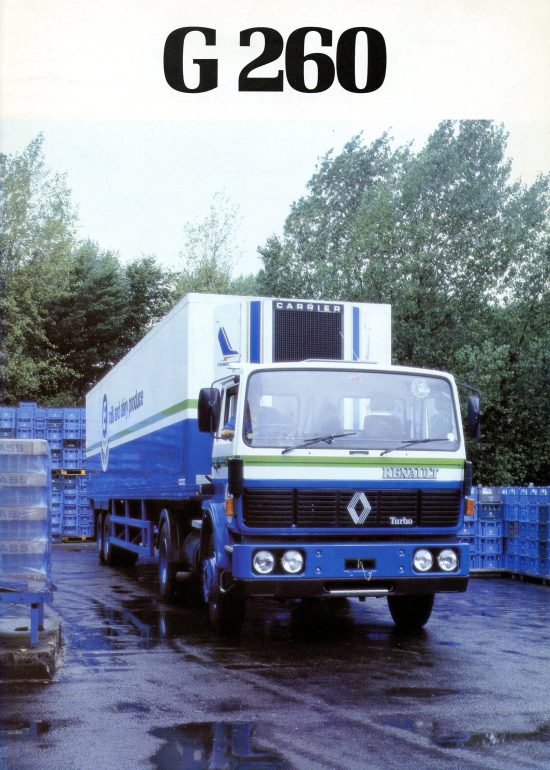
1983: Renault G260
Renault’s G260 won the 1983 IToY award by a surprising margin, enjoying little in the way of expectation at the shortlisting stage, but winning the 13 judges over with operational feedback in its first year of service.
The G260 was regarded as the first genuinely new product from Renault Véhicules Industriels following the eight-year merger between the Berliet and Saviem marques. It scored an impressive 53 points, knocking the Scania P and R ranges into second place for a second time with 40 points, with the DAF 2500 coming home in third place with 30 points. The Scania’s performance might be surprising, but the judges apparently regarded the 2-Series models as heavy with questionable transmissions, and the new intercooled models were ineligible until 1984.
This Renault was seen as a new class of vehicle – a 38-tonner with the capacity for heavy work across long distances, but also light and compact enough to be a strong proposition for city distribution work. Road tests revealed the G260 to be “quite out of the ordinary in the fields of economy, payload and earning ability” and so the unassuming French truck nailed the “greatest contribution towards the economics of the carriage of goods by road” criteria.
The G260 cab was of course a development of the “Club of Four” design, but Renault’s engineers had adopted a wider and lower interpretation of the concept than that used by Volvo on 1979’s award-winning F7.
The RVI cab was not new though; it had already appeared on both Saviem and Berliet-branded vehicles on the continent, as well as on the TF 231 model – a 32-tonner designed specifically for the British market, announced in September 1979. At the heart of the G260 was the MIDR 06.20.45 engine. This 9.8-litre, six-cylinder turbocharged and charge-cooled 260-hp (194-kW) motor was a long-stroke development of an earlier Berliet design that retained a minimum of 725lb/ft (983Nm) torque across the 950 to 1,850r/min working range.
The mechanical specification was completed with Renault’s own nine-speed B9 gearbox and a Berliet-derived hub-reduction axle with three weight ratings, dependent on the national market. The G260 arrived in Britain in July 1983, although a non-charge-cooled version of the engine – designated MIDS 06.20.45 but still rated at 260hp (194kW) – was standard. UK operators were offered the 11.6-tonne rear axle with a choice of day or sleeper cabs, and even in sleeper form, the 4×2 tractor weighed in at only 5.8 tonnes.
By 1984, British G260s were being assembled in the former Dodge factory at Dunstable, and the following year saw a change to the standard specification, with the B18 18-speed gearbox and sleeper cab with revised trim becoming the norm. The more powerful G290 models were introduced in 1985.



1984: Volvo F10
Volvo’s second Truck of the Year win came for the revised F10 in 1984, which again saw Scania held off in second place with the intercooled-112, and MAN in third with the 361.
Volvo’s philosophy of the all-purpose heavy-duty truck impressed the judges, who liked the idea of a premium vehicle totally on top of most of Europe’s operating requirements. The project to improve the F10 began as early as 1978 – just 12 months after the original vehicle’s launch – with full development funding released in late 1979.
When the new F10 emerged in 1983, it was the product of many hours of driver consultation in addition to the demands of legislation and technological advancement. In fact, the “Version Two” F10 received a re-designed cab, engine and chassis layout to secure the win.
The re-designed cab was a product of driver clinics whereby Volvo’s engineers noted that most drivers’ optimum eye level was higher than previously believed. A lower seat, deeper windscreen and re-positioned radio console were therefore introduced. The cab dimensions were also revised, with an extra 15cm of headroom over the sleeper bunk (courtesy of a new sloped roof panel) and an extra 15cm of length for the day cab, which was now long enough for a fold-down rest bunk.
A new version of the TD 100 9.6-litre engine was introduced – designated TD 101F – which featured charge-cooling to increase the output to 299hp (223kW). In addition to intercooling, the new engines received strengthened cylinder heads, gear-driven water pumps, improved cylinder liner sealings and a larger fan. The improved torque characteristics of the TD 101F meant that the eight-speed R62 gearbox was suitable as a standard fitment in most European markets, with the 16-speed SR62 remaining as an option. The non-intercooled 273-hp (204-kW) TD 101GA, which had been introduced in September 1981, was also available as an alternative.
The F10’s chassis also received considerable attention for the 1983 model, with the rear end being tapered for greater clearance and taper-leaf parabolic springs with rubber inserts and shackles replacing the previous slipper-ended design on the rear. Air tanks and the battery box were relocated to the left-side of the chassis and incorporated with a new, larger, exhaust silencer designed to conform with forthcoming EEC noise regulations. New, rectangular fuel tanks of aluminium alloy were adopted, and the standard capacity of 270 litres could be increased to 875 litres with the largest capacity tank being supplemented by a reinforced plastic tank of 250 litres mounted beneath the battery box in lieu of a spare wheel. A vertical exhaust arrangement was also added to the options list.
The 1983 F10 maintained the reputation of the original model and won many friends around the World, before being superseded by the final F10 version in 1987.


1985: Mercedes LN2
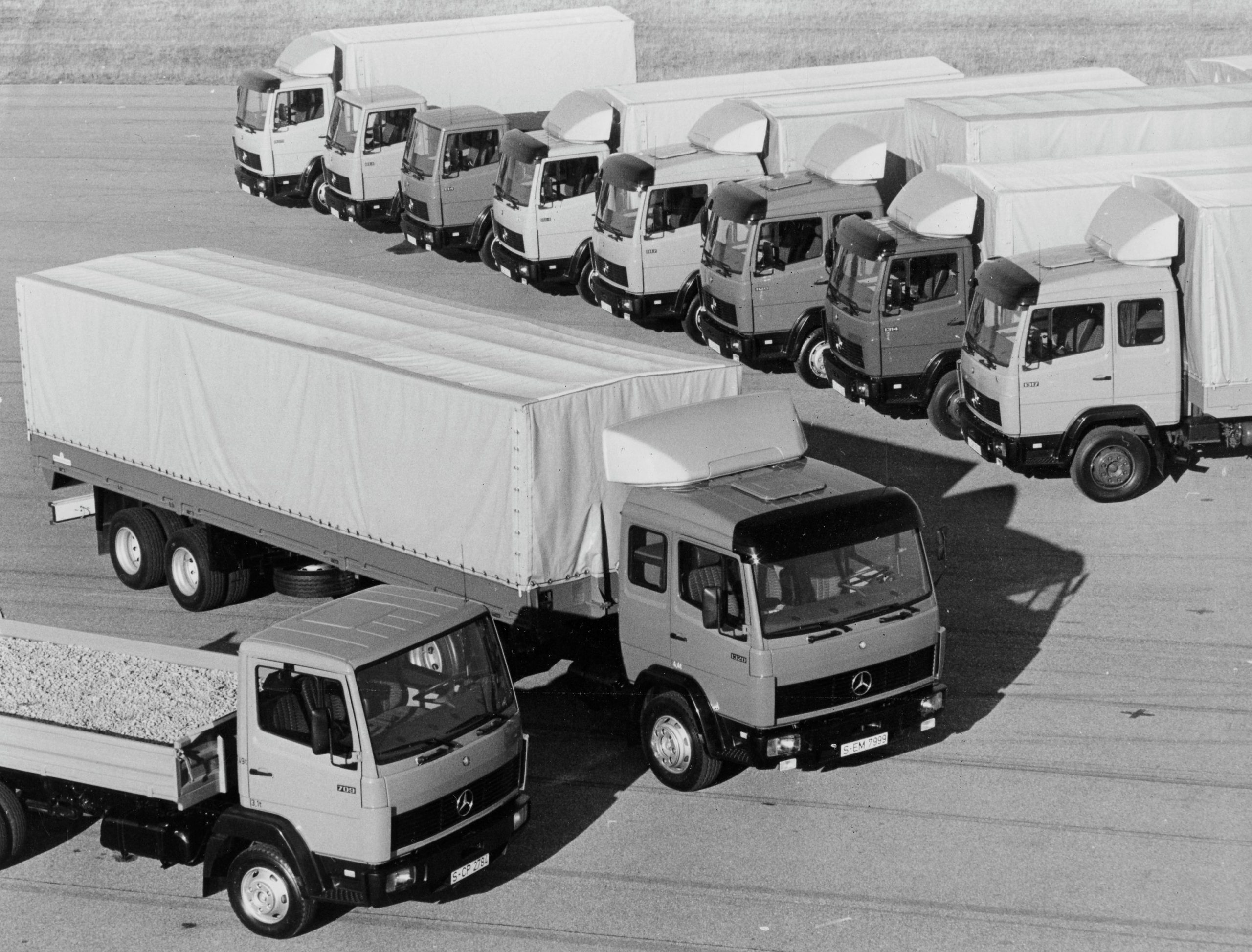
The following year, 1985, saw an emphatic win for Daimler-Benz, with the German manufacturer’s light-middleweight Mercedes-Benz LN2 range impressing the 13 judges with the versatility of its modular design. Scoring a total of 71 votes, the little Mercedes claimed victory by the largest margin yet seen in the competition, knocking the Iveco Turbostar into second place with 49 votes and Leyland’s Roadrunner into third with 19.
The runners-up were regarded as worthy designs, but essentially “one-class” vehicles, whereas the LN2 was a distinctly multi-class, multi-model range with a huge appeal across a range of European transport operations from 6.5 to 13 tonnes in rigid form, all the way up to 21 tonnes gross train weight. Whilst the Ford Cargo had offered a similar proposition in 1982, the Mercedes was wisely conceived as a lightweight truck without venturing into the heavy class, where Mercedes trucks had a distinct identity.
The LN2’s predecessor, the LP, had been a market leader in its class in Germany despite its origins in the mid-1960s, but its set-forward-axle imposed weight limitations that would hinder its development – additionally, in truth, the driving characteristics and its non-tilt cab had become antiquated.
The Mercedes engineers intended the LN2 to be a very high-quality grade of vehicle, rather than a technological marvel in its own right. The design brief was to produce the safest, most durable, high-quality truck for the top of the lightweight sector and to develop that concept down to the lowest tonnages in the range. The new cab, therefore, had a sleeper option and big-truck style, comfort and finish, while a full air-braking system replaced the previous air-over-hydraulic arrangement. Power steering was offered throughout the range and twin parabolic front springs with twin leaf and helpers at the rear gave excellent handling and ease of driving. Air suspension and ABS were also available.
Turbocharged and intercooled motors were also introduced as part of a major redesign of the engine range, and the LN2 spanned a total of 418 basic models at its launch. These included 90-hp (67-kW) to 201-hp (150-kW) engines, five- to 12-speed transmissions and automatic options to give European operators everything from a premium-quality 7.5-tonne delivery truck to a 21-tonne drawbar outfit for trunking. In Britain, the LN2 was most popular as a 7.5-tonner, but with a deep chassis designed to accommodate higher design weights and overloading outside of European markets, there was a slight weight penalty, which Mercedes sought to minimise with increased use of plastics for the cab.
The 809 variant was powered by the four-cylinder 88-hp (66-kW) OM 364 engine, with the 814 and larger 1114 both using the six-cylinder, 134-hp (11-kW) OM 366, both in naturally-aspirated form and each driving through a five-speed synchromesh gearbox.
The LN2 was anticipated to have a 20-year design life, but despite its huge success it fell short of this, bowing out for the Atego models in 1998.
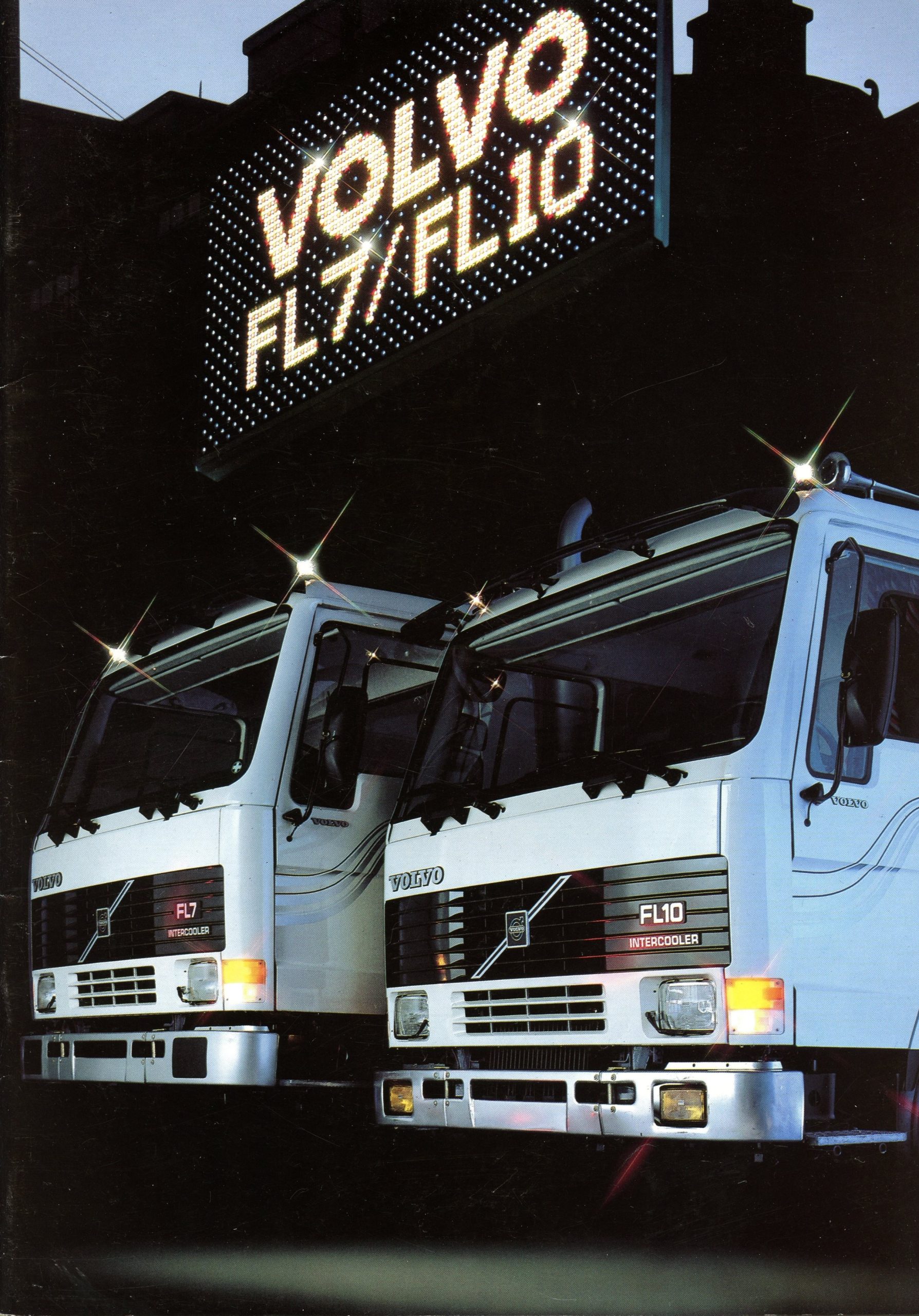
1986: Volvo FL
Volvo achieved an unprecedented third IToY win in 1986 with the FL family, which was introduced to replace 1979’s winning F7 range. Despite its huge success, the F7 was replaced within just seven years as transport technology moved on apace and the limitations of a seven-litre engine for heavy work became unsustainable.
The 13 judges awarded 121 of the 156 available points to Swedish manufacturers for 1986, with Volvo eclipsing the Scania 92 by just five votes, and the DAF 3600 ATi taking third position on 13 points.
Volvo’s application of technology to the specific distribution, construction and medium-haul sectors – and in particular the focus on reducing long-term operating costs – found favour with the judges. The company’s engineers paid special attention to flattening out the increase in variable costs traditionally associated with higher-mileage and focused on the four principal areas of basic design concept, engineering development, build quality and field support.
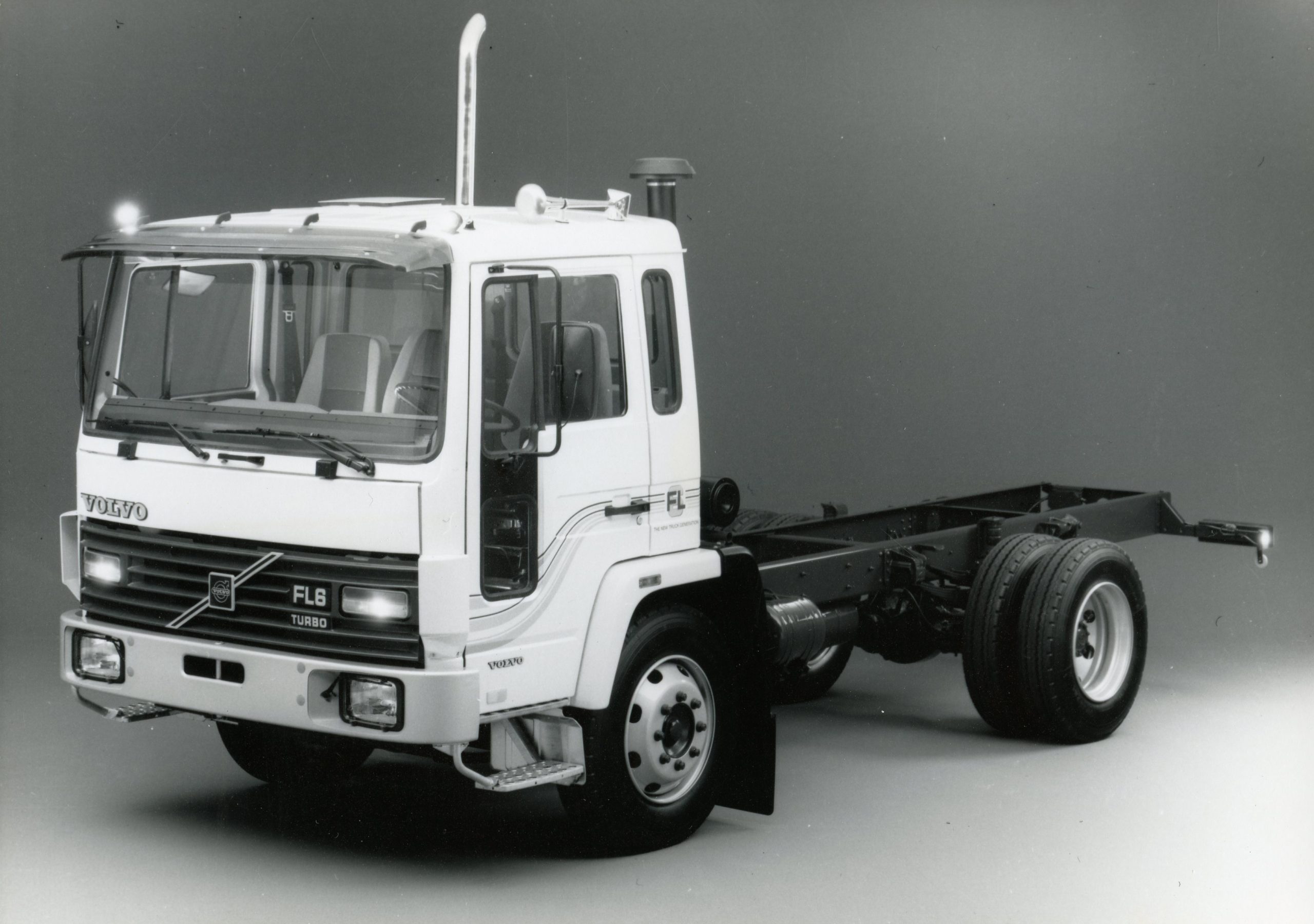
The FL family was somewhat unusual, being made up of two distinct forward-control, low-mounted designs spanning the 11- to 38-tonne sector. Whilst the FL7 and FL10 gained the most attention, covering the 16.26- to 38-tonne weight range with intercooled seven- and 10-litre engines, the Belgian-built FL6 slotted into the 11- to 16.5-tonne sector, with tractor units taking the train-weight up to 28 tonnes.
The new cab designs featured improved access and visibility and, controversially, a fixed seat as standard – Volvo’s engineers relying on advanced cab-mounting technology and long taper-leafed, shackled springs to provide an improved ride. Greater front-axle weight capacities, tighter turning circles, new brakes jointly developed with Girling and new wiring systems with a simplified loom and better weather protection were all incorporated. In addition to the two new cab designs were brand new engines in the six- and seven-litre classes and the adoption of the F10’s 299-hp (223-kW) TD101F engine for the top-power models.
The new engines were entirely redesigned and wholly different from their predecessors, although they enjoyed a degree of commonality with each other in terms of cooling, lubrication and ancillaries. For the FL6, the 5.5-litre TD61G was rated at 152hp (113kW) for 11-tonne work, with the TD61GS rated at 180hp (134kW) and the intercooled TD61F at 207hp. There were automatic and manual transmissions offered with ZF six-speed or Volvo eight-speed range-change gearboxes.
The FL7 was powered by the TD71 6.7-litre charge-cooled engine, rated at 230hp (172kW) in TD71F form or 245hp (183kW) in TD71FS form, with transmission generally being provided by Volvo eight-speed or 16-speed splitter gearboxes. The new engines incorporated design features from 1983’s 10-litre design, such as a stiffer block, a gear-driven coolant pump and improved oil-flow to enhance durability.
The FL went on to gain a 12-litre engine in January 1995, before the heavier models were replaced with the FM range in 1998, whereas the distribution sector is still served by an FL model in 2026.
- The original version of this article was published in Commercial Motor magazine. Hence, it contains several references to the British market. We have not removed these, as we believe that our South African readers will find them interesting. We will continue this series in the next issue.
Published by

Focus on Transport


focusmagsa