Facilitating cross-border trade
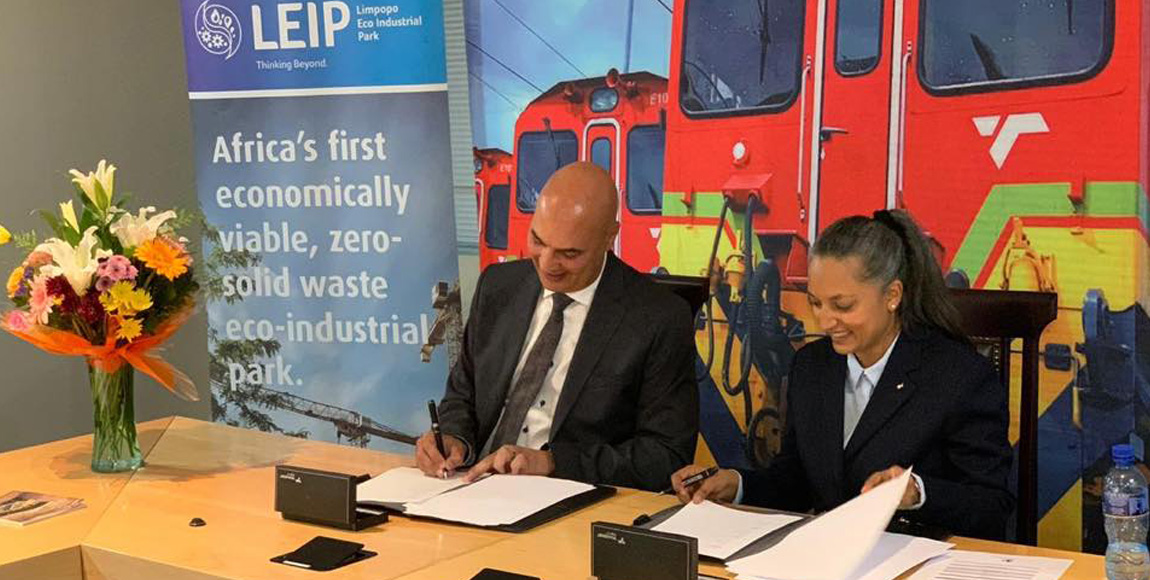
Transnet signs an agreement to establish an intermodal freight terminal in Limpopo’s Eco-Industrial Park
Transnet Freight Rail (TFR) has signed an agreement with Eco-Industrial Solutions (EIS) to develop an intermodal freight terminal within the Limpopo Eco-Industrial Park (LEIP) in Musina, near the Beit Bridge border – a major trade link between the country’s freight ports and Zimbabwe and Zambia. In terms of a Memorandum of Understanding (MoU) signed last week, the terminal will act as a multi-modal, dry-port logistics hub.
Launched in July 2018, the LEIP is one of South Africa’s top 10 national priority projects and forms part of a public-private growth initiative aimed at stimulating Limpopo’s economy and creating jobs in the region. The freight facility – located on both sides of TFR’s existing north-south rail corridor and the N1 – will be strategically positioned to simplify cross-border and intra-Africa trade.
The MoU was signed by TFR’s acting CEO, Lloyd Tobias, and Deshika Kathawaroo, CEO of EIS and LEIP. It is envisaged that the terminal will provide logistics services to heavy- and light-industrial tenants located within the park, as well as to international customers.
Design of the first phase – which will have capacity to handle and store about 50 000 containers – is scheduled to begin before the end of the year. When all construction phases have been completed, the terminal will have the capacity for about 400 000 containers.
In an address at a ceremony to mark the signing of the MoU, Tobias said Transnet formed part of a national action initiative aimed at reigniting the country’s economy. He described the LEIP – billed as Africa’s first zero solid-waste eco-industrial park – as a prodigious project that would create much-needed jobs in the region, helping to alleviate poverty and improve standards of living.
“Transnet is inextricably involved in all aspects of life in South Africa. Its role is to ensure that it plays a pivotal part in enhancing the quality of life in all areas in which it operates – not only for employees, but for communities and environments as well,” he said.
According to Tobias, the state-owned entity aims to reposition itself as a globally integrated logistics solutions provider, focusing on geographic expansion, diversification, product and service innovation as well as advanced manufacturing. “Our new and renewed focus will provide a stimulus for the re-industrialisation of the domestic and regional economy,” he maintained.
Webster Mfebe, non-executive chairman of Eco-Industrial Solutions, said the signing of the MoU had brought the collective vision of the LEIP sharply into focus at a critical time for South Africa. “With the park set to attract over R10 billion in initial capital-expenditure investment, and a further R5,4 billion estimated to flow into the region annually during the initial operation phase, it will fundamentally change the region’s current growth trajectory, bringing much-needed economic stimulus and meaningful jobs.
“It will also create a new benchmark for sustainable industrial development as Africa’s first zero solid-waste industrial park with a zero to negative carbon footprint. We’re therefore extremely excited about what the next six months will hold as we officially move into bankable feasibility,” he said.
Published by


focusmagsa