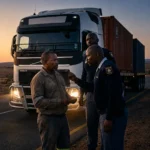
Cross-border trucking demands far more than driving skill. NICK PORÉE examines the endurance, judgement and knowledge required, while warning that hostility towards foreign workers could weaken Southern Africa’s logistics network.
Anti-foreigner protests have raised questions about employment, migration and opportunity. South Africans are understandably concerned about unemployment. However, slogans about foreigners “taking jobs” often ignore the experience and specialist knowledge required in particular sectors.
Cross-border road freight is one such sector. Operators do not simply need licensed drivers, they need professionals who can manage complex journeys, cargo, documentation, border processes and vehicle problems across several jurisdictions.
Foreign drivers have long formed part of this workforce, particularly on routes into Zambia, the Democratic Republic of Congo (DRC) and other regional markets. Removing experienced people without first creating an effective local skills pipeline could reduce capacity, increase costs and weaken supply chains.
The same applies to technical services. Migrant workers contribute skills in vehicle maintenance and repair. A hostile environment could push capable people elsewhere, leaving shortages that take years to correct.
A job unlike ordinary driving
The realities of long-distance cross-border transport are severe: a return journey to the DRC can keep a driver away from home for two months or longer. Delays of several days at border posts are common, while sanitation, washing facilities, safe accommodation and food and water may be limited.
Drivers often live in their cabs and remain responsible for the vehicle, load, documents and cash. They may have to cover and uncover loads, deal with punctures, inspect equipment and manage minor problems without workshop support.
Documentation is equally demanding. Drivers need to understand manifests, customs procedures, clearing documents and the requirements of different border authorities. A missing stamp, incorrect declaration or delayed release can immobilise a truck for days.
They also face personal risks. Operators report intimidation, extortion, roadside blockades, theft and arbitrary detention on some corridors. When crashes occur, legal processes may differ from those in South Africa. Drivers can be detained while companies arrange legal assistance, food, communication and negotiations with local authorities.
These conditions require maturity and judgement. A driver must remain calm under pressure, protect the load without provoking confrontation and communicate effectively with officials, communities, customers and the operator’s control room.
Recruitment must reflect the risk
A basic heavy-vehicle licence is therefore not enough. Cross-border recruitment should test technical competence and the candidate’s ability to cope with prolonged isolation, difficult living conditions and administrative responsibility. Applicants should hold a valid passport, appropriate driving licence and professional driving permit. Operators should verify employment histories, references, police-clearance records and experience on regional corridors.
Language ability can also be valuable. English may work in many situations, but familiarity with languages spoken along the route can help drivers obtain information, solve disputes and build trust. French is particularly useful on DRC routes, while Bemba, Nyanja, Chewa and Swahili may also assist.
Candidates should understand border posts and the corridors connecting them. They need practical knowledge of customs procedures, currency handling, security protocols, national road regulations and communication systems.
Technical assessments should include a medical examination, vehicle inspection, load securing, fuel-efficient driving and the ability to manoeuvre an interlink combination. Candidates should understand braking distances, gear selection, load placement, tyre safety and the effect of driver behaviour on fuel consumption. The ability to change a wheel or manage a puncture should be assessed realistically. Modern truck tyres and wheels are extremely heavy, and safe procedures and suitable equipment should take priority over proving physical toughness.
Building a sustainable driver pipeline
Even capable applicants should not be sent alone into unfamiliar territory; a structured learning period is essential. New cross-border drivers should complete formal training and accompany experienced mentors on several journeys before receiving sole responsibility for a vehicle.
This is where industry and government need to act. South Africa requires credible commercial-driver qualifications that go beyond passing a licence test. Training should include vehicle dynamics, customs procedures, fatigue management, cargo security, basic maintenance and regional law.
Operators must also improve working conditions. Complaints about skills shortages carry less weight when drivers are expected to tolerate unsafe stops, poor communication, indefinite delays and weak support. Proper trip planning, emergency assistance, fair remuneration and secure facilities are essential for attracting South Africans to this work.
Experienced regional drivers should not be treated as the enemy. Their knowledge can help train the next generation and keep trade moving while local capability is expanded. Cross-border trucking is demanding, risky and indispensable. South Africa should protect jobs, but it must do so by building skills and enforcing fair labour standards rather than driving away the expertise on which regional logistics still depends.