The challenges facing Africa’s taxi and bus entrepreneurs are structural and well-documented. What financing and insurance alternatives are being introduced to make operating in this fast-growing sector more accessible, affordable and sustainable? JULIA TEW investigates.
Across sub-Saharan Africa, informal public transport (IPT) is the primary way most people get around; it is agile, responsive and woven into the daily fabric of city life. Yet the operators who run these services are routinely shut out of the formal financial system. Without credit records or assets to offer as collateral, taxi and bus entrepreneurs are seen as high-risk by conventional lenders. In South Africa, approximately 80% of SA Taxi’s clients are unbanked and would not ordinarily qualify for a standard bank loan.
Where finance is available, the terms are punishing. Typical vehicle financing involves a 10% deposit and a 20% interest rate over a 72-month repayment period. For electric vehicles (EVs), the upfront cost hurdle is steeper still. As SANTACO secretary general Daki Qumbu put it bluntly in March 2025: “The industry is making money, but what kind of money is that? Is it enough for a living for the people that depend on the taxi industry? We cater to the poorest of the poor… There’s no money. If we provide you with statistics of repossessions, you will see that people are no longer able to buy vehicles or to keep up their instalments.”
That squeeze is playing out against a backdrop of rising opportunity. IPT makes a vital contribution to growing cities, supporting access to employment and services and generating jobs across the sector. The question is how to bridge the gap between the sector’s economic importance and the chronic underinvestment from which it suffers.
The BasiGo blueprint
The most compelling answer to that question has come not from South Africa, but from Kenya. BasiGo, founded in Nairobi in 2021 by Jit Bhattacharya and Jonathan Green, has reinvented how bus operators access EVs by removing the financing barrier entirely.
The company’s Pay-As-You-Drive (PAYD) model is the core innovation – and Bhattacharya is clear that the vehicle itself is almost beside the point: “At BasiGo, our key innovation is not the e-bus; it is our financing model. This tech-driven leasing model eliminates the high upfront cost of an e-bus and charging infrastructure, making it affordable for bus operators in Africa to access.” In practice, this means operators pay a small initial deposit and then a per-kilometre subscription that covers battery leasing, charging, servicing, roadside assistance and insurance. “What we are able to do through this model is to sell an electric bus for a similar upfront cost to a diesel bus,” Bhattacharya explains. “It removes all the risk of this new technology, essentially, from the owners. All they have to do is drive.”
Since its launch, BasiGo has deployed over 130 electric buses in Kenya and Rwanda, recording more than 12 million zero-emission kilometres. A US$42-million Series A equity led by Africa50 in 2024 – with debt facilities from British International Investment (BII) and the US Development Finance Corporation (DFC) – is funding the push toward a fleet of 1,000 vehicles. The company has also achieved a notable climate finance milestone: Africa’s first verified electric bus carbon project under Gold Standard certification, with emissions reductions tracked via on-board telematics and contracted for sale to Climate Impact Partners. With over 90% of Kenya’s electricity coming from renewable sources, the emissions case is strong.
BasiGo is also moving into local assembly. Working with Associated Vehicle Assemblers (AVA) in Mombasa, the company is building its Ma3e electric van from knocked-down kits, with a reservation pipeline already exceeding 500 units. Kenya has helped by introducing zero-rated VAT on e-buses under its National Electric Mobility Policy in February 2026. Bhattacharya credits local manufacturing as a key cost lever: “The moment that you do that, you’re not paying the import duties, you’re not paying the excise taxes, and it’s much easier for those EVs to compete head-to-head against combustion engine vehicles.”
In May 2026, BasiGo was named a BloombergNEF 2026 Pioneers Winner in the Wildcard category – recognition that its financing model, not just its technology, is genuinely reshaping how African transport operators can access clean energy vehicles.
Moove: financing through the rearview mirror
A different but equally instructive model has emerged from Nigeria. Moove, co-founded in Lagos in 2020 by Ladi Delano and Jide Odunsi, built its business around a simple diagnosis: traditional banks would not touch gig economy drivers. “Moove was initially started to solve a problem for Uber, which at the time had a lot of demand with people ordering trips – but there were few drivers with cars in Lagos,” says Delano.
Moove’s answer has been revenue-based financing – using a driver’s platform earnings and trip data as the basis for credit assessment, rather than conventional credit scores or collateral. Drivers receive up to 95% financing on a new vehicle within five days of sign-up, repaying via a fixed percentage of their weekly income. The model addresses a stark market reality: fewer than 5% of vehicles in Africa are bought with financing, compared to 92% in Europe.
Moove already operates profitably in South Africa, alongside the UAE, India and the UK. Its R300-million financing facility from Absa Corporate and Investment Banking – secured to grow its South African operations – was described by Delano as enabling the company “to serve more Africans looking for a path to economic prosperity”. By 2025, Moove had built a fleet of 38,000 vehicles globally, with revenue approaching US$400 million. Its EV rollout in Africa remains cautious due to charging infrastructure constraints – a factor worth noting given how quickly that infrastructure is evolving in markets like Cape Town.
SA’s homegrown solution
For the South African minibus taxi sector specifically, SA Taxi remains the foundational specialist. As the country’s only independent gateway financer for minibus “taxipreneurs”, it covers financing and insurance through its Mobalyz Risk Services offering (formerly SA Taxi Protect). Underwritten by Guardrisk and available to all operators – not just SA Taxi finance clients – it was designed with the sector’s particular vulnerabilities in mind. Of the estimated 250,000 taxis on the country’s roads, SA Taxi finances more than 28,000.
The wider insurance market is also developing. Santam’s Emerging Business Insurance covers minibus, midibus and e-hailing operators. Specialist brokers Taxisure and Hollard-backed Clarendon Transport Underwriting (CTU) offer tailored products for the sector; passenger liability cover is available from as little as R5/month for R500,000 worth of protection.
Policy-wise, the Taxi Recapitalisation Programme (TRP) remains a source of frustration. In operation since 2006, the TRP has scrapped over 84,000 old vehicles and paid out nearly R6 billion in allowances, but the current scrapping allowance of R159,500 is widely considered inadequate compared to today’s vehicle prices. SANTACO spokesperson Rebecca Phala has described ongoing talks with Minister of Transport Barbara Creecy: “The conversation we’re having on the side with the minister is to de-risk the industry, so that when this money is being given, (operators) are not paying the exorbitant amounts (in borrowing costs).”
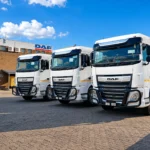
The EV transition is edging closer to home. Cape Town is expected to launch its first fully electric minibus taxi routes in Century City later in 2026, and MAN Truck & Bus is set to deliver 100 electric buses to the Paruk Group – one of the world’s largest MAN fleet operators – with production underway at facilities in Pinetown and Olifantsfontein and deliveries running through to end-2027. “Our move from diesel to electric isn’t just a technological shift,” says owner Mohmed Paruk, “but a promise (of) our continued focus on sustainable transport solutions in the region.”
The economics are shifting in operators’ favour: energy costs for electric minibuses run 33 to 57% lower than diesel, while maintenance demands are also significantly reduced. The remaining challenge is the upfront cost; as BasiGo and Moove have ably demonstrated on the continent, this is precisely the problem that smarter financing is designed to solve.