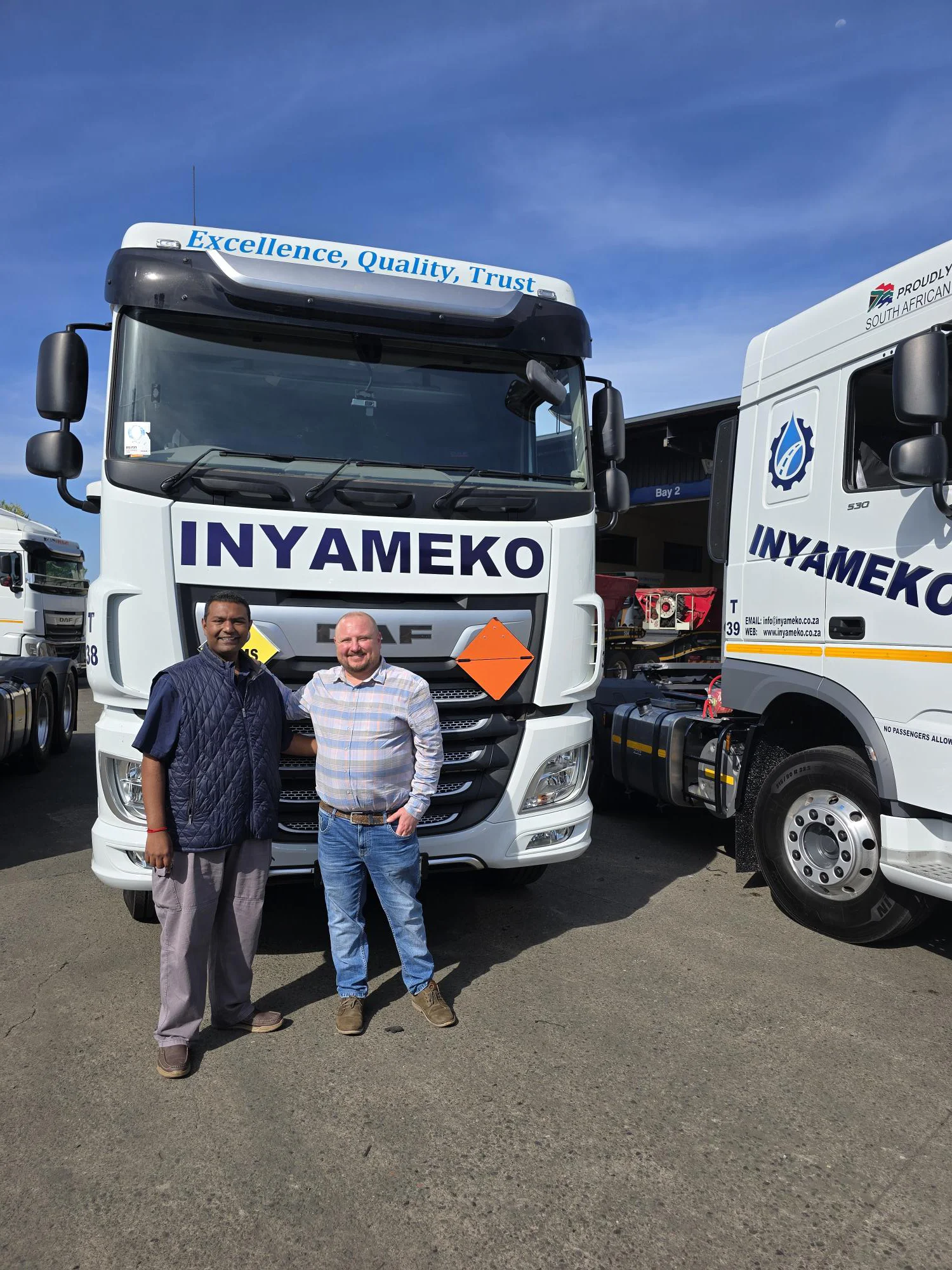
DAF bets big on South Africa

DAF bets big on South Africa

South Africaโ€™s truck market is shifting fast. Amid volatility, CHARLEEN CLARKE reports that DAF is betting big with a new assembly plant that signals the companyโ€™s long-term commitment to the local transport industry.

The South African truck market has rarely been straightforward. In 2024, the combined heavy and extra-heavy commercial vehicle segment contracted by 5.6%. By August 2025, sales of heavy commercial vehicles (HCVs) had slipped again โ€“ down by 185 units (8.8%) from the same month a year earlier. For many OEMs, such figures would ring alarm bells.

But Mark Gavin, sales director of DAF Trucks at Babcock, says there is no reason to panic. โ€œYes, it does suggest a trend, but itโ€™s not entirely linear,โ€ he explains. โ€œThe contraction in 2024 by 5.6% and the August 2025 dip of 8.8% reflect short-term volatility. However, broader forecasts indicate moderate recovery and growth; we expect total unit sales for 2025 to reach over 15,000 vehicles. While monthly figures show dips, the long-term trajectory is upward โ€“ driven by infrastructure investment and fleet modernisation.โ€

Gavin adds that macroeconomic shifts are slowly starting to turn the tide. โ€œBy the end of 2025, we expect the market to stabilise and possibly rebound modestly. Improved economic conditions and interest rate cuts are supporting affordability. Domestic sentiment is rising, with stronger credit access and a firmer rand,โ€ he explains. โ€œOf course, high fuel costs and tight credit conditions earlier this year have had an impact, and global uncertainty continues to affect exports and supply chains. But we are cautiously optimistic.โ€

Beyond the sale

One of the reasons for Gavinโ€™s optimism is the strong support that the company enjoys from its loyal customer base. This situation is a result of DAFโ€™s emphasis on service and support. A case in point is the companyโ€™s recent deal with Farmwise, a major agricultural operator. Drivers praised the trucks for their fuel efficiency, comfort, and driveability โ€“ but what stood out was the strength of the Babcock support package.

โ€œThe Farmwise deal is definitely a recent highlight,โ€ Gavin affirms. โ€œThe client feedback is very much in line with what we consistently hear from customers across South Africa and beyond. The partnership with Babcock is a major asset. Customers appreciate the responsive service, parts availability, and technical expertise โ€“ especially in remote or high-demand areas.โ€

That, however, does not mean the company is resting on its laurels. โ€œWe are constantly looking at how backup support can be taken to the next level,โ€ says Gavin. Among the initiatives are an expanded service network with new service points and mobile units, deeper integration of telematics through DAFโ€™s in-house Executrax platform, and ongoing driver and technician training. โ€œWe are also investing in faster logistics for parts availability and actively collecting feedback from customers to fine-tune our support offerings,โ€ he adds.

Uptime: the industryโ€™s currency

If there is one word that comes up repeatedly in conversation with Gavin, it is โ€œuptimeโ€. As he puts it: โ€œUptime is the heartbeat of any successful transport operation, and DAF trucks are engineered with that in mind.โ€

He cites three pillars underpinning this: robust PACCAR engines designed for durability and fuel efficiency, high-quality components selected for longevity, and an aerodynamic design that reduces strain on the engine while improving fuel economy. โ€œAll of this adds up to more time on the road and less time in the workshop,โ€ he says.

Telematics becoming a game-changer

While uptime remains central, technology is increasingly becoming the differentiator in South Africaโ€™s highly competitive truck market. For DAF, the linchpin is Executrax โ€“ a fleet management and intelligence system designed in-house by Babcock.

โ€œExecutrax is standard on all DAF trucks sold in Southern Africa, which speaks volumes about its adoption,โ€ says Gavin. โ€œItโ€™s rapidly becoming recognised as one of the most advanced fleet management systems in the region. Importantly, itโ€™s not just a tracking tool โ€“ itโ€™s a full-spectrum fleet intelligence platform.โ€

The systemโ€™s features include real-time GPS tracking, driver behaviour monitoring, geo-fencing, anti-hijack and anti-jamming functionality, cloud and mobile access, and detailed trip history reports. What sets Executrax apart, Gavin notes, is its deep integration with truck diagnostics and its tailoring to South African realities. โ€œExecutrax addresses local challenges such as theft, infrastructure gaps, and long-haul route complexity. Thatโ€™s something generic global platforms struggle to do.โ€

Busting the myths

Although Gavin is overwhelmingly positive, he reveals that the business is not without its challenges. Principal amongst these are misconceptions that still persist in the South African market: โ€œWe sometimes hear that resale value isnโ€™t as strong as other brands. The reality is that โ€“ with growing market adoption, strong uptime, and lower total cost of ownership โ€“ resale values are climbing. This is especially the case with well-maintained units with full service histories. Our pre-owned brand, Premium Select, is proving that DAF vehicles are in demand.โ€

Pricing has also been a point of contention. โ€œItโ€™s true that, for a period, we were up to 35% more expensive than comparable European brands,โ€ Gavin concedes. โ€œBut this has now been rectified. Our pricing is once again competitive and market related.โ€

Another misconception concerns reliability. โ€œSome believe DAF vehicles are not suited to South Africa. The truth is that our trucks here are specified for local conditions,โ€ he emphasises. On this note, a particularly revealing part of DAFโ€™s evolution in South Africa has been its willingness to listen to operator feedback and adapt specifications accordingly. โ€œFor instance, our suspension systems have been strengthened with higher ground clearance and chassis upgrades, to cope with mining and agricultural terrain. Cooling systems have been re-engineered with larger radiators and tropical configurations to handle South Africaโ€™s extreme temperatures. Furthermore, engines have been recalibrated to tolerate local diesel blends, supported by enhanced filtration to protect injectors,โ€ he says.

โ€œThese adaptations are a direct response to what operators told us,โ€ he continues. โ€œIt shows that DAF is not just importing trucks; we are customising them for the realities of this market.โ€

Big plans ahead

While in the past DAF has repeatedly demonstrated its commitment to providing South African transport operators with the ideal truck for their specific requirements, perhaps the most significant sign of its commitment to the country can be found in what comes next. By 2026, the company plans to establish a completely knocked down (CKD) assembly plant in the country โ€“ a step that marks a shift from importer to local manufacturer.

โ€œDAFโ€™s role in South Africa is poised to evolve from a premium European alternative to a strategic cornerstone of the countryโ€™s logistics transformation,โ€ Gavin emphasises. โ€œThe CKD assembly project is a major statement of intent. It signals long-term investment, job creation, and localisation.โ€

He sees this as part of a bigger transformation in South Africaโ€™s logistics sector. โ€œOver the next five to 10 years, we expect road and rail to develop in tandem. Rail will absorb bulk and long-distance freight, but trucks will remain essential for first and last mile deliveries,โ€ he predicts. โ€œBetter intermodal hubs will benefit everyone. DAF is aligning itself to lead, not follow, in that evolution.โ€

Beyond engineering, structural shifts are shaping the market. Leasing, rental, and flexible finance solutions are increasingly preferred over outright ownership. Gavin confirms: โ€œYes, thereโ€™s a clear and growing shift in buyer behaviour. Operators are looking for agility. We are responding with solutions that match those demands โ€“ whether itโ€™s leasing programmes, buy-back agreements, or more predictable cost models.โ€

Used trucks are another area where DAF is carving out a niche. Unlike some OEMs with thousands of used units sitting on their books, DAF keeps its stock deliberately modest. โ€œThrough Premium Select, we offer pre-defined buy-back values and leverage Executrax data to give accurate residual value forecasts,โ€ Gavin explains. โ€œWe avoid flooding the market, which helps maintain resale value.โ€

When pressed on what will truly define competitiveness in the coming decade, Gavin is unequivocal. โ€œIf I had to pick one, cost of ownership would be the key phrase. Fuel efficiency is critical, but itโ€™s one slice of the pie. Technology such as telematics, predictive maintenance, and AI optimisation are enablers. They enhance uptime, optimise routes, and improve driver behaviour โ€“ all of which reduce cost of ownership. Thatโ€™s where the real battle for differentiation will be fought,โ€ he says.

A strategic bet

The South African truck market is set to remain volatile, buffeted by currency shifts, fuel costs, and global uncertainty. But in Babcockโ€™s DAF operation, one sees a strategy built around more than short-term market share. It is about localisation, support, and long-term commitment.

As Gavin concludes: โ€œWe are not here just to sell trucks. We are here to be part of South Africaโ€™s logistics future. That means building trucks for this environment, supporting operators in the toughest conditions, and investing in local capacity. With the CKD plant on the horizon, we are showing that commitment in a very tangible way.โ€

Published by

Focus on Transport

FOCUS on Transport and Logistics is the oldest and most respected transport and logistics publication in southern Africa.
Prev Isuzu Trucks: built to build SMME businesses
Next How to move SA forward through transport

Leave a comment

This site is protected by reCAPTCHA and the Google Privacy Policy and Terms of Service apply.