Could transporters run out of diesel?

Could transporters run out of diesel?

For South African transport and logistics operators, diesel is the lifeblood of the industry, dictating operational costs, fleet efficiency and profit margins. However, a perfect storm of global supply chain disruptions and looming local energy constraints is threatening the very availability of this critical fuel.

“Diesel has always been South Africa’s ‘last line of defence’ for energy security, but that assumption is now at risk,” warns Dominic Goncalves, advisory partner for Energy Strategy at Cresco Project Finance and founder and director of Naviara Energy.

For decades, the trucking industry was able to rely on a steady, albeit expensive, stream of fuel. However, as the global disruption in the Strait of Hormuz enters its sixth week, the transport sector is being exposed to a severe vulnerability. The reality is that South Africa is no longer the self-reliant fuel producer it once was.

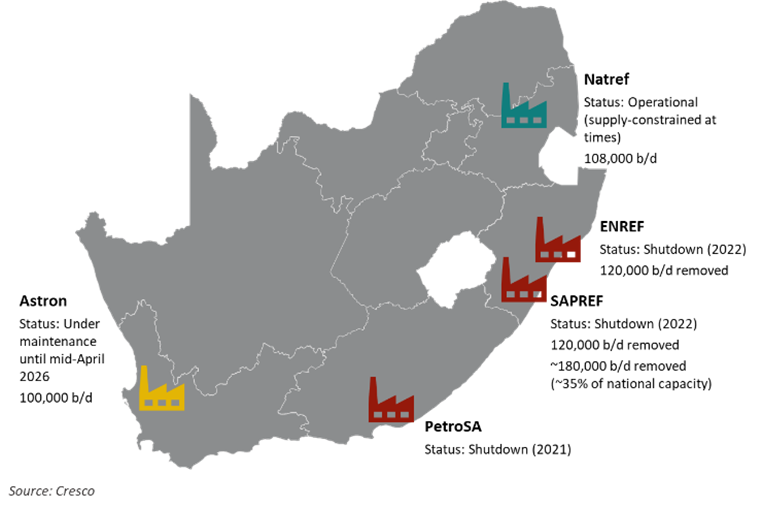
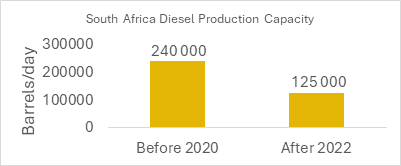
As Goncalves explains: “Since 2022, South Africa’s domestic diesel refining capacity has halved – the shutdowns of SAPREF and ENREF have turned South Africa from a relatively self-sufficient refiner of diesel products to a structurally import-dependent country (70 to 75%), exposed to global diesel markets and highly sensitive to shocks like the Hormuz disruption.”
The global bidding war for your fleet’s fuel

Transport operators are no longer just fighting local economic pressures; they are directly exposed to geopolitical fallout. “More than half of South Africa’s diesel is currently imported from Gulf suppliers directly exposed to Hormuz disruption, such as Oman (34%), UAE (12%) and Bahrain (11%), or indirectly exposed to Hormuz disruption via supply chains such as India (20%),” notes Goncalves.

With global supply chains fracturing, South African importers are being forced to fight for fuel on the international stage. Fleet owners will ultimately bear the brunt of this competition. Goncalves highlights the stark reality of this global squeeze: “SA is having to compete for non-Gulf barrels against stronger buyers such as Asia and Europe. India is acting as a swing supplier, reallocating barrels to the highest-paying market (Asia).”

While South Africa has not yet declared a national diesel shortage, transport operators are already navigating “pricing shocks, logistics disruption and localised shortages”.
The local threat: Competing against the grid

While the Strait of Hormuz creates an external shock, a massive internal shock looms on the horizon: South Africa’s power grid is currently stable, but that stability relies on an ageing coal fleet. “South Africa has now experienced three severe load-shedding crises (2008-2009, 2014-2015 and 2022-2023) and is in the midst of a global fuel supply crisis as of February-April 2026,” says Goncalves. He poses a critical question for all heavy fuel users: “What would happen if these were to happen together, and what could occur to revert Eskom to a load-shedding situation while the Hormuz closure, affecting diesel supply, rages on?”

The threat to transport operators is stark: when the grid fails, the rest of the country buys your diesel. “In the next three to four years South Africa is forecast to return to load-shedding if Eskom’s decommissioning schedule is followed,” Goncalves warns. If load-shedding returns, transport operators will suddenly find themselves competing for constrained fuel imports against Eskom’s massive Open Cycle Gas Turbines (OCGTs) and thousands of businesses scrambling to keep the lights on.

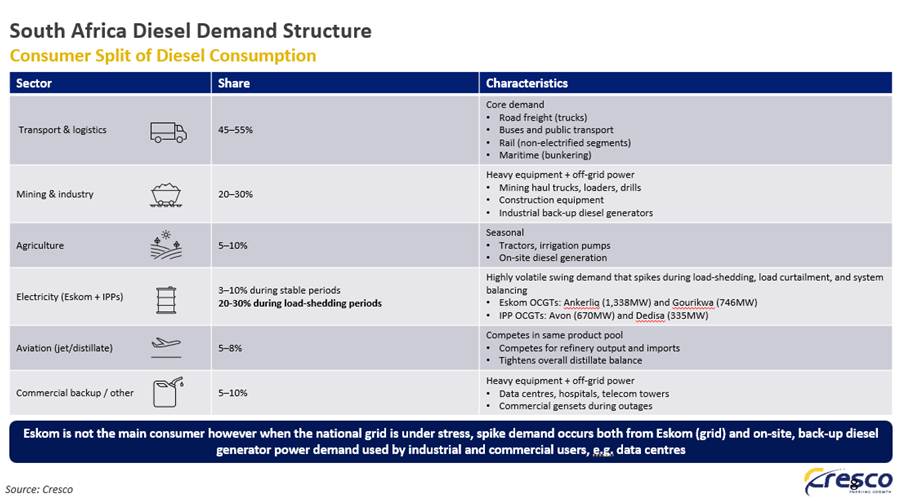
The numbers paint a worrying picture for fleet fuel security: “During stable periods, Eskom uses only 3 to 10% of the country’s diesel supply, for load-following and system balancing functions for the country’s 4 OCGT peaker plants. During load-shedding periods however, this percentage ramps up to 20 to 30%,” Goncalves explains. “This highly volatile swing demand has a larger impact: during times of load-shedding and load curtailment, private consumers – whether industrial, commercial, agricultural or residential – also increase diesel demand.”

A paradigm shift for transport planning

For the trucking and logistics sector, this means any future deterioration in Eskom’s fleet performance could instantly result in a massive spike in national diesel demand, draining an already constrained import pipeline.

The era of taking diesel availability for granted is officially over. Transport operators must now view fuel security as a major strategic and operational risk rather than a simple line item. “What the Strait of Hormuz crisis has taught us is that we can no longer rely 100% on diesel for the future,” Goncalves concludes. “Any major geopolitical risk or war could fracture supply chains and turn the ‘option of last resort’ into a difficult-to-obtain fuel source.”

Published by

Focus on Transport

FOCUS on Transport and Logistics is the oldest and most respected transport and logistics publication in southern Africa.
Prev Truck Test 2026 breaks all records
Next Power, partnership and a new era for MAN in southern Africa

Leave a comment

This site is protected by reCAPTCHA and the Google Privacy Policy and Terms of Service apply.