We’ve all heard the phrase, “The robots are coming”. Short, dramatic, and evocative, it suggests either an invasion or a revolution… or maybe both?
You know a phrase has hit a nerve when it shows up in TED Talks, business keynotes, and even on protest signs. “The robots are coming” is one of those loaded lines that people love to fear. It’s catchy, sure, but it also carries an emotional charge that cuts deep. And now, after my recent trip to Dortmund to judge the IFOY Award 2025, I’m here to confirm that the robots are no longer just coming: they’re here, they’re busy, and they’re getting smarter.
The scare factor
Unfortunately, “the robots are coming” sounds scary. Why? Well, the phrase taps into our collective anxiety on multiple levels.
Firstly, there’s technological disruption. We’re in an age where machines are rapidly learning to do things we thought only humans could do: drive, write, serve, deliver, and more. From chatbots and autonomous vehicles to warehouse robots and medical diagnostics, technology is changing everything; that’s both exciting and terrifying. Think of the automotive industry: assembly lines that once employed thousands now rely on industrial robot arms to do repetitive tasks with precision. In journalism, AI tools are beginning to write sports summaries and market reports faster than any human. Even legal firms are using AI to scan through mountains of case documents.
Secondly, science fiction hasn’t done us any favours. From The Terminator to I, Robot, pop culture has painted robots as a looming threat. These stories live rent-free in our heads and shape how we react to real-world advances. The idea that robots might one day “rise up” isn’t just a sci-fi trope; it’s a cultural undercurrent that breeds suspicion every time a new humanoid robot gets rolled out.
Then there’s the job market fear. We’ve all seen those headlines: “Robots are coming for your job.” Whether it’s self-service tills replacing cashiers, AI bots reducing the need for customer service agents, or warehouse robots automating manual sorting and packing, the threat feels personal. A study by Oxford Economicssuggests that up to 20 million manufacturing jobs worldwide could be lost to robots by 2030. That’s not just a figure; it’s families, livelihoods, communities that could be shattered.
A robotic future – here and now
Does this mean that we should be terrified of robots? Based on what I saw during my recent trip to Dortmund, Germany, my answer would have to be no.
I travelled to the city famous for its football team not to watch them play, but rather to get a sneak peek into our robotic future. As a judge at this year’s International Intralogistics and Forklift Truck of the Year (IFOY) Award, I got a front-row seat to the future of industrial robotics. The number of entries involving robots was staggering – and impressive.
What stood out immediately was how seamlessly robots are being integrated into real-world operations. What we saw weren’t just clever prototypes or showroom gimmicks. These are working systems, deployed and delivering value. One experience that stuck with me was seeing a video of a group of robots at work in a warehouse simulation – moving with the precision and grace of a ballet troupe, albeit one obsessed with logistics. It was both surreal and thrilling.
Take, for example, the project by Geekplus at Dr. Max in Italy. Some 50 picking robots manage thousands of products, scooting around a high-tech warehouse like futuristic ants. Add in 22 RoboShuttles storing items double deep, and you have a system that processes over 200 totes per hour. It’s fast, smart, and ruthlessly efficient.
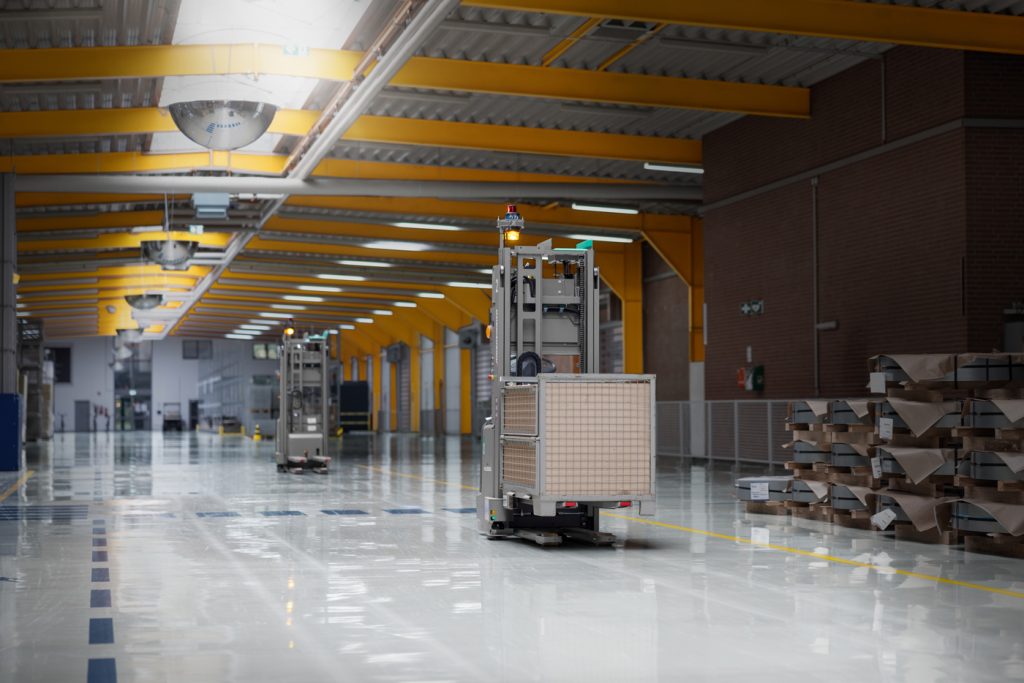
At Wildeboer Bauteile in Germany, Jungheinrich is automating the “last mile” of internal logistics. Mobile robots transport goods around the production floor, controlled by a fleet management system so sophisticated it can integrate third-party robots. That’s interoperability in action.
Then there’s Verity’s autonomous inventory system, used by none other than Ikea (or, more precisely, Ingka Group). It runs 24/7, saving around 800,000 labour hours per year. That’s not a typo. Eight hundred thousand. I imagined what the Verity system would sound like. I couldn’t help but think that this is what the future sounds like – not roaring engines, but the soft whir of optimisation.
Other finalists included robotic warehouse systems like Exotec’s Skypod and the Geekplus SkyCube, and mobile robots from STILL and Logitrans. These aren’t tech demos – they’re live, industrial solutions already in use. And judging them wasn’t easy. The innovation, engineering, and efficiency on display made this one of the most exciting judging panels on which I’ve served.