Shacman stakes its claim in South Africa
Shacman stakes its claim in South Africa
From a “staplerless start-up” to an 800-truck sales contender, Shacman Africa is forcing South Africa’s established manufacturers to reckon with a fast-growing, locally owned Chinese challenger with serious continental ambitions. CHARLEEN CLARKE paid the company a visit.
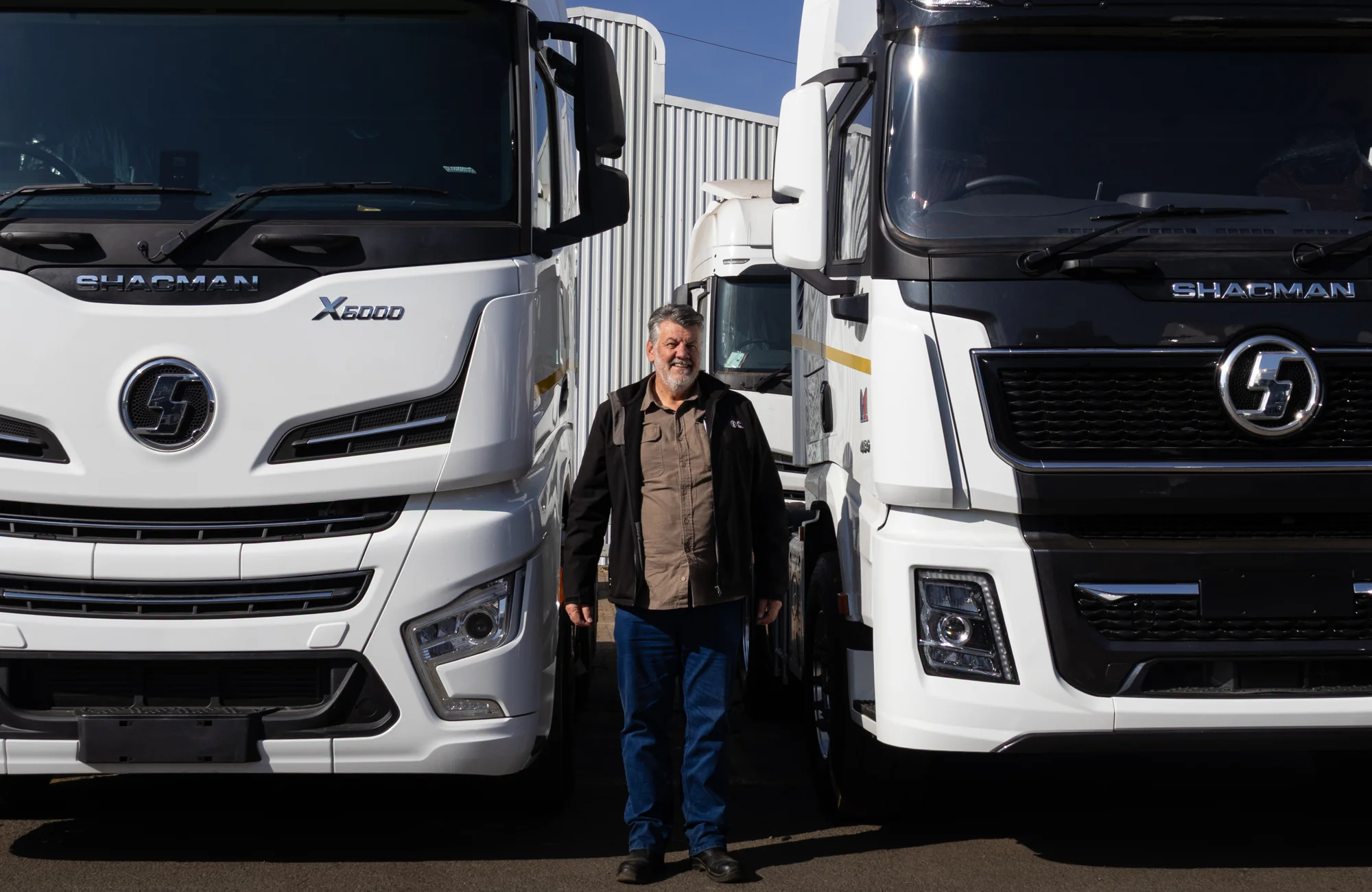
A stapler is an unlikely measure of corporate progress. Yet it neatly captures the distance Shacman Africa has travelled since its South African operation began in 2022. General manager Malcolm Gush, a commercial vehicle industry veteran with decades of experience in the South African market, recalls that the fledgling business had virtually nothing. “I didn’t even have a stapler or a punch,” he says with a wry chuckle.
Four years later, Shacman Africa employs 210 people, operates an impressive assembly plant in Wadeville, Germiston, has 20 dealers across South Africa and expects to sell approximately 800 trucks locally this year. Another 800 could be sold beyond South Africa’s borders. Those numbers do not make Shacman the country’s biggest truck supplier; Gush describes it as one of the smaller Chinese brands locally. They do, however, show that the company has moved beyond the stage at which it can be dismissed as another hopeful newcomer.
Its expansion also reflects a bigger shift. Chinese manufacturers are no longer competing only for buyers who cannot afford established European or Japanese products. They are becoming credible alternatives for operators scrutinising acquisition price, fuel consumption, payload, uptime and lifecycle costs.
“Since 2024, the Chinese brands have started changing the balance of the South African market,” says Gush. “Transport operators are under enormous financial pressure and want lower-cost vehicles that can still do the same work. Five or six years ago, there were far fewer credible alternatives. That has changed.”
A calculated African beginning
Shacman was not new to Africa when the South African business opened. The brand had already been operating on the continent for years, particularly in markets where Chinese trucks had displaced many new European vehicles.
That footprint gave Shacman Africa an unusual advantage. Instead of chasing immediate local volume, it initially directed about 90% of its business into neighbouring markets. Export sales allowed the company to test vehicles, adapt specifications and build the support infrastructure expected by South African fleets.
“We were very careful not to rush into South Africa and oversell,” Gush explains. “Selling the first truck is the easy part. What happens afterwards determines whether you sell the second one. We wanted the dealerships, parts, maintenance support and internal systems in place before we pushed aggressively.”
South Africa is far less forgiving than many other African truck markets. Some cross-border operators maintain vehicles in their own workshops. Large South African fleets frequently expect maintenance contracts, rapid breakdown response, sophisticated diagnostics, centralised warranty administration and predictable whole-life costs.
The foundation now includes company-owned and independent dealerships, a 24-hour breakdown service, parts distribution, maintenance contracts, a developing used-truck operation, a call centre and finance through Shacfin. Driver training is standard when a customer collects a truck.
Shacman also has dealerships or support points along important regional corridors, including in Namibia, Botswana, Zimbabwe and Zambia. This matters to fleets running north towards the Copperbelt and the Democratic Republic of Congo (DRC). “Cross-border support cannot stop at Beitbridge,” Gush emphasises. “A truck may be earning money in Zambia, the DRC, Namibia or Botswana, so the customer needs to know where the parts and technical assistance will come from.”
Production becomes the constraint
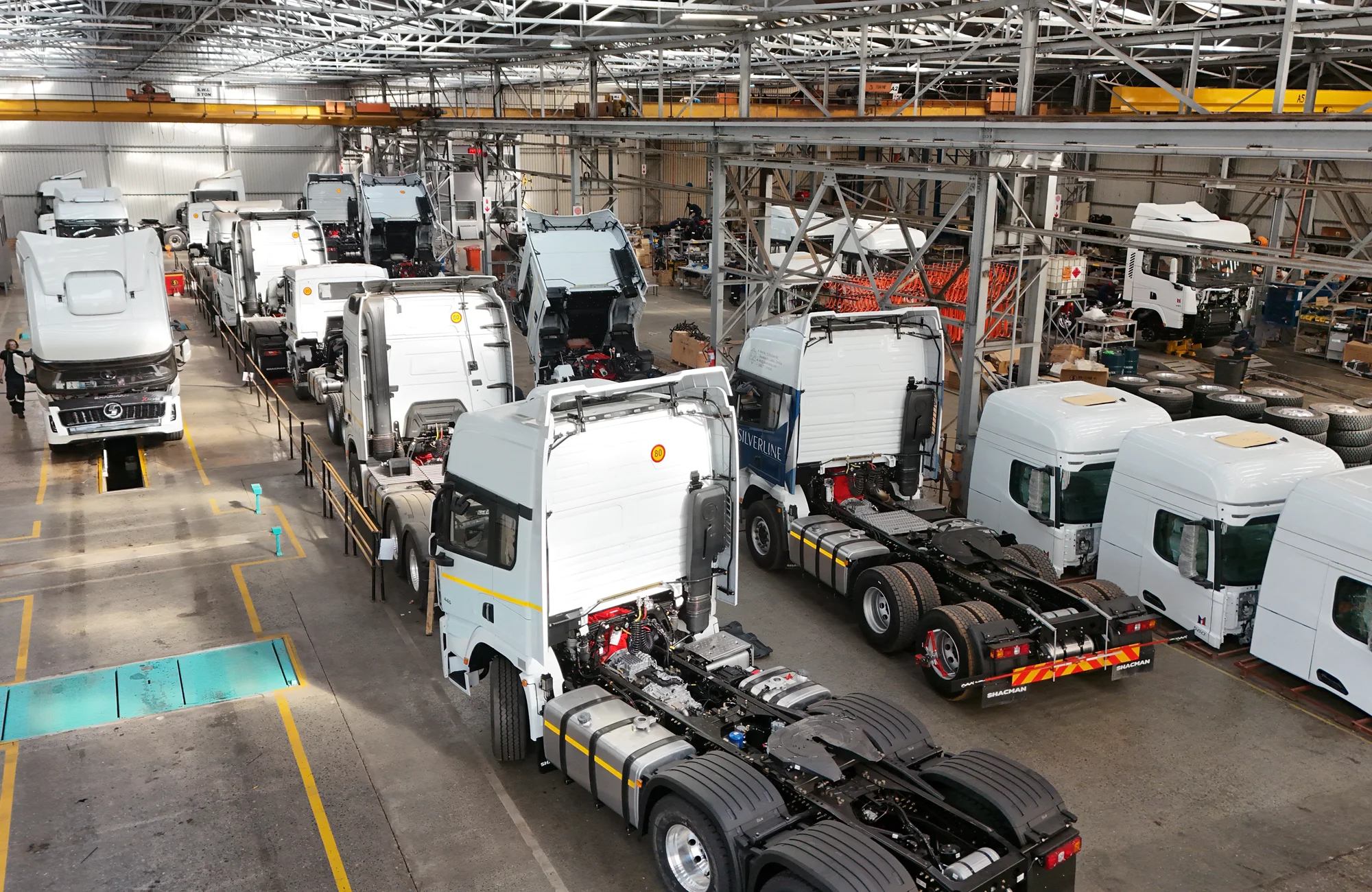
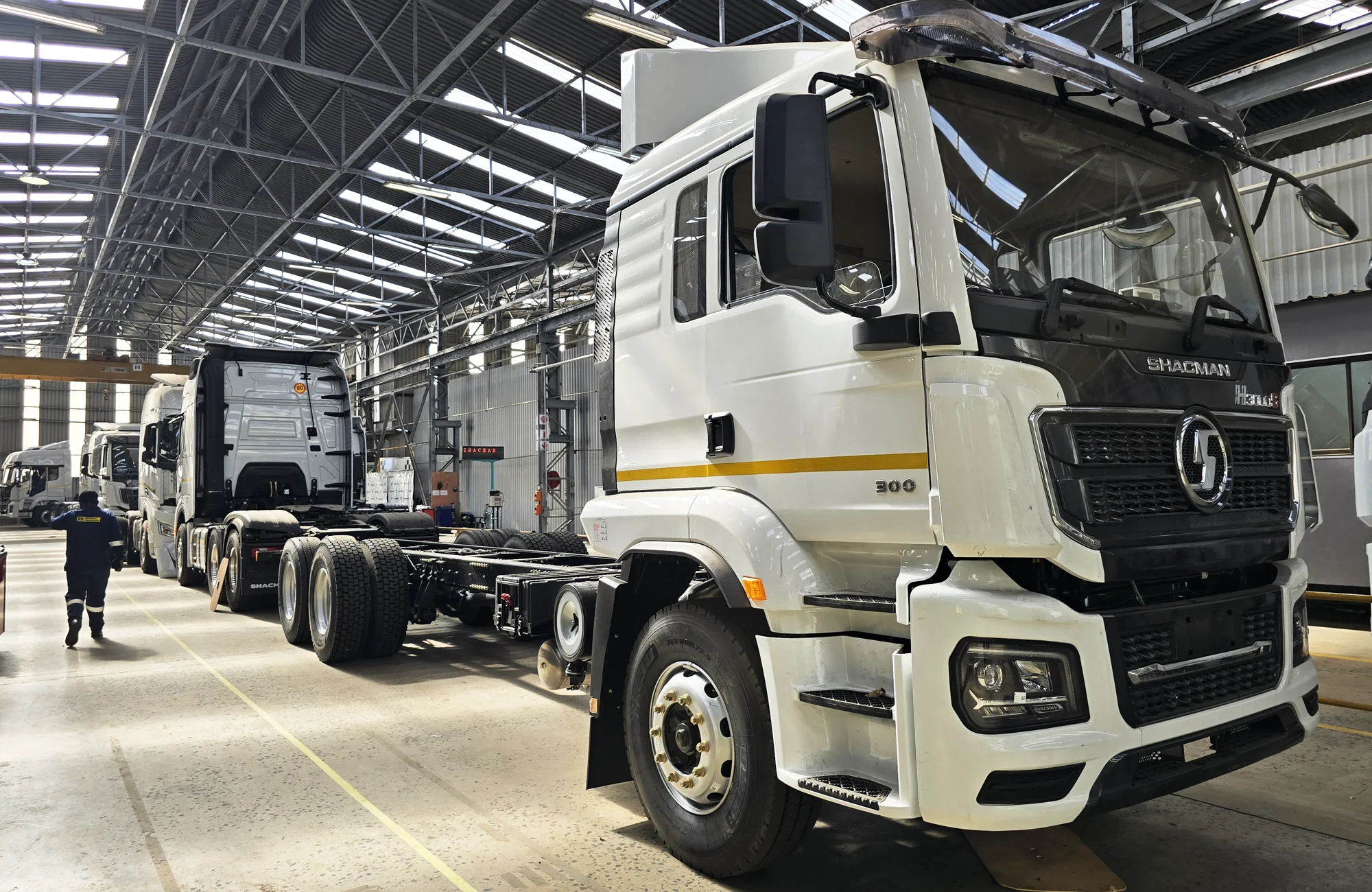
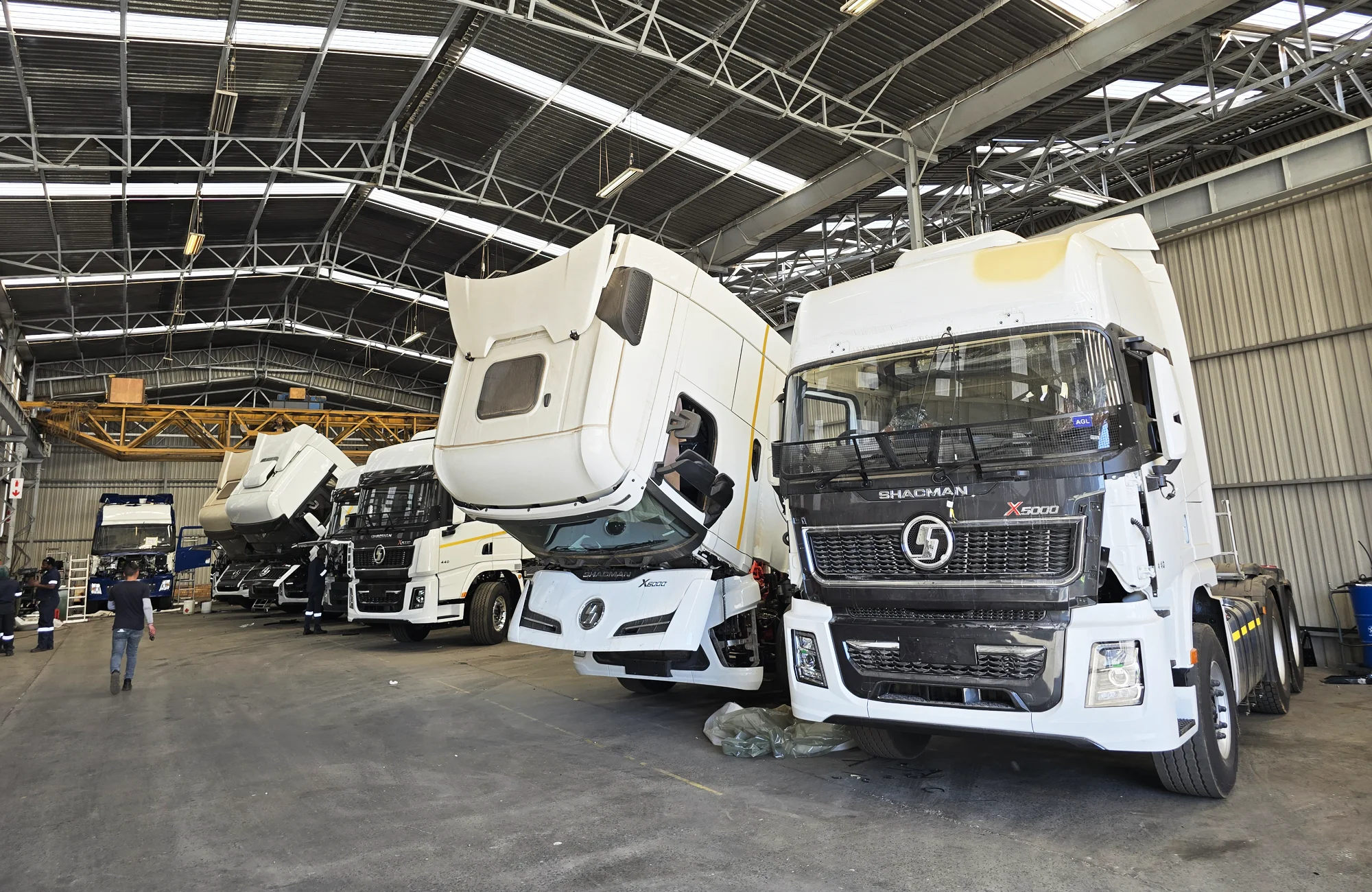
The most striking indication of Shacman’s acceleration is that its Wadeville plant is becoming a limiting factor. The facility was designed to assemble about 1,500 trucks annually. It is currently producing around four units a day, although Gush says output could rise to eight or even 10 by adding people to the fixed 10-station line. Around 60 employees work across the plant, pre-delivery inspection, inspection functions and the bond store.
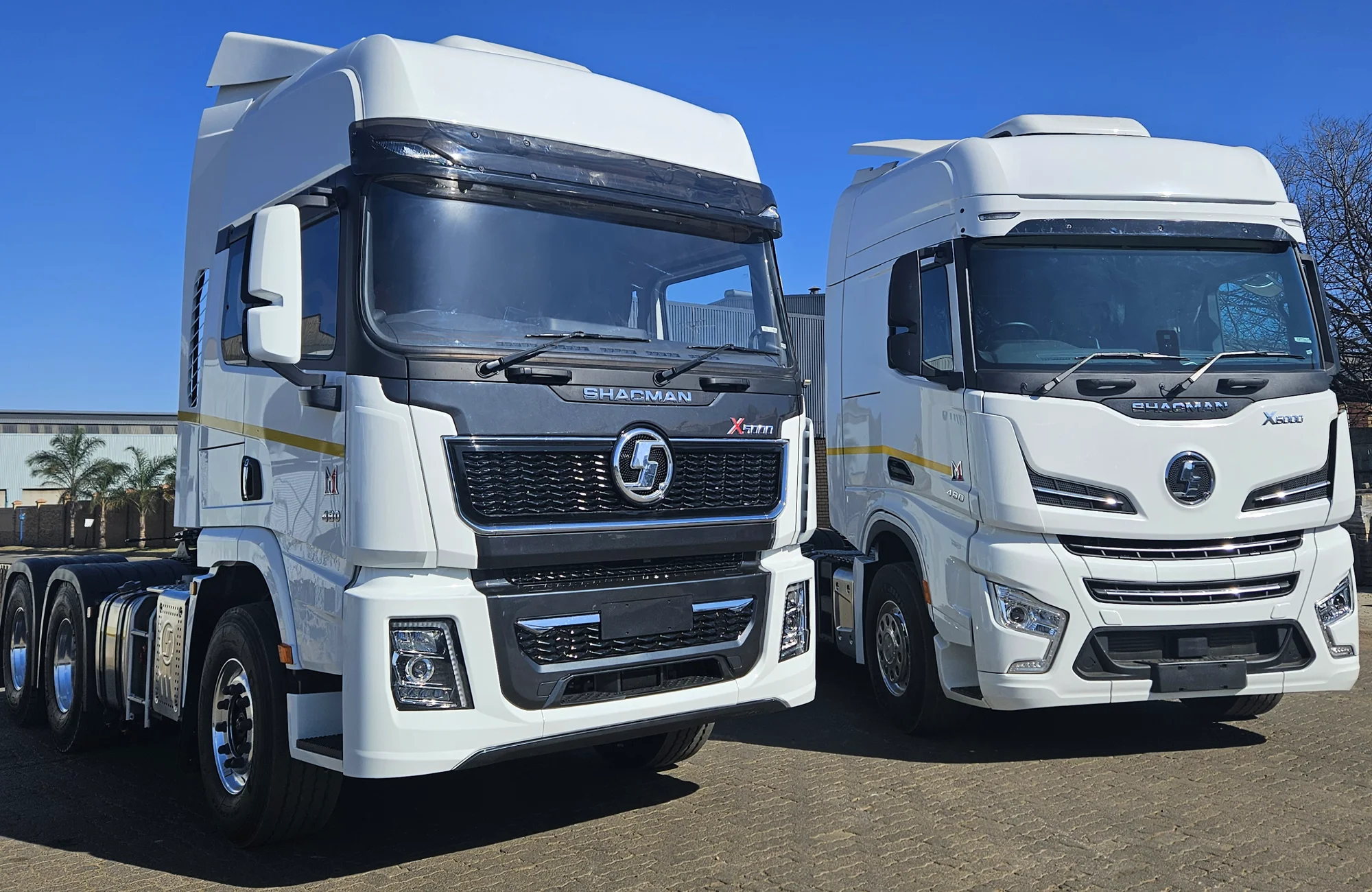
Demand rose sharply after the introduction of the X5000 and X6000 truck tractors. According to Gush, vehicles are increasingly moving almost directly from the factory to customers. “We initially set a South African target of 600 units, but we now believe the number could be closer to 800,” he says. “The immediate challenge is no longer simply finding customers. It’s getting the trucks through production properly and delivering them at the required standard.”
South African, Namibian and Botswanan vehicles are assembled locally from completely knocked down (CKD) packs. Trucks for many other African markets are imported fully built, avoiding a production bottleneck in Wadeville. Local assembly creates employment and fits South Africa’s duty structure, but it is not automatically cheaper. This is because Shacman’s Chinese factories can produce hundreds of trucks a day, while Wadeville builds a fraction of that volume.
“People assume local assembly must make a truck cheaper. At our volumes, that is not necessarily true. China has extraordinary scale and automation. We assemble locally because it is the correct structure for this market, but volume is what makes manufacturing efficient,” Gush elaborates.
The Wadeville building stretches roughly 350m from end to end and provides space for a separate line for smaller vehicles as the range broadens.
Not competing on price alone
Shacman’s rise can’t be explained solely by a low purchase price. Cheap trucks have entered South Africa before, only to disappear when parts, technical support or resale values failed to meet expectations. The company must persuade operators that its vehicles can survive South African payloads, distances, heat, gradients and maintenance realities. It must also overcome lingering perceptions about Chinese quality.
“The Chinese manufacturers are actively trying to move away from the idea that Chinese automatically means cheap and inferior,” Gush says. “Their focus has shifted towards quality, technology and innovation. Their factories are modern, highly automated and operating at enormous scale. That does not mean every product is automatically right for South Africa, but the gap people remember is no longer the gap that exists today.”
Shacman has reduced the perceived product risk by using familiar driveline and systems suppliers. Its X5000 and more driver-focused X6000 truck tractors offer outputs of 440hp, 480hp and 560hp, with Cummins M10 and M13 engines, Fast 16-speed transmissions and systems from highly reputable suppliers including Knorr-Bremse and Wabco.
This does not remove the need for independent evidence of operating costs. Fuel consumption is notoriously difficult to compare because routes, payloads, drivers, weather and operating cycles vary considerably. Manufacturer and distributor claims are therefore often met with understandable scepticism, particularly when they cannot be verified under controlled conditions. Hence, Shacman is entering Truck Test 2026, partly to establish a credible benchmark against its competitors and – critically – partly to demonstrate that its trucks can deliver competitive fuel economy in real-world South African operations.
“The first question a potential customer asks always pertains to fuel consumption,” notes Gush. “In Truck Test, the comparison is strictly controlled. The trailers and payloads are the same. The trucks travel the same route over the same two days, and they operate according to the same rules. This gives the market scientific evidence rather than another claim.”
A broader attack on the market
The 6×4 truck tractor remains Shacman Africa’s core product, but the company is moving beyond extra-heavy long-haul vehicles. It has introduced the eight-tonne L3000 with an eight-speed automated manual transmission. The H3000S rigid range includes a 300-hp 6×2 and a 350-hp 6×4, powered by Weichai engines. Tippers for quarry, construction and mining work are being added in 6×4 and 8×4 configurations.
The longer-term ambition is to compete from approximately 1.5 tonnes through to abnormal-load applications. A 1.5- to seven-tonne range is under discussion, with a dedicated assembly line planned for vehicles below eight tonnes. There is a commercial logic behind the expansion: a dealer relying only on extra-heavy truck sales may struggle to generate sufficient volume in smaller centres. A wider range spreads infrastructure and staffing costs across more sectors.
“The goal is to participate in long-haul, distribution, construction, mining, municipal and waste applications,” Gush says. “A broader range is not only about selling more vehicles; it makes the dealer network stronger.”
Africa supplies the momentum
Beyond South Africa, the strongest growth is linked to the Central African mining economy.
Zambia has become a strategic base for fleets serving the DRC’s copper and cobalt operations. Trucks registered there can access several port corridors, allowing operators to divert cargo towards Walvis Bay, Dar es Salaam, Beira or South Africa when disruption affects a particular route. Shacman Africa says orders of 60 or even 100 trucks are not unusual in these markets. One Zambian customer, for instance, is approaching a fleet of 100 Shacmans.
Parts availability is essential when a truck is operating thousands of kilometres from South Africa. Shacman China has invested heavily in continental support, including parts stock valued at about US$4 million at a distribution operation in Zambia. “A truck in the DRC cannot wait indefinitely for a component to arrive from another continent,” says Gush. “You do not win Africa simply by having the best brochure or the lowest price. You win by keeping the vehicle working in difficult places.”
That may be Shacman’s most important claim. South African operators have seen ambitious brands arrive with attractive prices and disappear when aftersales support became expensive. Shacman says its local ownership structure, backed by close technical involvement from China, allows it to respond faster.
Gush contrasts Chinese decision-making with the slower processes he experienced during years in the European truck industry. South Africa represents a tiny share of the global market, which can make local engineering changes difficult to prioritise. Shacman’s engineers, he says, are more willing to alter wheelbases, specifications or components for African requirements. “When we identify something that must change, they listen and react,” he says. “The speed is remarkable. They are determined to succeed here and understand that local knowledge must shape the product.”
Expansion brings growing pains
Rapid expansion has also exposed weaknesses Shacman cannot ignore. Training technicians across 20 dealerships is a major undertaking. South Africa’s shortage of mechanics with both mechanical and auto-electrical competence is particularly concerning as trucks become increasingly dependent on electronics, diagnostics and software.
Shacman has its own training department, but Gush acknowledges that it must expand. Processes must also remain consistent as new dealers, employees and customers are added. “We are growing quickly and that brings the problems any new organisation would expect,” he says. “The challenge is getting everyone trained, applying the same standards and finding the right technical people. We cannot allow sales growth to run ahead of our ability to support the vehicles.”
A claim that must be earned
Shacman Africa’s transformation since 2022 is remarkable. A business that began without basic office equipment (namely, the humble stapler) now has a large Wadeville assembly facility, hundreds of employees, a national dealer footprint, an ever-expanding product range and a growing presence on demanding African transport corridors.
Yet rapid growth is not the same as lasting success. Its 800-unit South African ambition must be matched by parts supply, technical competence, warranty performance, resale confidence and credible fuel results. Its expanding range must strengthen dealers rather than stretch support resources too thinly. Gush appears to understand that distinction. “We are not treating this as a short-term project,” he stresses. “The objective is not to flood the market, collect orders and then struggle afterwards. We want to grow responsibly, support what we sell and earn the customer’s next purchase.”
This is no easy undertaking in one of the world’s most competitive commercial vehicle markets. Shacman is not simply asking operators to consider another truck. It is asking them to turn away from familiar, well-established brands with long track records in South Africa and place their confidence in a comparatively new local challenger.
Price and specification may open that conversation, but they will not settle it. Lasting market share will depend on consistent performance, dependable support, credible operating costs and confidence in the vehicle’s second economic life. Gush and his team know this only too well – and, given their depth of industry experience and deliberately measured approach, there is good reason to believe that they will succeed.
Published by

Charleen Clarke


focusmagsa