In today’s high-pressure transport environment, sustainable fleet growth depends on disciplined planning and structured aftermarket support, where specification, uptime and lifecycle management combine to protect profitability and operational resilience.
Fleet growth in transport has never been a matter of simply adding vehicles. In 2026, it is a strategic discipline shaped by rising fuel costs, infrastructure constraints, regulatory pressure and increasing payload demands. The operators who succeed are not those who expand fastest, but those who expand deliberately.
That view is shared across Babcock’s Transport Solutions division, the DAF distributor in South Africa, where fleet planning and aftermarket performance are treated as two sides of the same equation. Together, they determine whether growth is sustainable or fragile.
According to Mark Gavin, sales director: DAF Trucks at Babcock, sustainable expansion begins long before a new truck is delivered. “Many operators enter the market with quality pre-owned units to manage capital exposure,” he explains. “That is often a smart starting point. The key is ensuring those vehicles are properly inspected, supported and backed by a strong aftermarket network.”
Starting smart, scaling intelligently
Pre-owned trucks provide a lower barrier to entry. They allow businesses to establish contracts, build cash flow and preserve working capital. However, as operations stabilise and customer demands increase, fleet conversations begin to change. “There is always a transition point,” Gavin says. “Once operators start running heavier combinations or extending into longer routes, the focus shifts from purchase price to total cost of ownership (TCO).”
At that stage, specification becomes critical. Higher-horsepower units make it possible to move greater gross combination masses efficiently, but power alone is not the solution. “It is about balance,” Gavin notes. “You need the right combination of power, fuel efficiency and reliability. If you get that balance right, you protect margins while increasing capacity.”
Modern driveline technologies and improved aerodynamics now allow operators to achieve higher outputs without disproportionate fuel penalties. In long-haul and bulk transport, where fuel remains a dominant operating cost, that balance directly influences profitability.
TCO as the anchor
Specification decisions are only part of the story. Lifecycle thinking ultimately separates engineered growth from accidental expansion. “Capital cost is important, but it is only one part of the equation,” Gavin explains. “Fuel consumption, service intervals, parts availability, warranty support and residual value all influence long-term performance.”
Operators who plan around lifecycle value often benefit from stronger asset sustainability and improved resale performance. crucially, they are also better positioned to manage risk in an increasingly volatile operating environment.
Uptime is commercial, not technical
If fleet planning defines growth, aftermarket discipline protects it. In an environment shaped by tight delivery windows and unpredictable operating conditions, uptime is no longer simply a technical metric, but also a financial one.
For Dave Black, head of operations: Transport Solutions at Babcock, aftermarket performance is where fleet profitability is either protected or eroded. “In today’s market, a truck standing still is revenue lost. Aftermarket is not an add-on to the sale. It is central to protecting cost per kilometre,” he says.
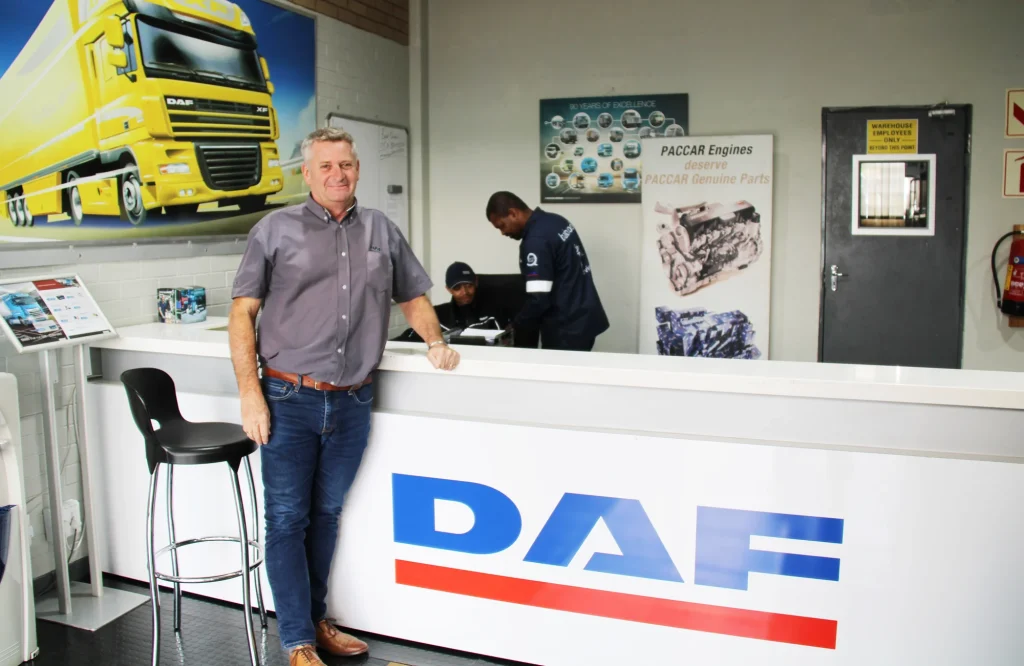
To support growing fleets, Babcock expanded into a purpose-built facility in Isando. The move was strategic rather than cosmetic. “Our previous branch faced space constraints, especially for truck-and-trailer combinations,” Black explains. “During peak months, that limits throughput – and throughput directly affects uptime.”
The new site operates 20 drive-through workshop bays capable of accommodating full truck-and-trailer combinations under one roof. It is supported by DAF-trained technicians, dedicated service advisers and expanded yard space designed for operational flow. Parts availability is equally critical, with a fill rate of approximately 99% on fast-moving lines. For high-utilisation fleets, workshop capacity and parts support are operational safeguards.