Is the combustion engine ready for its comeback?

Is the combustion engine ready for its comeback?

Battery-electric trucks dominate the zero-emissions conversation, But, as CHARLEEN CLARKE reports, new work on hydrogen, methane and ammonia suggests the internal combustion engine may still have a future in freight.

For years, the transport industry has been told that the future is electric. In many applications, that is almost certainly true. Battery-electric vehicles (BEVs) are already proving their worth in urban delivery, depot-based operations and predictable short-haul routes.

Long-distance trucking, however, is more complicated. Heavy trucks need range, payload, short refuelling times and reliable energy infrastructure. In many countries (including South Africa) the power grid, charging network and operational realities of freight transport make a single-technology solution unlikely.

This is where gaseous fuels enter the picture. According to a recent paper from global premium solutions and components provider, Phinia*, hydrogen, natural gas and ammonia could all play important roles in future transport systems. Crucially, they may also give the internal combustion engine (ICE) a second life in a lower-carbon world.

Not just diesel vs batteries

The paper argues that future mobility will not be a simple contest between diesel vehicles and BEVs. Instead, the energy system is likely to become more fragmented, with different fuels serving different applications.

Hydrogen is receiving significant attention as a zero-carbon fuel, whether used in fuel cells or ICEs. Methane, including compressed natural gas (CNG) and biomethane, is already widely available in some markets and can reduce CO₂ emissions compared with diesel. Ammonia, while less familiar in road transport, is carbon-free at the point of use and easier to store than hydrogen.

For freight operators, the significance lies in flexibility – different regions will have different energy sources, infrastructure and cost pressures. A technology pathway that allows trucks to use alternative gaseous fuels could therefore be highly valuable.

Why gaseous fuels matter

The paper’s authors point out that renewable electricity alone may not solve every transport challenge. Solar and wind energy are growing rapidly, but they do not always produce power when demand is highest. Fuels can store energy, move it across long distances and provide resilience where electricity infrastructure is constrained.

This matters in transport. A truck is not a passenger car – downtime is expensive, routes are long and operators cannot afford to wait hours for energy replenishment. For heavy-duty and long-haul applications, gaseous fuels could offer faster refuelling and greater operational flexibility.

Hydrogen is attractive because it produces no CO₂ at the tailpipe when used in an ICE. Methane can offer lower emissions than conventional fossil fuels, particularly when produced from renewable sources. Ammonia is more challenging from an ignition and combustion perspective, but it brings its own advantages in storage and distribution.

The combustion engine evolves

The key point in Phinia’s paper is that the ICE is not standing still. Future engines running on gaseous fuels will need advanced injection, ignition and control systems. This is where the engineering becomes important: hydrogen, methane and ammonia behave very differently in the combustion chamber. They have different flame speeds, ignition requirements, storage pressures and energy densities. A conventional diesel or petrol fuel system cannot simply be reused without major adaptation.

Phinia has therefore been developing gaseous fuel injection and ignition systems for more than a decade. First-generation systems for port fuel injection and low-pressure direct injection are now available, while second-generation systems are being developed to simplify fuel systems and improve performance. In practical terms, this means engines can be adapted to run on alternative gaseous fuels while maintaining the performance, durability and controllability required in commercial transport.

Hydrogen for heavy trucks

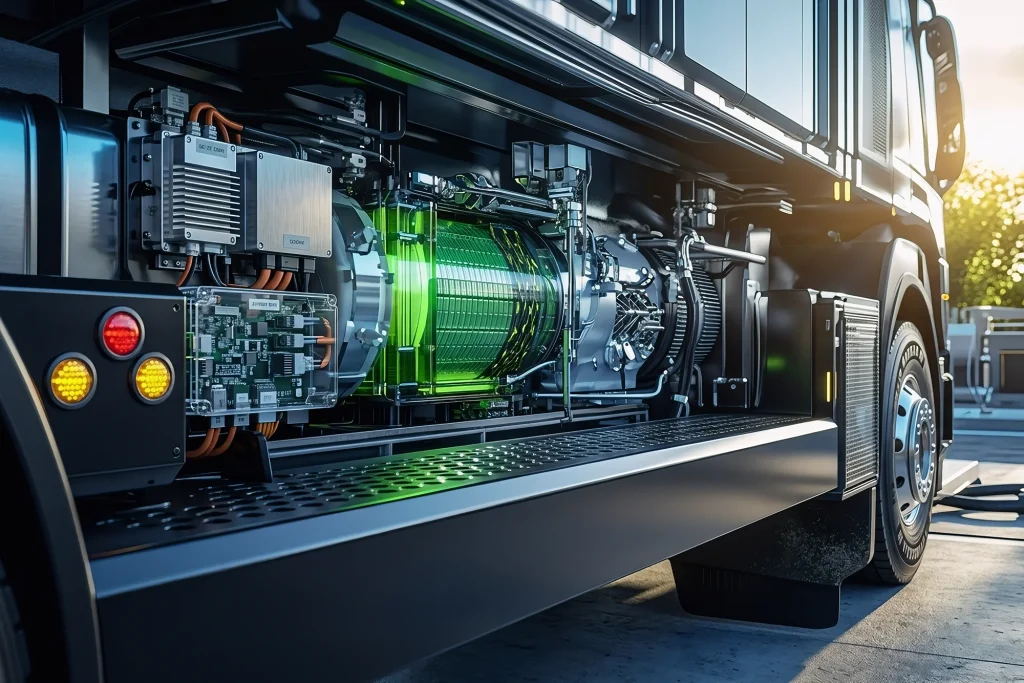
One of the most relevant developments for FOCUS readers is Phinia’s work on a 13-litre commercial vehicle engine platform. The company converted a heavy-duty diesel engine to run on hydrogen, while retaining much of the base engine architecture. A port fuel injection system was used, and the diesel injector was replaced with a centrally mounted spark plug and ignition system.

The result is particularly interesting. Phinia reports that the hydrogen engine showed strong alignment with the diesel torque curve in key operating ranges, with further optimisation underway. The company also reports a broad efficiency zone above 40% brake thermal efficiency at cruise speed and load, together with very low NOx generation at low to medium loads.

For long-haul transport, that is important – it suggests that hydrogen combustion could potentially deliver familiar truck-like performance while dramatically reducing tailpipe CO₂ emissions.
Hydrogen ICE vs fuel cells

Hydrogen is often discussed in relation to fuel cells, but Phinia’s paper highlights another route: hydrogen ICEs.

Fuel cells are highly efficient and produce no tailpipe emissions beyond water vapour, but they can be expensive and technically complex. Hydrogen combustion engines, by contrast, are closer to existing engine technology. They may offer a faster transition for some operators, manufacturers and service networks because they build on known platforms, skills and supply chains.

This does not mean hydrogen combustion will replace fuel cells, but it does mean that both could play roles in different applications. For markets with large existing diesel fleets, limited charging infrastructure and demand for robust powertrains, hydrogen combustion could be a practical stepping stone towards lower-carbon freight.

Methane and CNG: a nearer-term opportunity

While hydrogen attracts the headlines, methane may be more immediately relevant in some markets. CNG infrastructure already exists in parts of the world, and methane storage is less demanding than hydrogen storage. Phinia notes that methane at a pressure of 200 bar offers significantly higher volumetric energy density than hydrogen at 700 bar, which has major implications for packaging and cost.

The company also presents work comparing port fuel injection and direct CNG injection. Direct injection can
improve volumetric efficiency because the gas is injected after the inlet valves close, avoiding fresh air displacement. In testing, Phinia reported torque improvements of up to around 11%, as well as efficiency gains compared with port injection. For operators, the message is straightforward: more advanced CNG injection could deliver better drivability, lower emissions and stronger performance than older gas engine technology.

Ammonia: the wild card

Ammonia is perhaps the most surprising fuel covered in the paper. It is already widely produced for fertiliser and other industrial uses, and it contains no carbon. It can also be stored more easily than hydrogen. However, ammonia is difficult to ignite and burns very differently from hydrogen or methane. This makes the ignition system critical.

Phinia highlights its flexible ignition technology, Flexispark, which is designed to adapt the spark to different fuels and engine conditions. The system can vary voltage, spark duration and energy delivery, helping to improve combustion stability while reducing spark plug wear. This flexibility matters, because future engines may need to handle different fuels, blends or fuel qualities depending on availability and market conditions.

THE SOUTH AFRICAN PERSPECTIVE

South Africa’s transport sector faces a unique set of challenges: long distances, high diesel dependence, pressure to reduce emissions and uncertainty around electricity supply all complicate the transition to cleaner freight. Battery-electric trucks will have a role, especially in urban and regional distribution. But for long-haul freight, mining, agriculture and cross-border transport, other solutions may be needed.

Gaseous fuels could offer another pathway. Hydrogen combustion may be attractive where fast refuelling and heavy payloads are required. CNG or biomethane could offer lower-carbon options where supply is available. Ammonia may be further away, but it is already part of the global conversation around shipping and heavy transport.

For South Africa, the key issue will be infrastructure. Trucks cannot run on fuels that are not available. Any serious shift to hydrogen, CNG, biomethane or ammonia will require coordinated investment in production, storage, distribution, refuelling and regulation.

A future with more than one answer

The strongest message from Phinia’s paper is that the future of transport will not be solved by one technology alone. BEVs will grow and hydrogen fuel cells will have a place, but gaseous-fuel combustion engines could also play a meaningful role, particularly in heavy-duty applications where existing diesel technology has set high expectations for range, uptime and performance.

For fleet operators, this is encouraging. It suggests the industry may have more options than the current debate sometimes implies. The internal combustion engine may not disappear. Instead, it may evolve. In the world of heavy transport, that evolution could prove highly significant.

  • This article is based on the paper “Future Gaseous Fuels: Latest Developments in Injection, Ignition and Combustion” by Dr. Gavin Dober (Phinia, Belval, Luxembourg), Laurent Doradoux, Mathieu Da Graca (Phinia, Blois, France), Simon Coster (Phinia, Gillingham, UK) and Dr. Jakob Ängeby (Phinia, Amal, Sweden). This new research was first presented at the 47th International Vienna Motor Symposium, which took place from 22 to 24 April 2026.

Published by

Charleen Clarke

CHARLEEN CLARKE is editorial director of FOCUS. While she is based in Johannesburg, she spends a considerable amount of time overseas, attending international transport events – largely in her capacity as associate member of the International Truck of the Year jury, member of the International Van of the Year jury, judge of the International Pickup Award, judge of the Truck Innovation Award, judge of the Truck of the Year Australasia, and IFOY Award jury member.
Prev What REALLY happens at South Africa’s truck stops after dark
Next SA’s National Rail Master Plan: Doomed to derail?

Leave a comment

This site is protected by reCAPTCHA and the Google Privacy Policy and Terms of Service apply.