A study published in September 2025 by researchers from Stellenbosch University sheds new light on how truck drivers perceive fatigue, opening a path towards potential remedies.
Driver fatigue is a pervasive problem in the South African road freight sector, with truck drivers facing long and irregular hours on the road and a variety of health risks that impact on how their bodies function. This includes inadequate rest opportunities, due to a widespread lack of safe and quiet sleeping conditions, which in turn can lead to fatigue.
Fatigue arises from exertion or insufficient recovery and is influenced by physiological, psychological and contextual elements. “Fatigue is a multidimensional construct, caused by work-, sleep-, and health-related factors,” notes the paper, “Assessing truck driver fatigue perceptions: Insights from a South African road freight context”, authored by Andries Mouton and Anneke De Bod from the university’s Department of Logistics, along with Leila Louise Goedhals-Gerber from the Department of Industrial Engineering.
Unsafe and unhealthy working conditions
“The combination of long work hours, irregular schedules, shift work, and intense competition among transporters results in a fast-paced work environment with dwindling wages. These factors contribute to unsafe and unhealthy working conditions. Mental health challenges, cardiometabolic issues, and sleep disorders collectively and individually impact the well-being and safety of truck drivers,” the study continues. “The expansive array of health issues and demanding operational requirements poses significant risks not only for truck drivers but also for other road users in the road traffic system.”
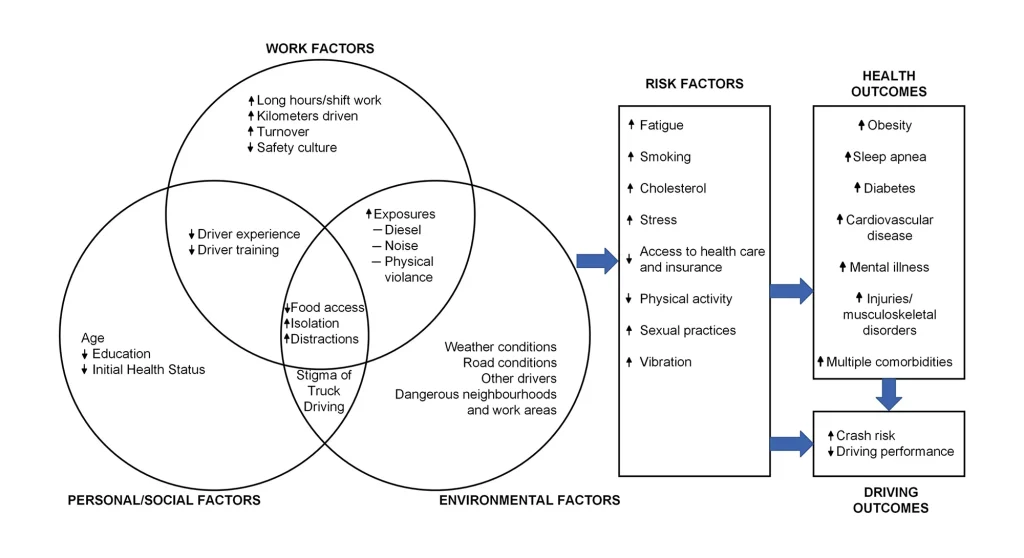
The wide-ranging risk factors for truck drivers – from smoking, obesity, hypertension and poor diet to lack of exercise, stress and insufficient sleep – can result in various health issues, such as sleep apnoea, cardiovascular disorders, diabetes and mental illness. The study’s authors further highlight negative effects that contribute to fatigue: the long work hours, irregular schedules and work times conflicting with circadian rhythms that characterise the road freight industry, as well as the stressful work environment drivers are required to endure, with the constant prospect of potential hijackings, diesel or cargo theft, inadequate truck stop facilities and substandard truck berths.
A feedback loop of unhealthy consequences
Due to these demanding operational requirements, the health risks faced by truck drivers appear to create a reinforcing feedback loop, perpetuating a cycle of unhealthy consequences. “For instance, long working hours and shift work often lead to increased consumption of stimulants like caffeine to stay awake. However, this negatively impacts restorative sleep, resulting in fatigue during work operations. Consequently, drivers may rely even more on stimulants, further disrupting sleep,” explains the study.
Long driving shifts are also linked to signs of depression, “highlighting the significant impact of long working hours on mental health.” Significantly, in contrast to research suggesting that mental health challenges start to increase at 39+ working hours/week, South African regulations allow truck drivers to work up to 90 hours/week. This is compounded by the lack of facilities and recreational activities, as well as healthy food options, at many trucking work and rest sites.
“Given these challenges, road freight carriers must understand the mechanisms that ensure operating environments support the health and safety of truck drivers,” the study emphasises.
Driver perceptions of fatigue
The study uses a survey of 1,788 professional truck drivers from one particular carrier to develop, evaluate and assess how truck drivers perceive 10 factors relating to fatigue: driver wellness, company support, work pressures, safety culture, driver engagement, health awareness, truck stop diet support, health status, driver mobility and home environment.
Drivers report high ratings in company support, safety culture, driver engagement and a supportive home environment. The authors note that the study “identified correlations between company support for health and fatigue management and improvements in driver wellness, safety culture, and driver engagement,” underscoring how important it is for company management to develop support systems that foster a safe driving culture and encourage drivers to make healthy lifestyle decisions.
“However, the discrepancies between these effective practices and actual driver health outcomes and awareness are concerning,” the study cautions. “A gap exists between perceived support and health awareness and status, indicating a need for targeted health interventions to enhance fatigue-related knowledge and behaviour,” These interventions, it emphasises, should aim to “enhance truck drivers’ knowledge about physical activity, diet, and sleep, and provide resources that facilitate the daily application of this knowledge”. In other words, while drivers may feel supported by their employers, this support may still be insufficient, as there is a need to improve understanding of how fatigue negatively affects driver health and performance and better promote awareness on the benefits of healthier choices.
Opportunities for improvement
Driver wellness, driver mobility, work pressures and health awareness all received moderate ratings from the drivers surveyed, “suggesting opportunities for improvement in promoting healthy behaviours and reducing commute times to maximise rest.” Despite scheduling challenges inherent in the road freight sector, the study takes this a step further, asserting that “it is evident that optimal scheduling should focus on aligning with drivers’ circadian rhythms and minimising continuous workload.”
It is critical, the study notes, that schedules “limit continuous driving time, reduce the number of consecutive working days, and provide sufficient recovery time between shifts, ideally at least 11 hours”, allowing truck drivers to receive sufficient quality rest. Fatigue management strategies should provide drivers with access to the knowledge, tools and resources to manage their fatigue and maintain a healthy lifestyle. Furthermore, this must be “reinforced by behavioural change techniques that facilitate the daily application of learned knowledge”, while national regulations need to be urgently and drastically reconsidered, given the immense workload that is legally allowed to be placed on truck drivers.
As well as improving drivers’ ability to get adequate rest and sleep, “Low ratings in health status and truck stop diet support underscore the need for better health interventions and more nutritious food options for drivers while on the road.” For this to happen, say the authors, collaboration with external facilities like truck stops is crucial to facilitate appealing healthy meal options, as well as amenities that “encourage healthy behavioural choices.”
The mere provision of these options, however, is unlikely to radically alter driver behaviour without “the implementation of additional health nutrition education, awareness campaigns, and practical guidance on meal planning,” which is “essential to build an understanding of the role of nutrition in managing fatigue and safe driving and to ensure daily application”.
The road ahead: Collaboration and targeted interventions are key
In summarising their findings, the authors stress that to overcome the existing gaps between perceived company fatigue support and driver health outcomes, targeted health interventions are necessary to enhance knowledge and behaviour, while tailored fatigue management systems are needed due to work and driver differences.
Collaboration with all road freight stakeholders, including truck drivers and external organisations such as customers, truck stops and the government, is crucial for effective fatigue management. Drivers – armed with the necessary health awareness to make informed decisions – must also take it upon themselves to actively adopt fatigue management into their daily routines.
Further insights into driver perceptions can guide policy decisions to improve health and safety by enhancing knowledge, healthy behavioural choices and access to supportive resources. The study advocates for future research that can “triangulate driver perceptions with objective health and operational data.”
More focused studies on individual fatigue-related factors could reveal more targeted insights, particularly when paired with physiological or behavioural fatigue indicators. “For example, linking scheduling data to biometric fatigue measurements could help unpack the relationship between shift structure and fatigue risk,” note the authors. “Similarly, field-based research into the quality and accessibility of truck stops across South Africa could clarify the drivers’ low ratings and highlight tangible opportunities for improvement.”
It will also be important to track changes over time. With this in mind the authors also recommend longitudinal studies (research that follows the subject of the study over a certain period) to assess the long-term impact of fatigue-related interventions on driver well-being and safety outcomes.