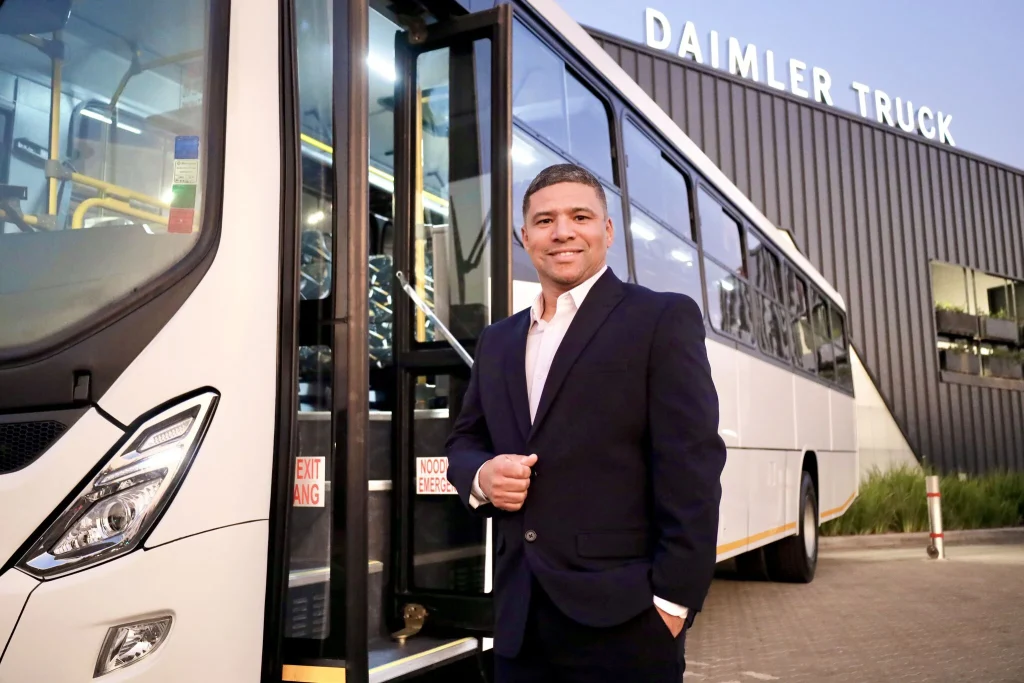
Why the bus bounce-back?
Positive trends De Vries has been observing in the “people-moving space” include the recovery of international travel, which he says is now back to pre-Covid levels. South Africa’s neighbours in the Southern African Development Community (SADC) make up 75% of international travellers to the country. This is good news for operators focusing on the intercity segment. The rest comes from the tourism industry and includes charter operations, which have been benefitting from the rise in international tourists in the past year – 97% of whom entered South Africa for holiday purposes.
In the commuter space, where government contracts generally expire every 10 to 15 years, it’s been a good opportunity to boost sales when those contracts have come up for renewal. As older bus models reach their end-of-life stage, new orders are being placed with growing regularity. The tide, De Vries believes, is turning.
Future-fit features
“We try to fill any product gaps our customers might experience and work to add value with new developments and features from Daimler Germany,” he says. Many of these are in the luxury coach category, where features normally reserved for trucks are now being introduced in upmarket buses. “The first Fleetboard telematics units, for example, have been fitted into customers’ Mercedes-Benz luxury coaches in Brazil,” he adds. Collaboration is ongoing with other Mercedes-Benz Bus operations in South America and Southeast Asia, so there could be further exciting developments on the way.
Prioritising safety
De Vries says a lot of vehicle enhancements are centred on safety. “This is a critical focal point for us, especially in Southern Africa, where the market has seen some horrific bus accidents over the years,” he expands. A Road Traffic Management Corporation (RTMC) study estimates that there were over 320 fatal bus crashes in South Africa over the past five years.
Integral to the safety of most Mercedes-Benz bus models is Active Brake Assist 5, which delivers emergency braking in case of a potential collision. It works with a combination of radar and camera systems and is one of the only systems of its kind capable of carrying out automated emergency braking up to a standstill – not only for stationary and moving obstacles, but also for moving pedestrians.
Taking all this into account, it’s no wonder De Vries sees the future of the local bus industry in a positive light. It’s certainly high time for a turnaround – and Mercedes-Benz Buses Southern Africa intends to be part of that shift.
Why the bus bounce-back?
Positive trends De Vries has been observing in the “people-moving space” include the recovery of international travel, which he says is now back to pre-Covid levels. South Africa’s neighbours in the Southern African Development Community (SADC) make up 75% of international travellers to the country. This is good news for operators focusing on the Intercity segment. The rest comes from the tourism industry and includes charter operations, which have been benefitting from the rise in international tourists in the past year – 97% of whom entered South Africa for holiday purposes.
In the commuter space, where government contracts generally expire every 10 to 15 years, it’s been a good opportunity to boost sales when those contracts have come up for renewal. As older bus models reach their end-of-life stage, new orders are being placed with growing regularity. The tide, De Vries believes, is turning.
Future-fit features
“We try to fill any product gaps our customers might experience and work to add value with new developments and features from Daimler Germany,” says De Vries. Many of these are in the luxury coach category, where features normally reserved for trucks are now being introduced in upmarket buses.
“The first Fleetboard telematics units, for example, have been fitted into customers’ Mercedes-Benz luxury coaches in Brazil,” he adds. Collaboration is ongoing with other Mercedes-Benz Bus operations in South America and Southeast Asia, so there could be further exciting developments on the way.
Prioritising safety
De Vries says that a lot of vehicle enhancements are centred on safety. “This is a critical focal point for us, especially in Southern Africa, where the market has seen some horrific bus accidents over the years,” he expands. A Road Traffic Management Corporation (RTMC) study estimates there were over 320 fatal bus crashes in South Africa over the past five years.
Integral to the safety of most Mercedes-Benz bus models is Active Brake Assist 5, which delivers emergency braking in case of a potential collision. It works with a combination of radar and camera systems and is one of the only systems of its kind capable of carrying out automated emergency braking up to a standstill – not only for stationary and moving obstacles, but also for moving pedestrians.
Taking all this into account, it’s no wonder De Vries sees the future of the local bus industry in a positive light. It’s certainly high time for a turnaround – and Mercedes-Benz Buses Southern Africa intends to be part of that shift.