Strategic rail: The backbone of Africa’s resource corridors

Strategic rail: The backbone of Africa’s resource corridors

Rail corridors across Africa are reshaping how minerals reach global markets. From the Copperbelt to the Cape, strategic rail investments are strengthening supply chains, lowering logistics costs and supporting the continent’s growing role in the energy transition, as JULIA TEW reports.

South Africa’s Minister of Transport, Barbara Creecy, has described rail as a critical driver of continental integration, economic growth and sustainable mobility. “Already we are witnessing vital investments in upgrading and expanding rail networks across Africa,” she noted at the Southern African Railways Association International Rail Conference in 2025.

Corridor-scale infrastructure development and related innovations have the potential not only to transform local economies, but also to secure Africa’s place in global minerals trade and the energy transition supply chain.

Strategic mining corridors

Both regional logistics and mining across the continent are being reshaped by a growing number of rail-based transport corridors and related projects.

Among the most significant is the Lobito Corridor in Central Africa’s Copperbelt region, anchored in the Benguela Railway. The 1,300-km rail corridor links the mineral-rich regions of the Democratic Republic of the Congo (DRC) and northern Zambia to the Port of Lobito on Angola’s Atlantic coast, cutting inland transportation time to roughly seven days (about a quarter of what it can take via road or alternative corridors).

It also creates a direct route to global markets for copper and cobalt exports – minerals crucial to the energy transition. The DRC and Zambia together account for around 14% of global copper mine production, while the DRC accounts for 73% of global cobalt production. Controlling access to these minerals is at the heart of growing US-China competition, sometimes referred to as a “second cold war”.

In a new development phase starting in late 2025, the system is being rehabilitated with financing from a US$553-million loan from the US International Development Finance Corporation and US$200 million from the Development Bank of Southern Africa. Rail and logistics operations are managed under a long-term concession by Lobito Atlantic Railway (LAR), a consortium comprising Trafigura, Mota-Engil and Vecturis.

LAR COO Nicolas Gregoir told audiences at the 2026 Mining Indaba that the project is one of the continent’s most strategically important rail logistics developments, especially for the African mining sector. Roughly 200,000 tonnes of freight were moved between the DRC and Lobito Port in 2025, with ambitions to significantly grow that volume in 2026. Current operations involve around 12 trains per week with hundreds of wagons and multiple locomotives. 

Enhancing the east-west route

Serving as a strategic counterweight to the Atlantic-facing Lobito Corridor, the 1,860-km Tanzania-Zambia Railway Authority (TAZARA) line is an east-west artery that moves copper from Zambia (and increasingly the DRC) to the Indian Ocean via Dar es Salaam. China, Zambia and Tanzania have signed a deal to modernise the bulk freight line, increasing capacity and reliability on a route first built in the 1970s. The US$1.4-billion investment by the China Civil Engineering Construction Corporation will be executed under a 30-year concession arrangement.

The project plans to rehabilitate tracks, upgrade signalling and communications and pave the way for heavier and faster trains to transport copper concentrates, refined copper, sulphur and fuel. Once the upgrade is completed, TAZARA should enable mines and exporters to bypass congested road corridors while reducing losses from pilferage and road damage.

The East African region is home to another example of China’s deepening investment in African rail infrastructure. Tanzania and Burundi signed a US$2.15-billion agreement with the China Railway Engineering Group and China Railway Engineering Design & Consulting Group in 2025 to construct a 282-km standard-gauge railway (SGR) linking Uvinza in Tanzania to Musongati in Burundi. The line is expected to facilitate the export of up to three million tonnes of minerals annually, significantly improving regional and international market access.

West Africa’s emerging rail backbone

Running through rugged terrain in West Africa, the TransGuinéen corridor comprises more than 600km of railway connecting the Simandou iron ore operations in southeastern Guinea with port infrastructure at Morebaya, south of Conakry. The multi-use corridor provides a vital export route from the remote mining region to the Atlantic coast and is also expected to support Guinea’s broader economic and regional integration.

The infrastructure is owned through La Compagnie du TransGuinéen, a joint venture in which the Government of Guinea holds 15%, while SimFer Infraco and WCS Infraco each hold 42.5%. SimFer is backed by Rio Tinto and Chinalco, while WCS is associated with Winning Consortium Holdings and Baowu.

The railway includes 12 stations, 206 bridges and four major tunnels and is designed to support exports of up to 120 million tonnes of high-grade iron ore annually from the WCS and SimFer mining concessions. US company Wabtec secured a US$248-million order from WCS for locomotives and related services, following a separate US$277-million locomotive order from SimFer.
Southern Africa’s freight rail advantage

The Southern African region is not without its own success stories, particularly in the transportation of bulk ore and minerals. These include the Nacala Transport Corridor spanning Mozambique and Malawi – an integrated, multimodal logistics network comprisingboth rail and road. The 912-km rail route extends from Nacala port through Liwonde in Malawi to the coal fields of Tete Province in Mozambique. The line is also used to import fertiliser and fuel for Malawi while moving other cargo for export. One-stop border posts between Mozambique-Malawi and Malawi-Zambia have simplified cross-border movement, streamlining operations and cutting down transit times.

The Beitbridge Bulawayo Railway (BBR) in Zimbabwe is another example of private-sector participation in regional rail infrastructure. The company provides bulk transport services over a 350-km stretch within the North-South Corridor, linking Beitbridge to Victoria Falls through an agreement with the National Railways of Zimbabwe. Opened in 1999, the line provides a shorter route between Bulawayo, Victoria Falls and destinations in neighbouring South Africa, enabling the movement of goods such as copper, sulphur, clinker, coal and limestone.

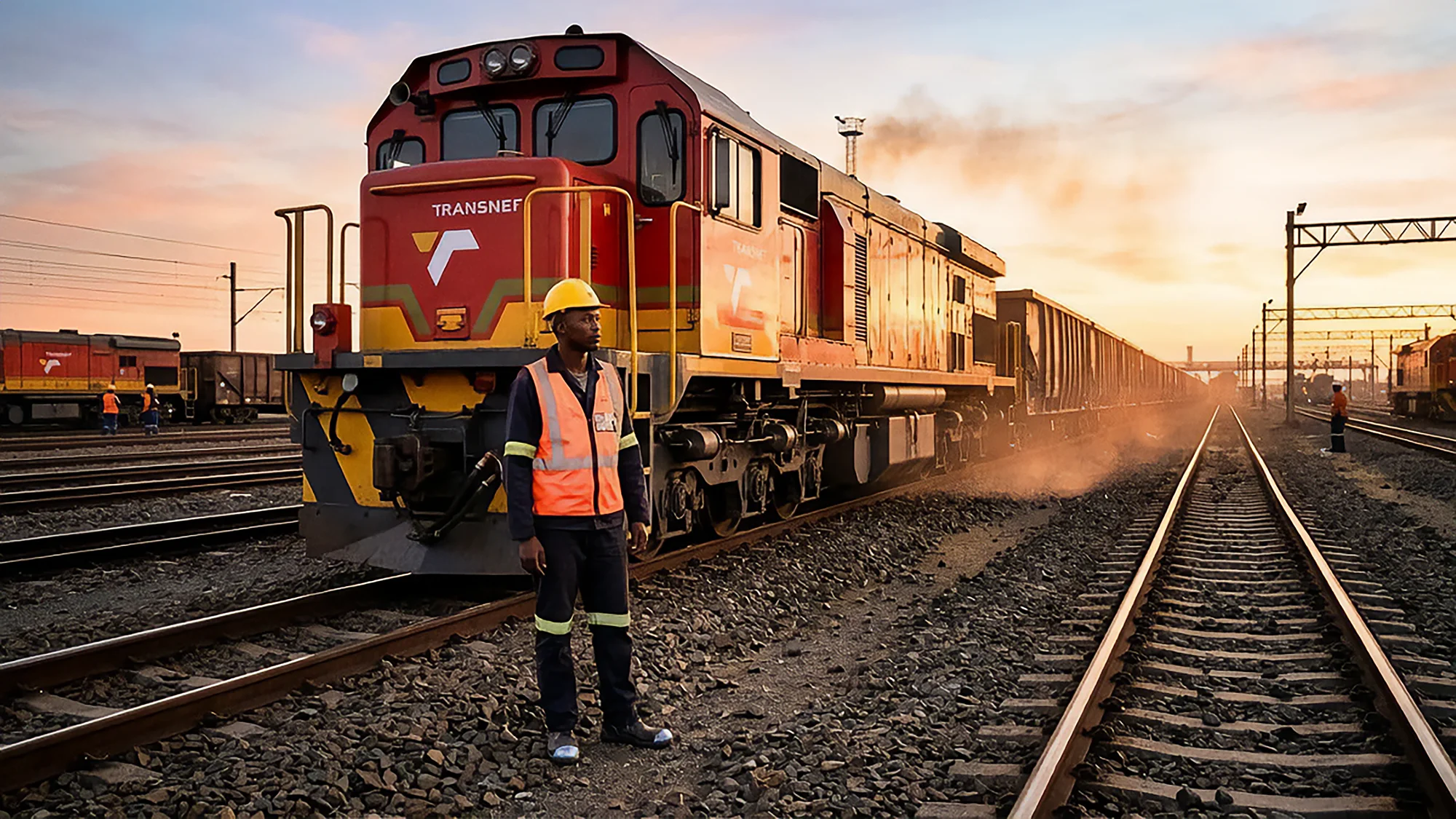
In South Africa, the 861km Sishen–Saldanha heavy-haul railway forms the backbone of Transnet’s Ore Export Corridor. The line connects Kumba Iron Ore’s Sishen and Kolomela mines in the Northern Cape with the Port of Saldanha in the Western Cape, home to South Africa’s only dedicated iron ore export terminal. According to Kumba, trains weighing around 34,200 tonnes leave the mines approximately every nine hours, typically comprising more than 340 wagons of iron ore.

Built in 1974, the line can transport around 60 million tonnes of iron ore annually. While recognised as one of the most efficient and advanced logistical systems in the world, “there’s a lot of work that still needs to be done” to restore the system to optimal functionality, says Kumba Iron Ore CEO Mpumi Zikalala.

Government reforms are also aimed at revitalising the broader rail sector. Minister Creecy has announced measures to allow third-party participation on branch lines, encouraging investment and laying the groundwork for greater private sector involvement. The Department of Transport is also finalising the National Rail Bill, which aims to establish a legislative framework for collaboration across government spheres and facilitate expanded private participation in rail infrastructure.

At an operational level, Transnet has entered into strategic partnerships with mining companies to improve rail efficiency and capacity. In August 2025, the state-owned logistics firm signed an agreement with Exxaro Resources to upgrade rail infrastructure and expand capacity between the company’s 3.6-million-tonne-per-year Leeuwpan coal mine in Mpumalanga and domestic and export markets. The partnership supports Exxaro’s sales target of between 38.3 and 42.4 million tonnes of coal, including up to 7.2 million tonnes for export.

Similarly, in July 2025 United Manganese of Kalahari concluded a 10-year agreement with Transnet to transport manganese from its Northern Cape operations to ports for export, supporting South Africa’s efforts to maximise critical mineral exports under its forthcoming Critical Minerals Strategy.

The Western Cape Government has outlined a rail infrastructure transformation roadmap in its Overberg Rail Business Case. The proposal envisions a modern, integrated freight system linking the Overberg corridor with inland markets such as Gauteng. The corridor could potentially move nearly 105,000 tonnes of freight annually, including refrigerated containers carrying agricultural produce. Developing an intermodal corridor linking Transnet’s Belcon Inland Terminal to the Port of Cape Town will be key to unlocking this potential.

Keeping economies firmly on the rails

With natural resources among the most important drivers of Africa’s growth, the efficient movement of minerals and related commodities is becoming increasingly important. Railways and their supporting infrastructure therefore serve as a lifeline for transporting bulk materials reliably, safely and at scale.

Across the continent, new and revitalised rail corridors are demonstrating how strategic infrastructure can reshape supply chains. As global demand for critical minerals grows – particularly those required for renewable energy systems, batteries and electrification – Africa’s role in international supply chains is likely to expand. Ensuring that rail networks are capable of moving these resources efficiently will therefore be essential, both for mining companies and for national economies and regional trade integration.

In this context, rail is far more than a transport mode. It is strategic economic infrastructure that connects mines to markets, unlocks regional trade corridors and strengthens Africa’s position in the global resources economy.

Published by

Focus on Transport

FOCUS on Transport and Logistics is the oldest and most respected transport and logistics publication in southern Africa.
Prev Sinotruk fire trucks join Malaysia’s emergency response fleet
Next Aftermarket opportunities in South Africa's NECV sector

Leave a comment

This site is protected by reCAPTCHA and the Google Privacy Policy and Terms of Service apply.