Fuso and Hino merger marks major shift in CV landscape

Fuso and Hino merger marks major shift in CV landscape

In a significant development for the global trucking industry, Hino Motors and Mitsubishi Fuso Truck and Bus Corporation (MFTBC) are set to merge under a new holding company.

The deal, formally concluded in June 2025, follows earlier intentions announced in 2023 and represents a landmark collaboration between four major automotive players: Daimler Truck, Toyota Motor Corporation, Hino, and Fuso.

The move, described as an integration โ€œon an equal footingโ€, will see Hino and Fuso brought under one corporate roof, with a new listed holding company expected to commence operations in April 2026. The entity will be based in Tokyo and listed on the Prime Market of the Tokyo Stock Exchange. Daimler Truck and Toyota will each hold 25% of the new company, which in turn will own 100% of both Hino and Fuso. Karl Deppen, currently president and CEO of Mitsubishi Fuso, is set to lead the new company as CEO.

A consolidation built on shared goals

The driving force behind the merger is a shared need to address growing pressures within the global commercial vehicle (CV) market โ€“ from rising R&D costs and increased regulatory scrutiny to mounting expectations around carbon neutrality and digital transformation. The companies believe the combined entity, which will have over 40,000 employees, can better navigate these challenges through streamlined development, production, and procurement.

While Hino and Fuso have long been competitors โ€“ particularly in key Asian and African markets โ€“ this collaboration aims to strengthen Japanโ€™s position in the global truck manufacturing sector. It also positions the new company as a serious contender in developing CASE (Connected, Autonomous, Shared, Electric) technologies, including hydrogen propulsion, which is a growing area of focus amid tightening global emissions targets.

Statements from all four parent companies strike a tone of ambition and cooperation. Daimler Truck CEO Karin Rรฅdstrรถm called the merger โ€œhistoricโ€, noting that scale will be essential in the industryโ€™s transformation. Toyotaโ€™s CEO Koji Sato described the agreement as โ€œjust the starting lineโ€ of a broader effort to reshape the future of commercial transport. Both Hinoโ€™s Satoshi Ogiso and Fusoโ€™s Karl Deppen pointed to the potential for innovation, resilience, and shared value creation.
South Africa waits for clarity

While global implications are clear, the impact on South Africaโ€™s CV sector remains uncertain. Both Hino and Fuso are well-established names in the region, with distinct dealer networks and strong customer bases. However, as of mid-2025, there are no plans to combine their local operations.

Toyota South Africa Motors (TSAM), which distributes Hino in the region, emphasised that the brands will continue to operate through separate distribution channels. TSAM vice-president for Hino, Anton Falck, acknowledged the potential for synergies and efficiencies but confirmed that both Hino and Fuso would maintain independent commercial paths in Southern Africa โ€“ at least for the foreseeable future.

A similar message was echoed by Daimler Truck Southern Africa, which stressed that the integration remains in its early stages and that further details โ€“ especially those affecting local markets โ€“ are yet to be finalised. The company has promised to share updates as the merger progresses.

This โ€œwait and seeโ€ position may be frustrating for South African stakeholders, but it reflects the complexity of combining two well-established global brands with entrenched local operations and identities. It also raises important questions about how brand loyalty, product portfolios, and aftersales service might evolve once the new company becomes operational.

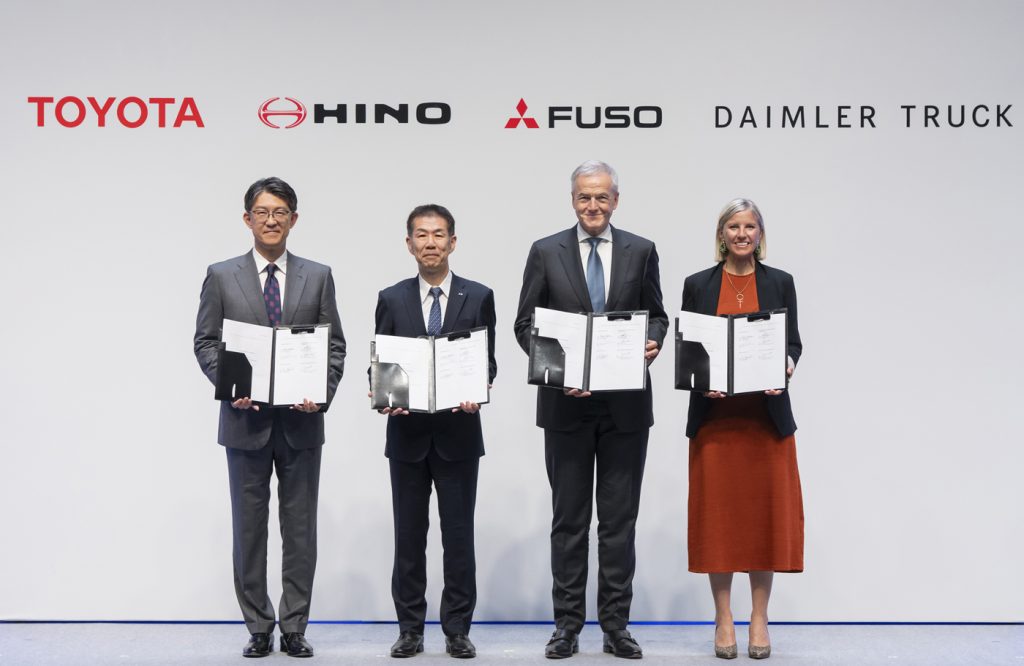
Pictured from left to right: Koji Sato, president and CEO, Toyota Motor Corporation; Satoshi Ogiso, president and CEO, Hino Motors; Karl Deppen, president and CEO, Mitsubishi Fuso Truck and Bus Corporation and designated CEO of the new holding company; and Karin Rรฅdstrรถm, CEO, Daimler Truck Holding.

Not a first

While this is not the first time the Japanese truck industry has seen consolidation โ€“ Isuzuโ€™s acquisition of UD Trucks was another landmark deal โ€“ the Hino-Fuso integration is notable for its scale and the backing of two of the worldโ€™s largest automotive groups.

The new company will have considerable technological, financial, and human resources at its disposal. If successful, the merger could become a model for future collaborations in an industry under immense pressure to transform.

That said, integrating two historic competitors will not be without its challenges. Cultural differences, overlapping product lines, and market-specific requirements will all need careful navigation. Additionally, customer confidence โ€“ particularly in regions like South Africa where both brands have strong legacies โ€“ will hinge on clear communication and consistent support.

In the short term, operations are likely to continue much as before, with Fuso and Hino maintaining their own identities. But over time, the combined force of two of Japanโ€™s most iconic truck brands could reshape competition, product innovation, and strategic direction in the global trucking sector.

Whether this merger results in genuine synergies or simply a larger entity facing the same challenges remains to be seen. What is certain is that the industry will be watching closely.

Published by

Focus on Transport

FOCUS on Transport and Logistics is the oldest and most respected transport and logistics publication in southern Africa.
Prev Indian CV giant rolls into Mzansi
Next ACT Expo 2025 maps the future of freight

Leave a comment

This site is protected by reCAPTCHA and the Google Privacy Policy and Terms of Service apply.