Crude awakening: the alchemy of black gold

Crude awakening: the alchemy of black gold

Crude oil, natureโ€™s hidden treasure, undergoes a remarkable transformation to become the fuel and materials powering our modern world.

Imagine a humble, dark liquid pulled from deep within the Earth โ€“ mysterious, dense, and seemingly simple. Yet, in the right hands, this “black gold” holds the power to fuel your car, light up cities, and shape the products that make modern life possible. This is where science meets alchemy and engineering takes on the role of a wizard, transforming crude oil into petrol, jet fuel, and the very materials that power our world.

WearCheck diagnostician Rivendren Wayne Moodley explains further. โ€œRefining crude oil is not just a process; it’s a carefully orchestrated mystical journey. Over millions of years, organic material decomposes and undergoes chemical transformation to produce crude oil โ€“ a unique blend of hydrocarbons, made up of alkanes and aromatics,โ€ he says.

Extracting crude oil begins with locating oil deposits deep beneath the Earthโ€™s surface. โ€œDeep wells are drilled into the underground reservoirs. Once the reservoir is accessed, bringing the oil to the surface is no straightforward task,โ€ Moodley continues. โ€œOil does not always flow freely: pressure within the reservoir helps push the oil up, but additional methods like pumps, water, or gas injection may be needed. Hydraulic fracturing (fracking) may also be employed, where water, sand, and chemicals are injected into the rock to fracture it and release trapped oil. The extraction process is highly technical, requiring precision and the right equipment.โ€

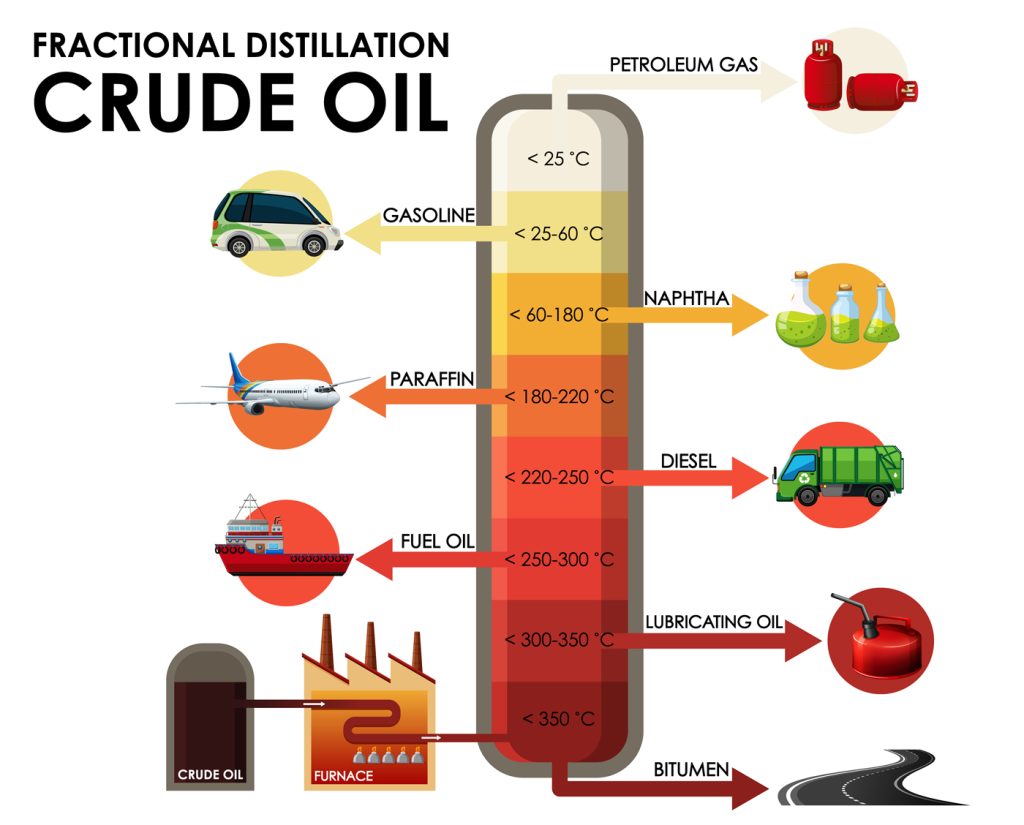
WearCheck diagnostician Rivendren Wayne Moodley discusses the processes involved in the refinery process, where crude oil undergoes fractional distillation in a distillation column after being extracted from underground wells, desalted, and preheated, before being transformed into other products.

Once extracted, the oil is refined, transforming it into usable products. It is then transported from well to refinery in tankers, trains, trucks, and even via underground pipelines. At the refinery, impurities are removed from the crude oil โ€“ particularly salt. โ€œThen it is preheated to reduce its viscosity, allowing it to flow easily through the refinery units without overheating,โ€ adds Moodley.

The distillation column โ€“ a tall, vertical structure containing a series of trays โ€“ is next. โ€œThe bottom of the column is heated to 350 to 450ยฐC, causing the crude oil to vaporise. As the vapour enters the fractionating column, it cools down,โ€ he notes.

Each hydrocarbon in the crude oil has a distinct boiling point, leading to condensation at different heights in a process known as fractional distillation. โ€œLighter fractions (methane, ethane) condense at the top, while heavier fractions (diesel, lubricating oils) condense lower down, where the temperature is higher,โ€ Moodley expands. โ€œSmall openings in the columnโ€™s trays allow the vapour to rise and condense back into liquid form at various levels. At each tray, a fraction is extracted and sent for further processing. These fractions include light gases (methane, ethane, propane), naphtha, kerosene, diesel, gas oils, and residuum.โ€

Once separated, many fractions undergo further refining โ€“ including cracking, reforming, coking, treating, and blending โ€“ to transform them into even more valuable fuels and petrochemical products and derivatives.

From crude oilโ€™s unrefined beginnings to the highly specialised products that fuel our world, Moodley emphasises that the refining process is an extraordinary feat of science and engineering. โ€œEach step plays a vital role in transforming something seemingly simple into the driving force of modern society,โ€ he says. โ€œSo, the next time you fill up your fuel tank, remember: youโ€™re not just pumping fuel; youโ€™re tapping into a process that spans millions of years and an ongoing journey that fuels our modern world.โ€

  • More information is available here.

Published by

Focus on Transport

FOCUS on Transport and Logistics is the oldest and most respected transport and logistics publication in southern Africa.
Prev Crafter 50: Power, safety, and space redefined
Next Sinotruk goes green

Leave a comment

This site is protected by reCAPTCHA and the Google Privacy Policy and Terms of Service apply.