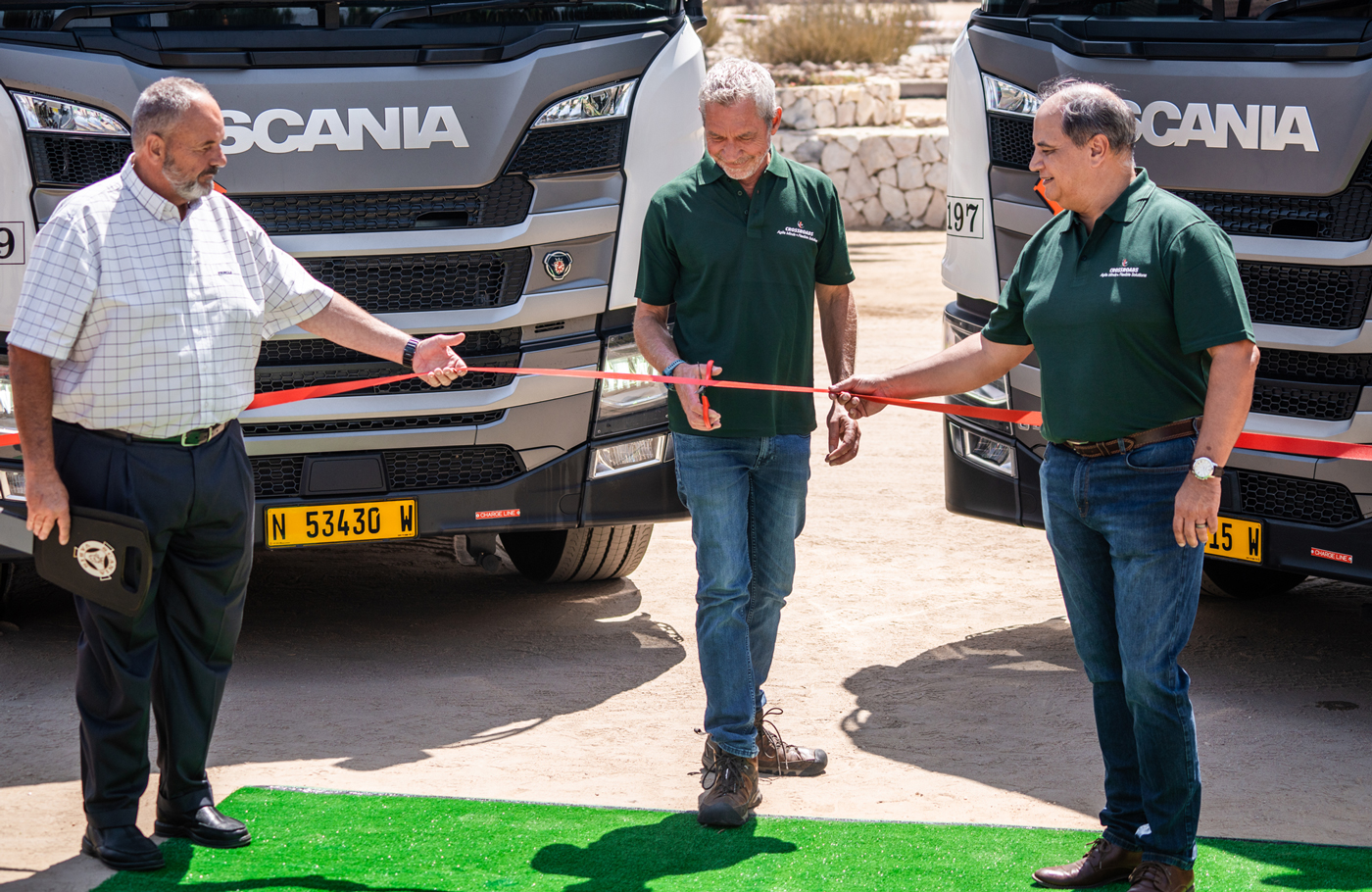
In line with the manufacturer’s core focus on sustainability and minimising the environmental impact of its operations, Scania is supplying new Euro 5 trucks to logistics provider Crossroads Namibia, helping the company to accelerate its carbon emission reduction process.
A majority-owned subsidiary of Midrand-based Crossroads Distribution, Crossroads Namibia shares Scania’s motivation to proactively implement wide-ranging environmental responsibility policies, including the imperative of reducing the carbon footprint of transport operations.
Scania continues to lead the way in the push for decarbonisation, having set science-based targets for this in 2020. These are part of the company’s corporate goals, and impact on investment decisions across all business areas. To track its sustainability performance, Scania has developed 18 sustainability indicators linked to the impact, risk, and lifecycle of its products. It was also the first heavy vehicle manufacturer to produce engines that met the EU’s emission standards, acquiring selective catalytic reduction (SCR) aftertreatment to comply with Euro 5 standards in 2005. When installed on diesel vehicles, SCR systems reduce harmful nitrous oxide emissions by injecting an automotive grade fluid through a specially designed catalyst into the exhaust stream of a diesel engine.
The seven Euro 5-certified Scania G450 6×4 trucks, delivered to Crossroads Namibia will primarily transport fuel throughout Namibia for Total Energy, continuing a long-standing relationship between Scania, Crossroads, and Total in the country. The trucks exemplify Scania’s environmental commitment. “Energy efficiency is a core priority for Scania, regardless of fuel type or energy source,” says Clifford Marchbank, Scania Namibia country manager. “Fuel consumption is an important factor for commercial vehicle customers, and improving our vehicles’ energy efficiency is vital in helping us to reduce our carbon impact.”
Marchbank says Scania is continuously looking at a sustainability agenda to become greener, including through electrification – but that diesel vehicles shouldn’t be discounted. “We don’t yet have the electrification infrastructure in this region, and it will take a bit longer here to make the move. We’re looking at hybrids as a more realistic option,” he notes. “Electrification offers huge benefits in cutting emissions, but we can do things right now to make a difference,” he continues. “Our trucks are very fuel efficient and with focused servicing, driver training, and better fuel usage we can start the process right away. Our Euro 5 trucks will provide significant reductions in the emissions produced during Crossroads Namibia’s operations.”
Johan Van Zyl, Crossroads Namibia depot manager, says the company’s focus on reducing its environmental impact is central to its operational plans. “We’re directly investing in changes to curtail our carbon footprint and make a meaningful contribution in this regard,” he elaborates.
“The transport sector is a major source of carbon emissions, and we should therefore lead by example to play a key role in this transition,” Van Zyl continues.
“The new Scania trucks are equipped with advanced emissions control technologies that significantly reduce pollutant emissions into the atmosphere compared to older models.”
This emphasis makes Scania the ideal partner: while Southern African countries still only require vehicles to meet Euro 2 standards, the introduction of Scania’s Euro 5 trucks is a clear statement of intent by both the manufacturer and its client.