Port of Durban
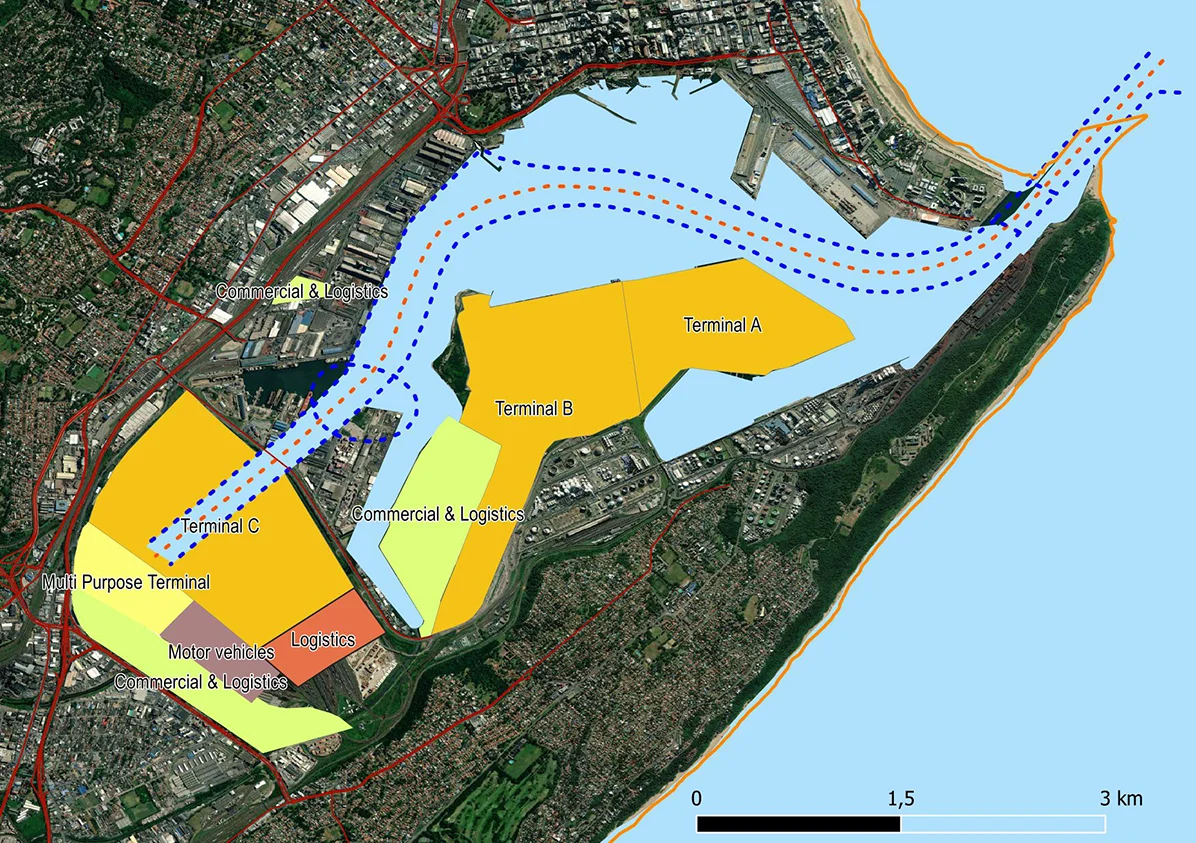
The “recovery” of the Port of Durban is currently being refinanced and rebuilt on outdated, inefficient systems and spatial layouts. For future efficiency, the interrupted port development should follow the logical process proposed in 2012: clear the naval presence and expand Terminal A (Pier 1) onto the “Island”.
Infill basins and deepen berths using the technique deployed at Point multi-purpose terminal (MPT), with materials delivered by water and construction conducted on site. Once the site is geologically stabilised, progressively build a new, modern, efficient gantry-based terminal (for example, Melbourne’s R20-billion fully automated terminal for one million containers per year). This must include upgraded roadway and rail connections, as well as extensive reorganisation of signage and traffic flow systems. Terminal B (Pier 2) should eventually be replanned to the same standard.
Development must also include restarting Terminal 3 in the vacant railway yard between the dry dock and Solomon Mahlangu Road, as planned in 2012. This cuts off Bayhead Road and creates a basin with seven to nine berths to serve Container Terminal C (also gantry-based) on the south side, and a new MPT and automotive/abnormal load terminal on the north side.
All of this port restructuring requires internationally experienced developers to ensure terminals are commercially efficient, sustainable, and economically viable.
City streets
Cutting off Bayhead Road will require the double-decking of Solomon Mahlangu Road, with commuter traffic on the upper level and heavy commercial vehicles at ground level. This will likely include repurposing existing properties to support logistics – for example, relocating the eThekwini Market to Duffs Road and moving railway engineering to Masons Mill – to make space for modern container and general cargo depots. These changes will consolidate the currently dispersed 100 hectares of container depots spread over a 20-km radius.
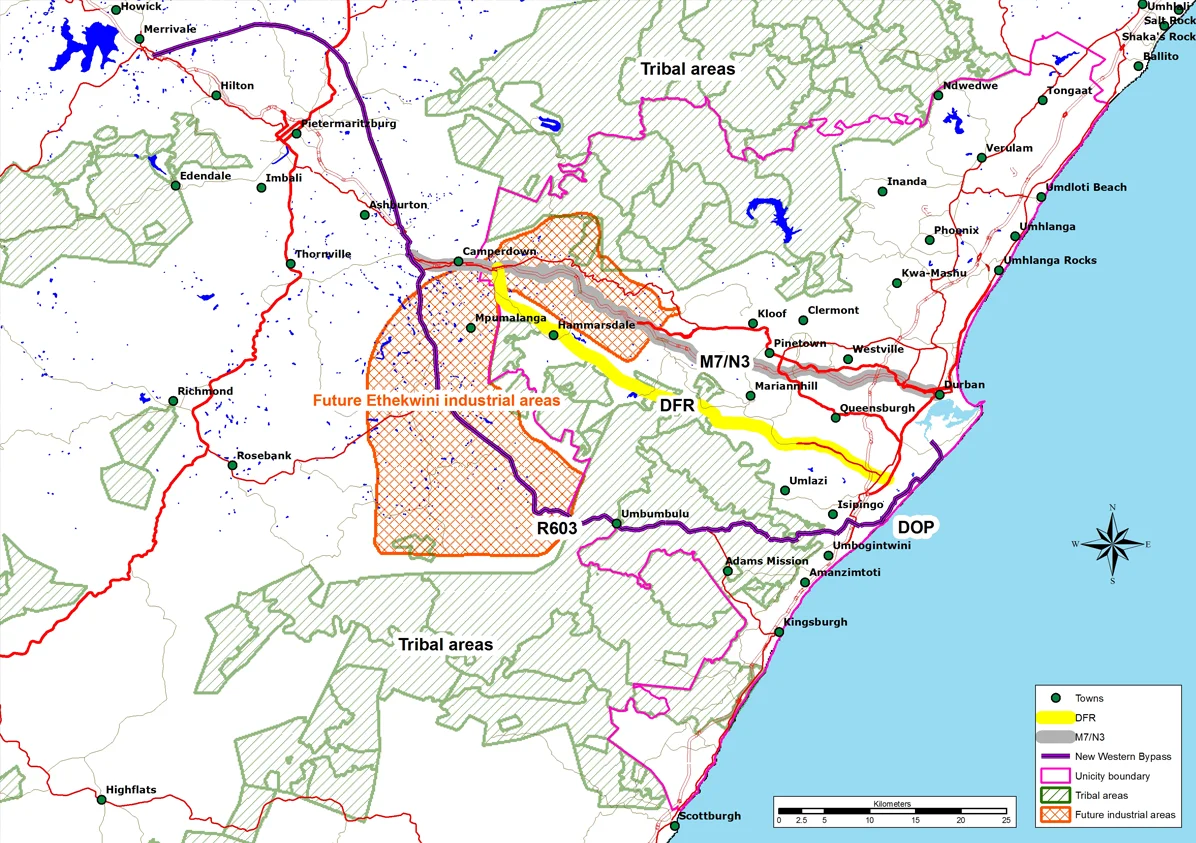
It will also be necessary to plan for trucking facilities on currently unused railway land. In Maydon Wharf, spatial redesign should enable more efficient freight load points and consider double-decking roads or rail to separate freight from commuter traffic. The broader replanning will reduce congestion on Margaret Mncadi Avenue and allow eThekwini Metro to develop the Point Waterfront into a tourist and entertainment hub.
Coordination
As these developments will span many years, it is essential to appoint or establish an overarching entity with clear authority to implement a plan jointly agreed by government, eThekwini Metro, Transnet, and the industrial sector – who will ultimately be the users. Establishing competitive terminals run by private operators will improve port efficiency, attract throughput, and reduce the state’s need for continual bailouts.
Success will hinge on private investors seeing clear potential for ownership and profitable operation; plans burdened with excessive bureaucracy or caveats will discourage engagement. The port’s operation should also be aligned with the National Ports Act No.12 of 2005 by establishing a local representative board.
The entire programme must be managed by an organisation with the experience and financial capacity to assume full oversight and eliminate inefficiencies. Many such port developers exist worldwide, as seen in Maputo, Dar es Salaam, Walvis Bay, Tanger Med, Melbourne, and elsewhere.
Preparation
A critical first step is addressing the serious shortage of appropriate skills and low productivity in the area. With a population mix of 51% black African, 25% Indian/Asian, 15.3% white, and 8.6% of mixed racial descent, eThekwini has significant educational and training potential. The province must prioritise establishing training institutions led by internationally qualified lecturers using modern materials.
Without the infrastructure to train future workers, progress will stall. There are gaps at every level – from journeymen to managers – and international specialists will be required in fields such as systems development, database management, statistical analysis, robotics, AI, and advanced machinery maintenance. The focus must be on delivering job-ready training, not more certificates or degrees with no employment outcome.
- Illustrations: Geosys; NP&A 2025