Durban’s economic future is inseparable from the fortunes of its port. As ageing infrastructure, mounting congestion and outdated logistics systems place growing pressure on trade, NICK PORÉE warns that long-term investment and integrated planning are becoming increasingly urgent.
eThekwini and the Port of Durban have suffered from the same prolonged decline in maintenance, management and modernisation that has characterised much of South Africa’s public infrastructure over the past four decades. Like many state assets, they continue to rely heavily on development undertaken in the 50 years following the Second World War. As economic growth has slowed, infrastructure has steadily deteriorated, contributing to South Africa’s poor GDP growth performance relative to the rest of Africa.
The past and future of Durban are closely tied to the port. It remains South Africa’s key maritime link to the country’s industrial heartland and the landlocked states of the interior. The future development and modernisation of the port are therefore essential for economic growth, not only for South Africa but also for the North-South Inland Corridor and the Durban-Pietermaritzburg industrial region. Together, these form the core of KwaZulu-Natal’s manufacturing, logistics and employment base.
Planning failures and fragmented development
Historically, port planning by the national port authority has largely been shaped by corporate interests. Port efficiency continues to be constrained by outdated layouts and cargo handling systems inherited from the former railway monopoly. Expansion is further restricted by large tracts of underutilised railway land.
Current planning also fails to address serious long-term constraints on port expansion. These include fragmented planning between government departments and even within state-owned entities (SOEs) themselves. Port, rail and metro development plans are not integrated into a cohesive long-term strategy. The current Point Waterfront reclamation proposals, for example, conflict with both eThekwini planning objectives and port operational requirements while introducing additional traffic complications.
There is an urgent need for an overarching planning structure capable of aligning the objectives of a modern 30-year port strategy with metropolitan development and efficient freight movement by road and rail. Such integration will be critical if South Africa is to benefit fully from the African Continental Free Trade Area (AfCFTA).
Modernising container infrastructure
One of the most pressing priorities is the redevelopment of Durban’s container handling infrastructure and associated logistics systems. Existing layouts, roads and handling operations were designed more than 50 years ago and require substantial redesign and upgrading to meet modern international standards.
Major modernisation programmes at several ports around the world, including Melbourne, Tanger-Med and Walvis Bay, provide useful reference points. Durban has similar opportunities through a coordinated public-private partnership (PPP) approach.
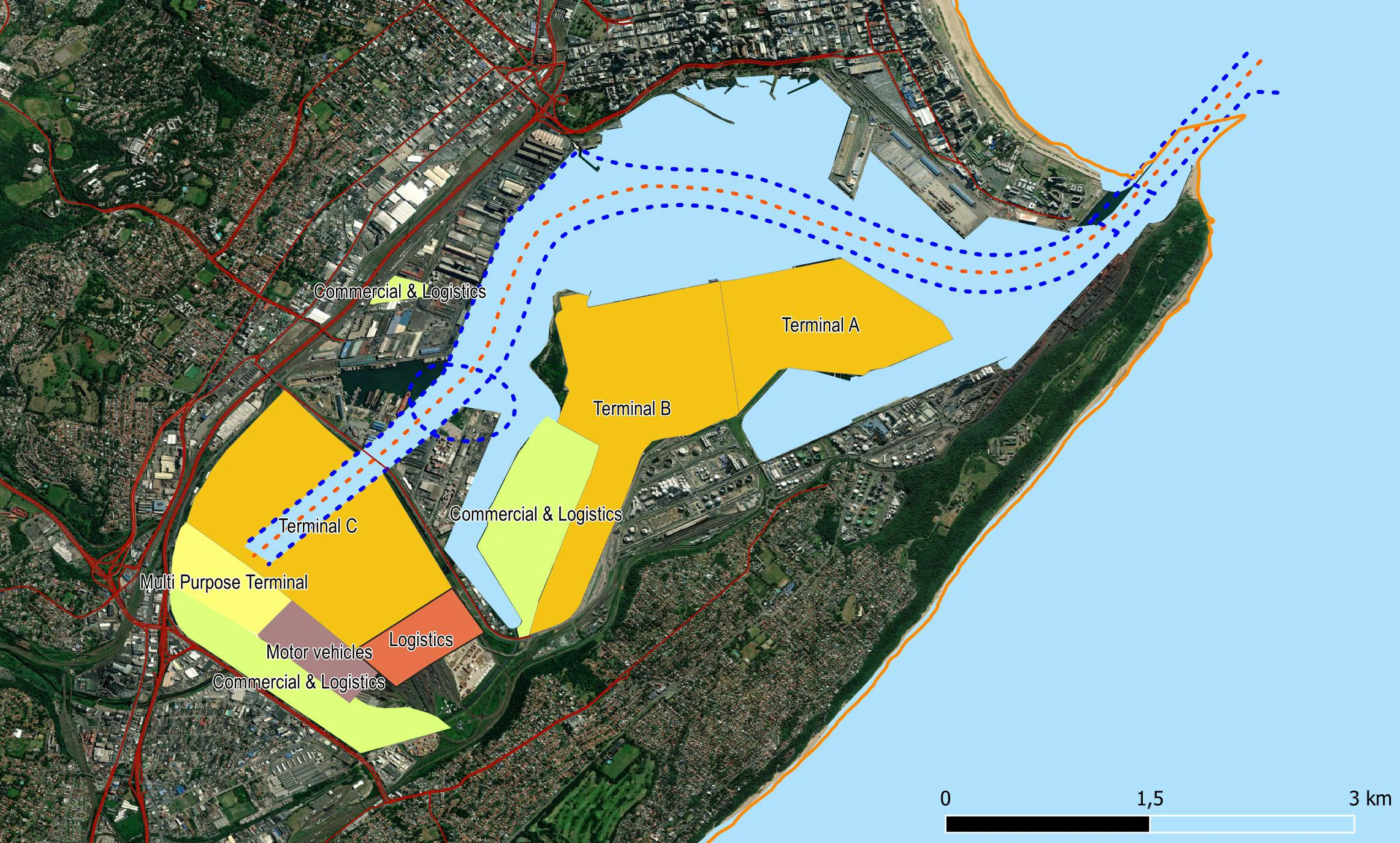
A potential development option would involve using the vacant Salisbury Island naval property as the base for expansion. Engineering works supplied by barges could support berth deepening and the construction of a new gantry-equipped container terminal integrated with the current Pier 1 to form a new Terminal A, similar to redevelopment processes undertaken at the Port of Melbourne.
This development should be coordinated with the alignment, berth deepening and expansion of Pier 2. At the same time, a third PPP terminal could be developed in the Bayhead area, in line with earlier Portnet proposals from 2012.
Freight access under growing pressure
Alongside terminal expansion, Durban’s freight access routes will require major redesign. The current route via Mariannhill Toll Plaza, the M4 and Bayhead Road is already frequently congested despite stagnant economic growth. It will not be capable of supporting the freight volumes associated with long-term port expansion.
The Bayhead precinct accommodates three major terminal complexes handling containers, chemicals and fuels, as well as bulk minerals. Most of these operations depend heavily on road haulage because they manage less-than-trainload breakbulk cargoes.
While fuel distribution can increasingly be shifted to pipelines linked to storage facilities at the former refinery site in Prospecton, substantial road freight demand will remain. Existing rail infrastructure is also inadequate for efficient shuttle services moving import containers to proposed container depots at the former Durban airport site.
A long-term transport solution
The proposed long-term solution is the construction of a freeway-standard access corridor linking the N3 at Umlaas Road with Bayhead via the South Durban Basin.
The route would follow the alignment of the R613 provincial road through Prospecton, before passing the former refinery and continuing through tunnels beneath the Bluff to Bayhead Road. Beyond improving freight efficiency, the corridor would strengthen the position of a future Eston-Mid Illovo-Thornville-Cato Ridge industrial zone with direct port access and links to the interior through a future Pietermaritzburg N3 bypass.
The proposed Bluff tunnels should also include parallel rail lines to support container shuttle services between Bayhead terminals and the former airport site. This site could then be developed into a large private-sector container depot hub equipped with gantry infrastructure, allowing more efficient road and rail distribution within the metro, across KwaZulu-Natal and along the North-South Corridor.
Implementing these road access solutions would require extending the authority of the South African National Roads Agency to include strategic port access routes. Given the scale of investment required over the next 30 years, it would be unrealistic to expect eThekwini ratepayers to fund these projects alone.
Governance will determine success
For these developments to proceed, it will be necessary to fully implement the provisions of the National Ports Act of 2005 – particularly those relating to the establishment of a port management structure that integrates the interests of the port authority, users, provincial government, eThekwini Metro and other stakeholders. A dedicated Special Purpose Vehicle would be required to coordinate planning, funding and oversight of phased development over the coming decades.
Durban’s future competitiveness will depend on whether government and industry can move beyond fragmented planning and commit to an integrated long-term strategy. Without decisive intervention, the city risks losing its position as Southern Africa’s leading trade gateway. With coordinated investment and governance reform, however, Durban could once again become a globally competitive port city and a major driver of South African economic growth.