Defence, decarbonisation and disruption
Defence, decarbonisation and disruption
A record 600 delegates made their way to Amsterdam for the 2025 ECG Conference, confirming its status as the biggest annual meeting point for Europe’s finished vehicle logistics (FVL) sector. CHARLEEN CLARKE joined them – and she reports that the industry is being squeezed on every axis…
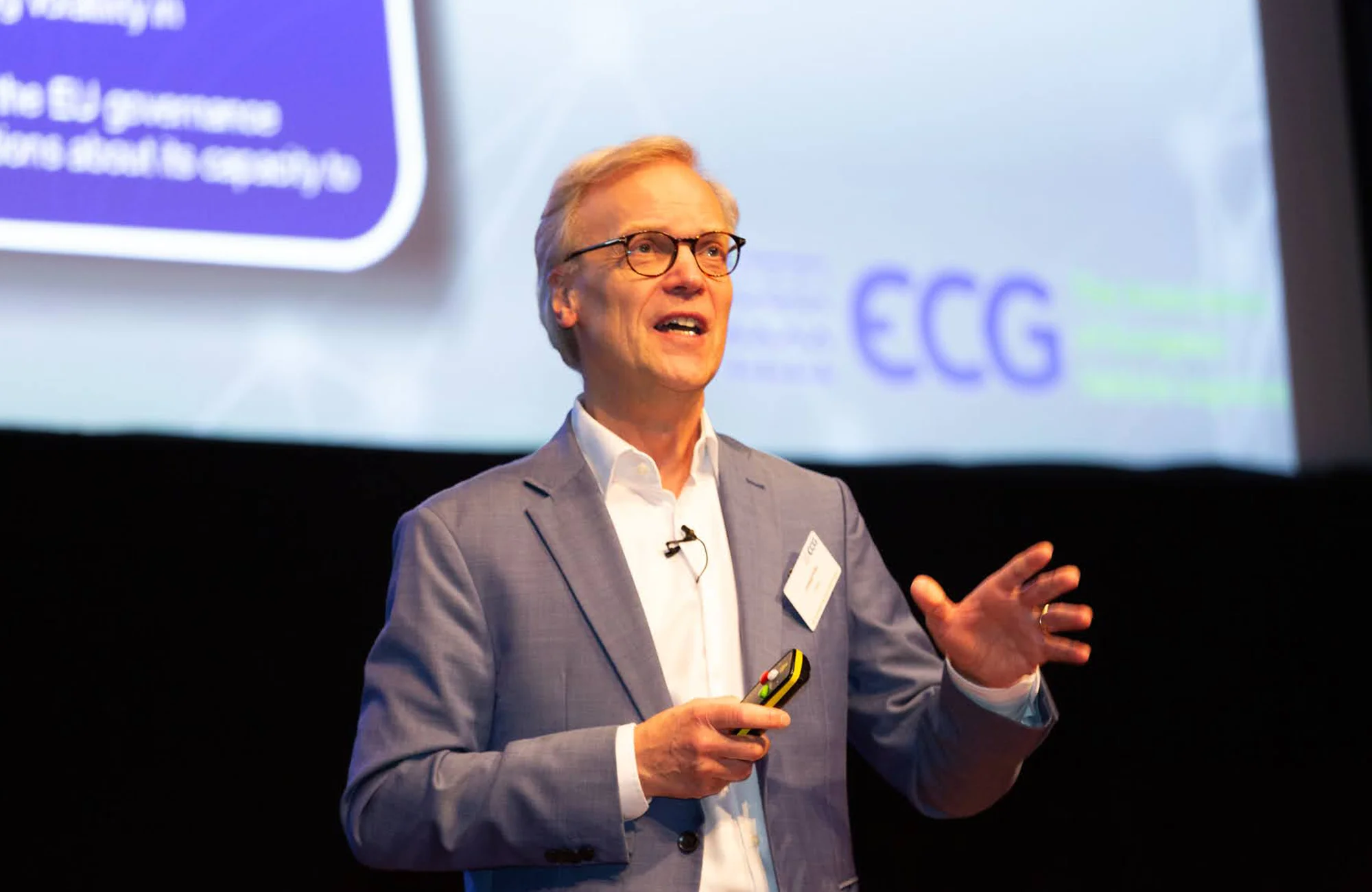
ECG president Wolfgang Göbel opened the conference, noting that the market is flat. Spain and Poland are showing some growth, he said, but across the rest of Europe “there are no big developments foreseen,” and the outlook is “not promising”.
This is not just a cyclical lull. Göbel pointed to the Draghi Report, which argues that Europe has become structurally uncompetitive: high energy costs, slow decision-making and exposure to geopolitical instability now collide with fierce import competition. Europe cannot assume others will secure its energy, its industrial base, or even its physical security any longer. The report sets out three imperatives: close the innovation gap and increase efficiency; plan decarbonisation in a way that protects competitiveness; and reduce dependency, especially on external powers for critical inputs.
There is a profound tension, however, in how that plays out in finished vehicle logistics. More than 80% of companies in the sector say they are willing to invest in greener technology. Yet only 18% of their customers are prepared to pay for greener transport. Göbel showed data from ECG’s Costs & Confidence Trends Survey: the industry is still ready to invest in new trucks – including lower-emission assets – but shippers remain reluctant to fund the step-change in cost that true decarbonisation requires. The result is an expectations gap: regulators and OEMs demand lower CO₂; logistics providers are told to “make it happen”; customers won’t pay the premium.
Göbel positioned ECG as a facilitator rather than a bystander, noting that it is pushing hard on three intertwined fronts: innovation and efficiency; decarbonisation; and resilience and security. That includes a tech board to accelerate uptake of proven digital tools; a Rail Initiative to tackle rail bottlenecks and reliability; and joint work on eInvoicing standards in FVL so that basic processes stop wasting time and capital.
Two sustainability deliverables stood out. First, ECG
is coordinating a common emissions calculation methodology for the sector. Göbel described it as “one methodology to calculate and report on emissions in the industry… same method / same dataset / same routing model.” Version 2 of the guideline is due shortly, following multiple pilots. Second, ECG is developing a dynamic “Green Cost Calculator” to bring transparency to the true cost base of low-emission road transport, with the explicit goal of accelerating e-truck adoption. That tool still needs sponsors. Current tools, he warned, are static rather than dynamic, and not externally validated, which makes them unusable in long-term contracts.
Security is now an automotive topic
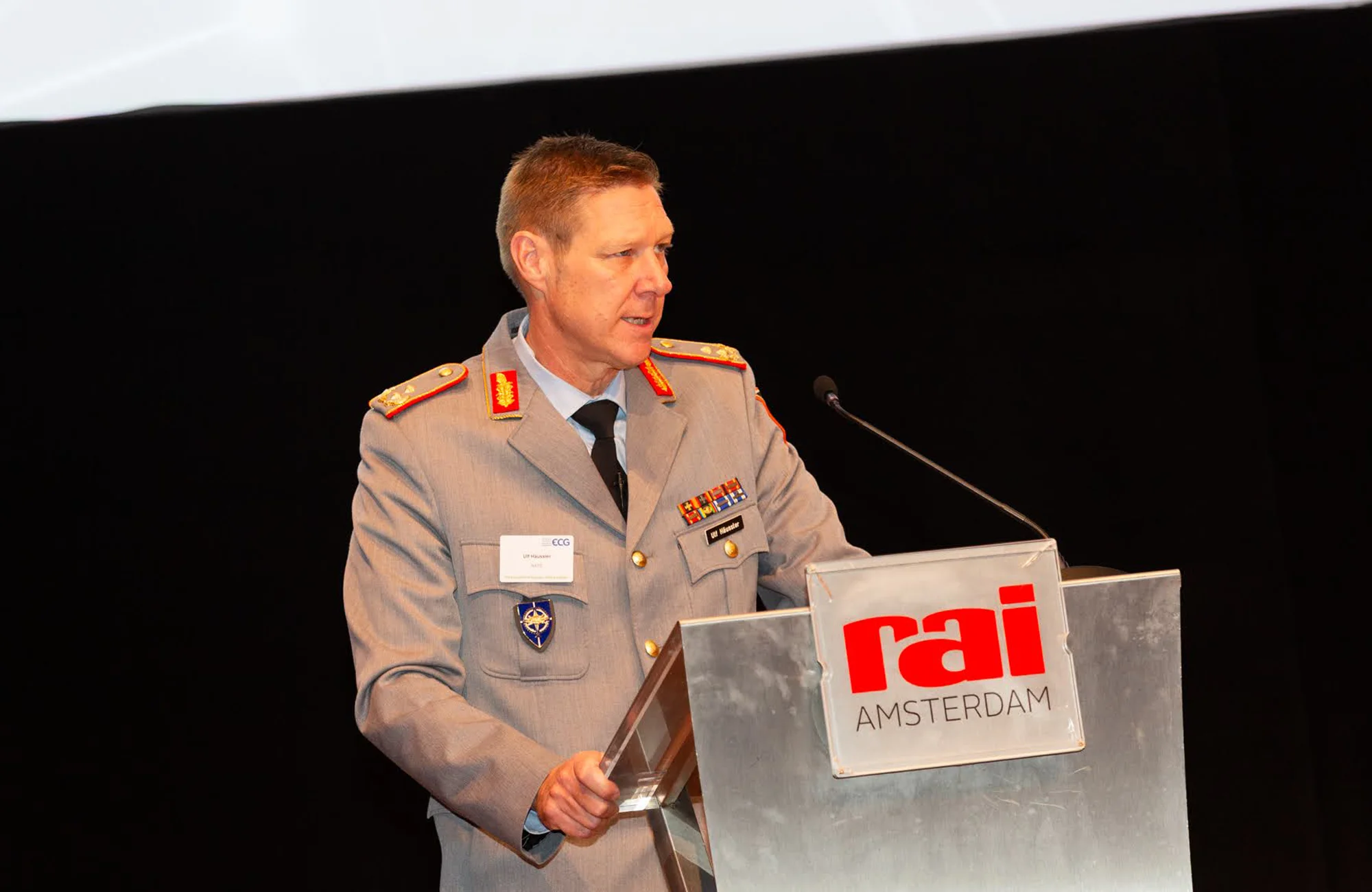
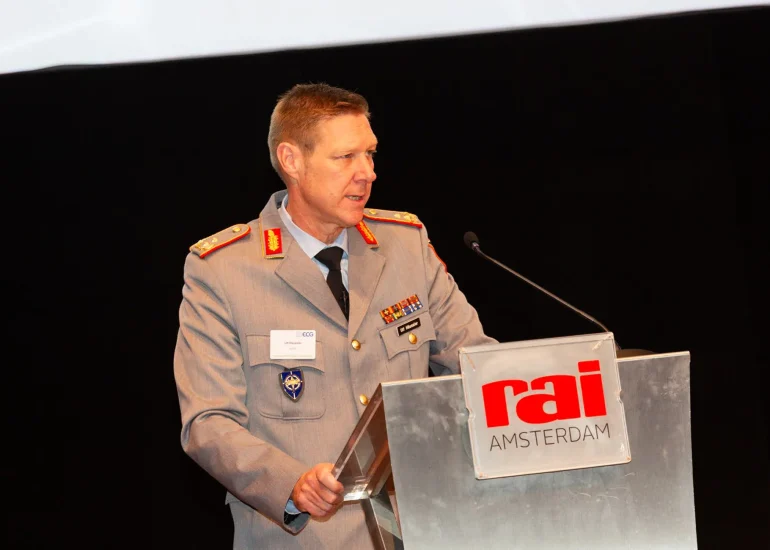
If Göbel’s message was that Europe’s competitiveness is under strain, Major General Ulf Häussler’s message was that Europe’s security is under strain – and that logistics is vital to NATO.
Häussler, director of the Operations and Planning Division at NATO Headquarters, underscored that NATO is currently carrying out the greatest modernisation of its deterrence and defence systems since the end of the Cold War. NATO today is responsible for protecting one billion citizens, and it is spending accordingly: allies have committed to invest 5% of GDP in defence and security-related planning, infrastructure, mobility and resilience. That is not a theoretical number; he described hundreds of thousands of forces now kept at high readiness, and exercises involving 90,000 troops, 50 ships and more than 80 aircraft to practice rapid reinforcement across Europe. NATO, he said, “is stronger and readier than it’s ever been”.
Russia remains the most significant and direct threat to Allied security, he said, but terror groups must not be underestimated. Ukraine, in his words, is “fighting for freedom every day” and demonstrating what deterrence and sovereignty mean in practical terms. The alliance’s job is to ensure credible deterrence – which he defined as the ability to show capability and impose unacceptable cost on any adversary – at all times, on land, sea, air, cyber and space.
Why does this matter to an automotive logistics audience? Because deterrence is not just tanks and missiles. Häussler laid out, in strikingly operational terms, the logistical backbone required to “defend every inch of allied territory all the time”: resilient ports, rail corridors, customs procedures that don’t snarl troop movements, harmonised national and NATO plans, and a supply chain able to surge capacity under stress. He was explicit that this cannot be delivered by the military alone. It demands “a whole-of-society and whole-of-government effort”, which includes civilian transport providers, compound operators, terminal managers and shipping lines.
This was a new kind of message for an ECG main stage, and it landed. Häussler closed by saying there are still “a lot of challenges, but also opportunities for all of us in the room”.




A market on the brink of reshaping
If NATO is reconfiguring physical Europe, Chinese OEMs are reconfiguring commercial Europe.
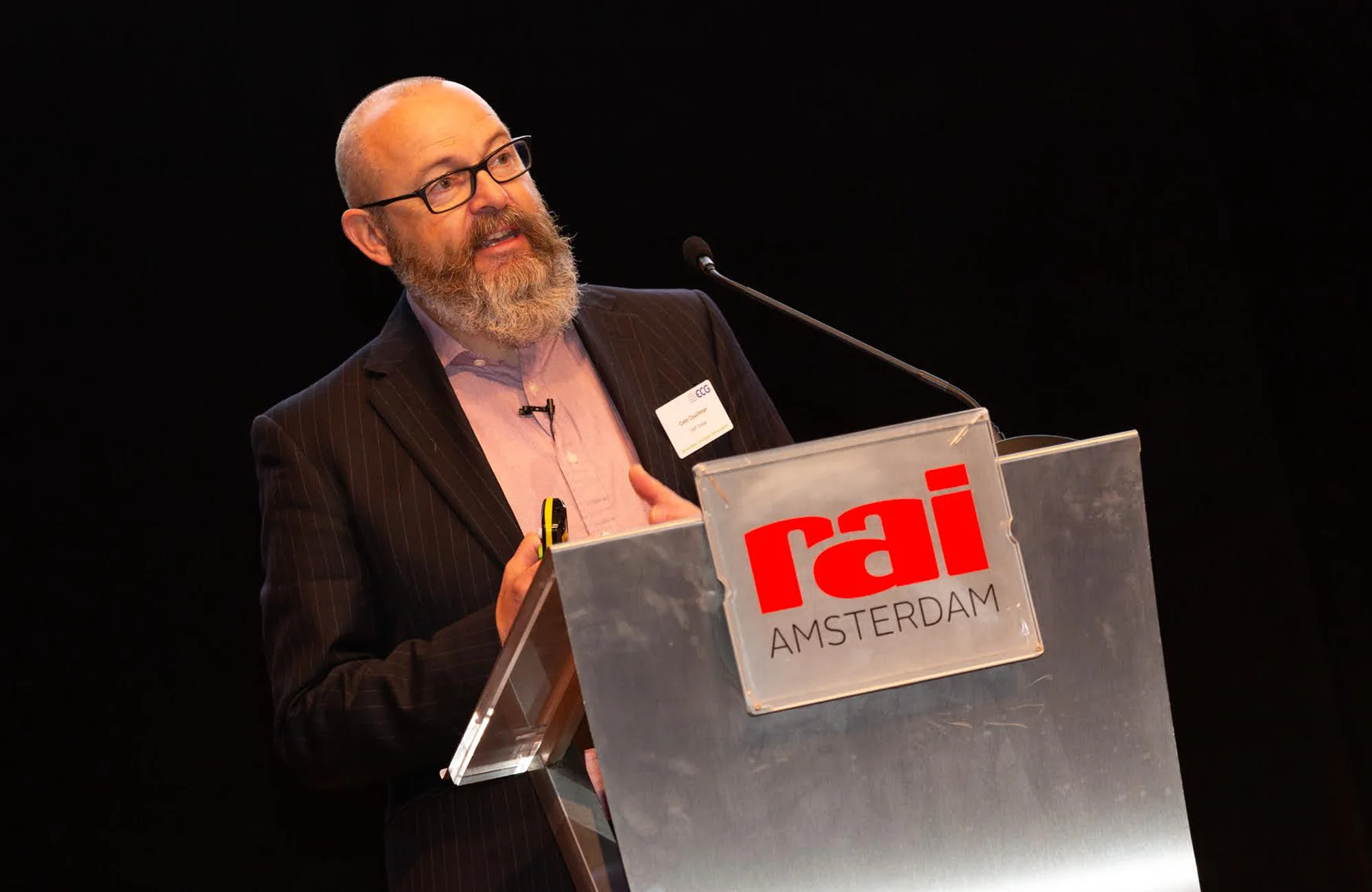
Colin Couchman, executive director of global light vehicle sales forecast at S&P Global Mobility, unpacked a global demand picture that is both fragmented and brutally competitive. Global economic conditions remain challenging and are eroding consumer spending. Geopolitical developments – including higher tariffs and reshoring policies in the US – are reshaping trade flows. Stricter emissions rules are still coming, even as affordability deteriorates.
The centre of gravity in growth has shifted decisively. Over the next decade, Couchman expects 84% of all incremental light vehicle volume growth to come from Asia-Pacific, led by India, ASEAN and South America. Mature Western markets – Western Europe, North America, Japan/Korea – are effectively saturated. Europe’s traditional export-led model is under attack from several directions at once: the loss of Russia as a volume outlet; US tariffs that limit transatlantic flexibility; and an accelerating wave of highly competitive Chinese entrants.
There are now roughly 150 Chinese brands, Couchman noted, and they can “launch into Europe really quickly”. Chinese manufacturers are not only exporting directly into Europe (often at aggressive price points, especially on electrified models); they are also localising at “China speed”. BYD, for example, is scaling capacity in markets such as Hungary, Brazil and Turkey, often announcing plants with capacities in the tens or hundreds of thousands of units per annum and targeting utilisation rates above 70% within a few years. This localisation bluntly undercuts tariff defences and brings Chinese brands physically inside the European production footprint.
European OEMs, Couchman said, now face a “perfect storm”: US tariffs, Chinese competitive pressure, CO₂ reduction requirements, and the “sorry tale” of losing Russia as a market and as an industrial buffer. On top of that, European buyers are not moving to full battery-electric fast enough to hit Brussels’ timelines – and, where they do buy electric vehicles (EVs), many are eyeing attractively priced Chinese battery-electrics, plug-in hybrids (PHEVs) and range-extended hybrids.
Skoda: freedom of choice is vital
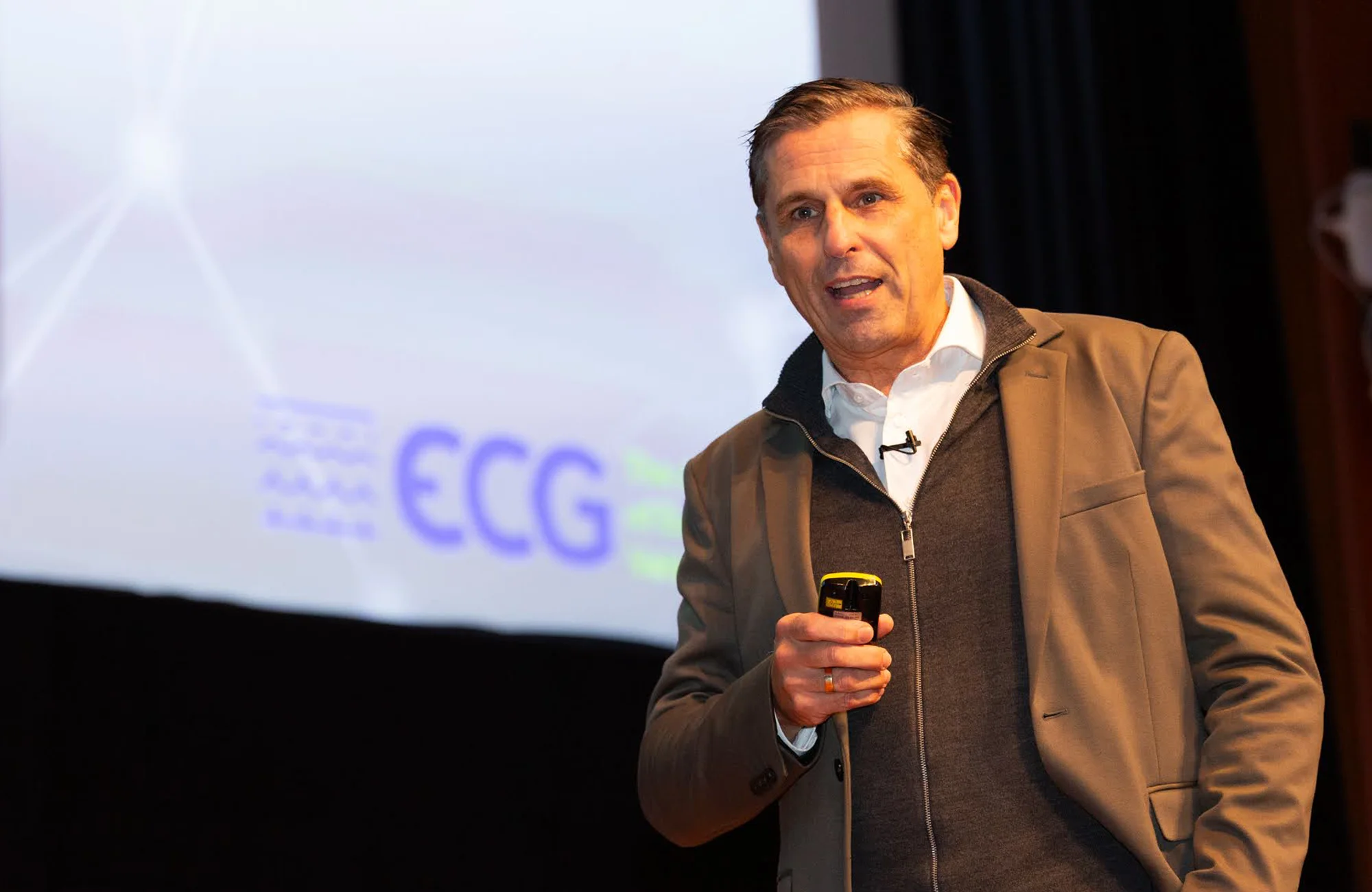
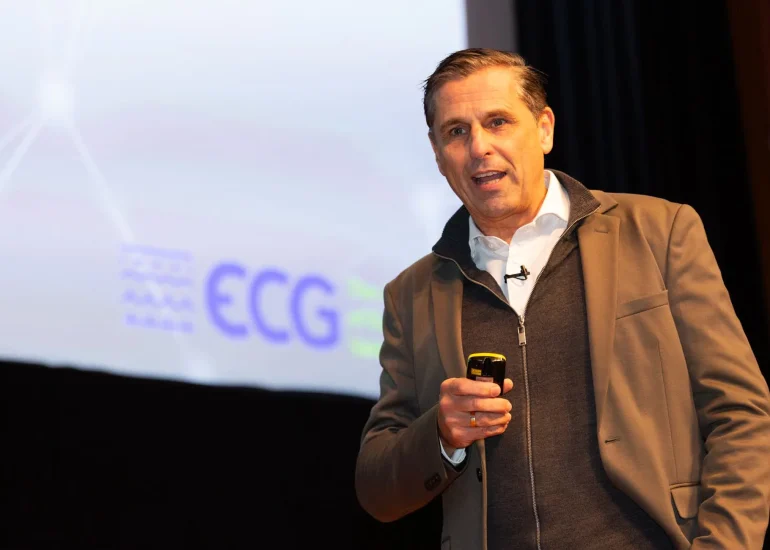
Klaus Zellmer, CEO of Škoda Auto, picked up that thread. Škoda’s strategy, he said, is “freedom of choice while complying with EU CO₂ regulation”. In practice, that means expanding its all-electric portfolio, launching further improved PHEVs and mild hybrids, and continuing to offer highly efficient internal combustion engine (ICE) models. He openly opposes a blanket requirement to register only electric cars by 2035, calling it politically simplistic and commercially dangerous. Many German politicians, he argued, “have not understood anything”, because in the end consumers – not policymakers – decide what to buy, and voters vote with their wallets.
Zellmer set out the structural problem: Europe has imposed the most ambitious regulatory timeline in the world. The EU has a hard 2035 ICE stop; China, the US, India and Japan do not. Yet Europe is nowhere near the conditions that enabled Norway’s ultra-fast EV adoption curve. In Norway, VAT exemptions on EVs, punitive taxes on ICE registrations, cheap electricity and dense charging infrastructure made full electrification socially and economically attractive. Replicating that across 27 EU states plus associated markets is, in his view, unrealistic without similar fiscal firepower and infrastructure. Today, for example, electricity in Germany costs roughly 2.7 times what it costs in Norway, which flips the total cost of ownership equation for many buyers.
At the same time, Zellmer said, batteries still represent about 37% of the total production cost of a fully electric vehicle. That drags BEV margins down towards break-even compared with ICE vehicles – a structural profitability gap that Škoda is attacking with brutal internal cost discipline. The company has carved over €1 billion out of its cost base through efficiency measures, automation and AI, and is targeting even more.
And yet, despite those headwinds, Škoda is performing. Sales revenue in H1 2025 hit €15bn and operating profit €1.28bn, while global sales were up 13.6% year-on-year to more than 509,000 vehicles in the first eight months of 2025. Škoda is now the number three brand in Europe by sales, behind only Volkswagen and Toyota – a remarkable rise, given it was outside the top 12 as recently as 2020.
But Zellmer was not complacent. Chinese brands already hold about 5.1% share in Europe and are building plants inside the EU and its near neighbourhood. That localisation could push Chinese share into the mid-teens by 2030. Zellmer showed maps of Chinese production footprints planned or under construction in places like Hungary, Spain, Poland and Austria, mirroring the pattern that Japanese and Korean OEMs followed in previous decades. “I’m not worried about competition,” he said. “We just have to get better. We have to get leaner, more efficient, more innovative, better quality and offer a better customer experience.”

This was his closing four-point prescription for European carmakers:
- Embrace competition: don’t whinge about Chinese entrants; out-execute them on brand, service and customer-centricity.
- Decouple and localise: “local for local” supply chains; resilience against regulatory shocks; less dependence on any single export market.
- Speed to market: cut complexity, shorten lifecycles, move more like China’s “996” engineering culture.
- De-bureaucratise Europe: stop loading industry with new rules “like a footballer playing with a backpack full of rocks”.
China’s outbound machine
Chris Zuo, executive vice president of the China Automotive Logistics Association (CALA), added a fascinating Chinese logistics perspective. China’s domestic vehicle market is enormous, electrified and fast-moving. New energy vehicle sales (BEV, PHCV and range-extended) have climbed sharply, with domestic brands now accounting for well over 30% of the market – reaching 70% in some recent months – thanks to relentless product refresh, AI-enabled features and aggressive pricing.
The export machine is scaling just as fast. Chinese automotive exports have surged from well under a million units per year a decade ago to multiple millions today, with key destinations including Mexico, the UAE, Russia, Brazil, Belgium, Saudi Arabia and the UK. Europe is firmly on the map, with Zeebrugge, Bremerhaven, Barcelona, Southampton and Amsterdam all now acting as dedicated gateways for Chinese brands. Amsterdam, in particular, is positioning itself as an “Electric Vehicle Conversion Centre” and a European headquarters location for Chinese automakers.
What’s striking is that China is solving its own outbound bottlenecks in-house. The number of Chinese-owned ro-ro (roll-on/roll-off) vessels has exploded from 11 in 2021 to an expected 61 in 2025, and total Chinese ro-ro parking capacity is forecast to grow from 48,000 spaces to 365,000 over the same period. In other words, China is no longer waiting for Western or Japanese pure car and truck carrier (PCTC) operators to move its metal; it is building its own fleet at speed.
At the same time, rail is being deployed as a strategic pressure valve. Dedicated China–Europe block trains for finished vehicles are now moving BYD cars to Germany with around 40% shorter transit times than sea freight, and even double-deck wagon solutions have appeared for commercial vehicles. Priority allocation of empty containers, customs streamlining and “one-stop” handling packages are being baked in. This is a logistics model designed for resilience, flexibility and political optionality: if a sea lane gets disrupted, trains roll.
For European logistics providers, the takeaway is uncomfortable: you are not just competing with Chinese car brands, but with an increasingly vertically-integrated Chinese export logistics ecosystem that is already building capacity in Europe.
Policy, lobbying and the rulebook problem
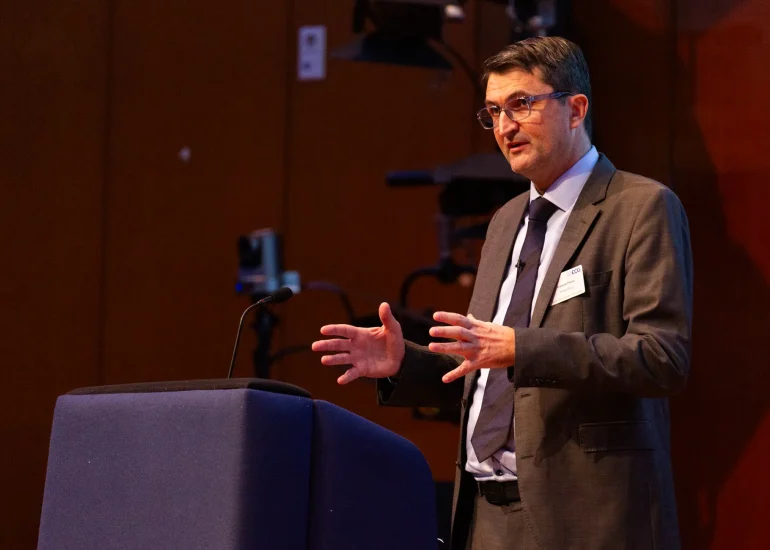
This leads directly to the political layer, addressed by Christof Klitz, special advisor on transport policy at Finsbury Integrated Public Relations and Affairs (FIPRA). Klitz argued that Europe is in the middle of a geopolitical reinvention. The EU has shifted from a purely “green transition” narrative to something broader: strategic autonomy, industrial sovereignty and security of supply. But that shift is messy, politically fragmented and urgently contested.
On paper, Brussels is trying to help. The new Clean Industrial Deal (CID), published in February 2025, is pitched as a reset of the Green Deal to support decarbonisation without sacrificing competitiveness. Its sector-specific spin-out – the Action Plan for the European Automotive Sector (March 2025) – promises an Alliance for Connected & Autonomous Vehicles, €1.8bn to secure battery raw materials, a “Small Affordable Car” initiative, and a regulatory simplification package for automotive. Clean Corporate Fleets, due by the end of 2025, will replace the Clean Vehicles Directive and aims to push corporate fleets to zero-emission.
But industry has pushed back on how. The fleets proposal, in particular, has drawn criticism of top-down quotas. Operators and shippers say they need standardised emissions reporting, predictable fiscal incentives (capex support, accelerated depreciation and CO₂-differentiated tolls) and infrastructure funding – not yet another compliance stick layered on top of many others.
For finished vehicle logistics, one regulatory file is especially tangible: the Weights and Dimensions Directive. The Commission and Parliament both support allowing loaded open car transporters to exceed current maximum lengths up to 20.75m using authorised (including extendable) load supports. That change sounds technical, but it is directly linked to efficiency, network utilisation and emissions per unit moved. Member states are split – Nordics, Italy, Belgium, Germany and the Netherlands are seen as progressive; France and Bulgaria more conservative – and final agreement will hinge on Council negotiations.
In Brussels right now, “cut the red tape” is no longer an industry talking point; it has become a political slogan. Göbel echoed this in Amsterdam, noting that ECG has been publicly calling for simplification since at least March 2025, and that the Commission’s Omnibus Package – meant to streamline sustainability reporting, due diligence, investment and defence requirements – is moving too slowly.

Volkswagen: autonomy in the yard
Peter Hördlein, managing director vehicle logistics at Volkswagen Konzernlogistik, brought things back to the ground – quite literally – with a look at what automation in compounds and terminals might actually look like when it’s not just a glossy concept.
Volkswagen’s AutoLog project is testing automated driving for finished vehicle movements in logistics areas such as factories, ports and distribution yards. The objective is not robo-taxis; it’s automated shunting, parking and marshalling of finished vehicles, controlled by intelligent infrastructure over public 5G networks. The business drivers are familiar to every yard manager: volatile volumes, emissions targets, labour shortages, limited space and the need for far more flexible process control.
Here’s how it works: instead of putting full autonomy in every vehicle, AutoLog uses an infrastructure-led model. LiDAR poles and cameras create a live 3D digital twin of the yard. A cloud-based marshalling system (developed with partners including Telekom and Unikie) calculates safe paths and transmits “driving missions” to vehicles over an optimised 5G network. The vehicles then move driverlessly to where they’re needed – loading bays, parking lanes and handover zones. That central brain means processes can be redesigned around space efficiency and flow, not human walking distance or shift patterns.
The test field at Volkswagen’s Emden vehicle yard has been live since June 2025, and in September 2025 the project hit a major milestone: full dynamic testing in a highly frequented roundabout, with 17 poles, 25 LiDAR sensors and prototype vehicles under real complexity. The ambition is clear: standardise the interfaces (including alignment with ISO 23374-1 and VW’s internal IT ecosystem), then scale the model from yards to depots and last-mile hubs. The target benefits are lower cost, higher utilisation of scarce space, lower dwell penalties and new value for end customers through faster, cleaner handovers.
In other words, this is cost-out, capacity-up, decarb-enabling automation – exactly the cocktail Göbel said the sector needs.
Renault: the control tower mindset
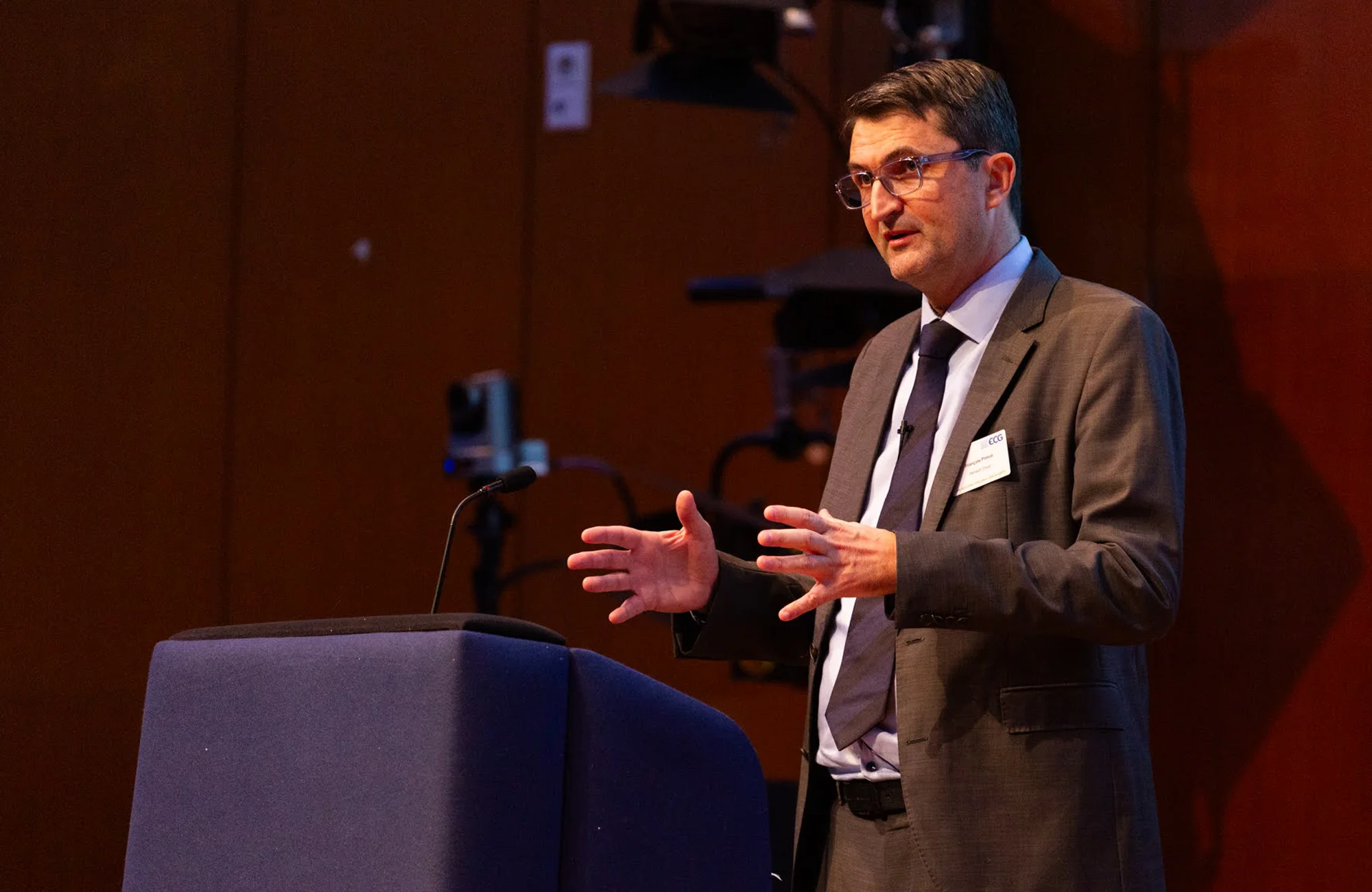
François Prince, general manager at Renault, focused on resilience. The automotive supply chain since 2020, he argued, has been hit by a number of crises: semiconductor shortages, inland transport crunches in Europe, deep-sea capacity shortages and spiralling rates, energy inflation, port congestion, climate-related disruptions and wildly fluctuating customer demand. Despite all of this, OEMs are still expected to keep costs under control, deliver on decarbonisation roadmaps to 2030, keep customers happy and keep their people motivated.
Renault’s response has been to become “extremely reactive and collaborative”. Prince described the rise of end-to-end control towers – not just classic track-and-trace dashboards, but integrated, shared operational nerve centres spanning OEMs, tier-1 suppliers, logistics providers and digital partners. On the outbound side, the Vehicle Control Tower is designed as a single source of truth for each car’s journey, from plant release to final delivery. It combines real-time GPS and TMS events with predictive arrival scheduling, flags anomalies early and lets customer care act before the dealer (or the driver) starts shouting. The aim is simple: one tool, real-time, shared by all stakeholders, with the explicit goal of on-time delivery to the end customer.
The next step, he said, is to hardwire that same responsiveness into structural planning, not just firefighting. Renault is now building a Supply Chain Engineering Control Tower to link network design, compound capacity, transport capacity and sales and operations planning. The ambition is to let logistics constraints (rail slots, truck driver availability and yard throughput) talk back to commercial planning, instead of being informed too late. That requires OEMs to share mid-term volume forecasts by destination with their logistics partners – something many OEMs have historically resisted – and to smooth weekly volume swings that make capacity planning impossible.
If Volkswagen showed how to automate the yard, Renault showed how to make the yard – and the compound, the ship slot and the truck leg – visible, predictable and prioritised around the final customer promise.
What’s next?
So, what’s next for the FVL sector? Delegates were told that the sector must behave like a unified digital network; prove and price its CO₂; integrate with defence logistics; match Chinese speed; satisfy customers who expect Amazon-level visibility; and lobby Brussels for not just greener rules, but simpler ones.
No-one on stage argued for going back to “how it was”. Instead, the call – from OEMs, NATO, analysts, lobbyists and logistics leaders alike – was to build the next operating model now. The era when the FVL sector could sit quietly at the end of the value chain is over. The 2025 ECG Conference made that undeniable.
- ECG, the Association of European Vehicle Logistics, has been the voice of the finished vehicle logistics industry in Europe since 1997. ECG represents the interests of over 200 member companies and partners, from family-owned SMEs to multi-nationals, and is the major champion of the European vehicle logistics sector. ECG represents all transport modes at EU level – road, rail, maritime and fluvial. ECG members provide transport, distribution, storage, preparation and post-production services to manufacturers, importers, car rental companies and vehicle leasing operators across the European Union as well as Norway, Switzerland, the United Kingdom, Turkey and beyond. It owns or operates more than 470 car-carrying ships, 14,000 purpose-built railway wagons, 23 river barges and over 26,000 car transporters.
Published by

Charleen Clarke


focusmagsa