ITOY turns 50: These were the winners from 1992 to 1996
ITOY turns 50: These were the winners from 1992 to 1996
The International Truck of the Year (IToY) is 50 years old! In celebration of this, RICHARD STANIER is paying tribute to all the winners over the years.
We kicked off the tribute in FOCUS March 2026, with the first five winners (1977 to 1981). In April and May, we covered the winners from 1982 to 1986 and 1987 to 1991 respectively. Here are the winners from 1992 to 1996.
1992: Iveco EuroCargo
Iveco was the last of Europe’s major manufacturers to win an IToY title, but did so in fine style with a £2.5-billion (about R61-billion) investment in 1992.
Each of the 13 European judges had 12 votes to cast, with a maximum of seven allocated to one vehicle. The new Ivecos scored with all the judges to secure a convincing win on 80 points. Scania’s Turbo-Compound 400 was pushed into second place, while the Low Emission version of the Mercedes SK took third.
Hailed as the first “all-new” Iveco since the company’s founding in 1975, the EuroCargo’s design brief originated in 1985 as an attempt to streamline the sprawling range of legacy models, which included Club-of-Four cab Magirus trucks, Ford’s original Cargo and older designs from OM and Unic. The EuroCargo was a very ambitious model range (arguably two model ranges). The six- to 10-tonne models shared more engineering features than the heavier versions, which completed the programme up to 15 tonnes in rigid, or 24 tonnes in articulated form. The 540 standard variants on offer were so extensive they effectively made “special builds” redundant.
The judges always appreciated a comprehensive and adaptable range of light trucks; with Euro 1 technology, “exceptional standards of handling and stability” and reduced scheduled maintenance times, Iveco was onto a winner.
EuroCargo’s power was derived from the existing 8000 Series engines, but these had been extensively re-engineered with new piston designs and injectors to improve combustion and reduce smoke. All the engines were turbocharged, and the four-cylinder versions of 3.9 litres were rated at 116hp (87kW) or 135hp (101kW). Six-cylinder designs of 5.9 litres covered the 143hp (107kW), 177hp (132kW), 207hp (154kW) and 227hp (169kW) ratings, with intercooling employed on the two highest-powered options. A single 7.7-litre engine of 266hp (198kW) was offered for the heaviest models.
A new range of gearboxes was jointly developed with Eaton; these were known as the 2800 Series by Iveco. They consisted of five-, six- or nine-speed units, with a splitter version of the six-speed also offered. The gears were of a generous width to reduce noise and prolong durability.
Up to 10 tonnes, EuroCargos used Iveco’s own drive axles – with a choice of up to six ratios on some models – and disc brakes from Lucas were employed all round. The heavier variants used Rockwell axles with wedge actuator brakes. Suspension options spanned parabolic or multi-leaf springs, parabolic front and air rear combinations, or air suspension all round. Torsion anti-roll bars and telescopic dampers were common to all applications.
The brand-new cab, designed in a joint venture with ItalDesign, was of modular construction and pressed at the Brescia factory, which was said to have Europe’s most sophisticated press complex. Much of the assembly work was robotic, and the clean lines of the cab were adapted for Iveco’s heavy range in the years to follow.

1993: Iveco EuroTech
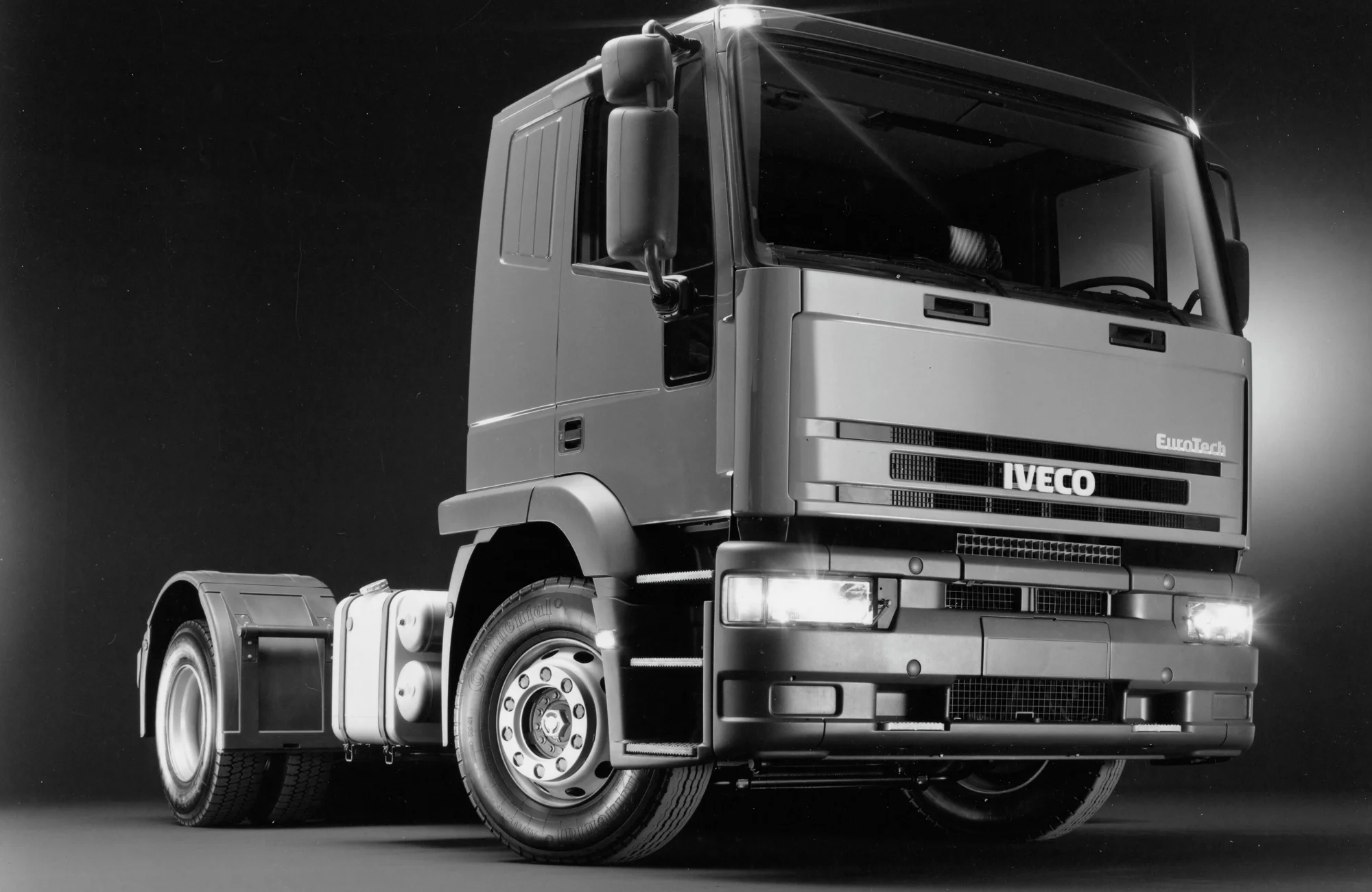
Iveco waited 15 years for its first IToY award before two came along in a row, with the EuroTech winning a close competition in 1993.
Having scored a convincing win in the 1992 competition with EuroCargo, the next phase of Iveco’s massive investment programme produced another winner with the EuroTech medium/heavy range. The new Ivecos saw strong competition from DAF’s 75/85 Series, with the 13 judges settling the question in the EuroTech’s favour by a mere four votes. The Volvo Euro-1 Geartronic came in a distant third.
The judges were intrigued by the differing approaches employed on the new Iveco and DAF ranges, with the new DAF models being a distinct model range between the 45 and 95 Series vehicles, while the Ivecos were part of a highly rationalised programme integrated with the EuroCargo and EuroStar.
The EuroTech cab featured very similar styling to its smaller stablemate, but was 2.28m wide with four options – day, standard sleeper, top-sleeper or medium-roof sleeper – the latter selling itself a little short given its 2.02-m internal height.
Engine capacities spanned 7.7, 9.5 and 13.9 litres, with the 9.5-litre available at 345hp (257kW) or 375hp (280kW) at launch. The 13.9-litre was initially rated at 420hp (313kW), but a 470-hp (350-kW) version was later added, along with a 300-hp (224-kW) version of the 9.5-litre.
The new engines were developments of the existing 8000 Series with new piston designs, higher-pressure six-hole injectors and waste-gate valves, all Euro 1-compliant at launch. The 375-hp (280-kW) 9.5-litre engine was electronically controlled and the adoption of this size of engine in the 360hp-plus class presented a significant weight saving over its predecessor. This was enhanced with aluminium gearbox casings for the ZF gearboxes and fabricated steel chassis bracketry used in place of heavier cast iron.
Eaton Twin Splitter gearboxes were offered alongside the ZF Ecosplit and Rockwell drive axles featured on most models, with the Iveco hub-reduction unit reserved for some six-wheelers. Rear axle ratios ranged from 2.93:1 up to 5.7:1 to allow a wide range of performance possibilities when matched to various wheel and tyre sizes, and all the Iveco-built front and non-driven axles employed Bendix air-disc braking.
In keeping with its name, EuroTech was a truly pan-European engineering project, with engines built in the French Bourbon-Lancy plant, frame rails and cross members sourced from Turin and cab panels pressed in Brescia. Final assembly was completed in the former Magirus plant in Ulm for the Central and Northern European markets, while the newly acquired Pegaso plant at Barajas, near Madrid, supplied France and Southern Europe.
The EuroTech was a strong contender and caused its rivals much concern. However, build quality on early models dogged the truck’s reputation to a degree.
1994: Volvo FH
The Volvo FH earned the Swedish manufacturer an unprecedented fourth win, dashing Iveco’s hopes of a three-in-a-row triumph in 1994. When Volvo announced the new FH range in September 1993, the odds on another win for Gothenburg would have been short and, true to form, the FH secured 74 votes against 46 for Iveco’s EuroStar flagship and 18 for the DAF 75/85 Series.
The all-new family of heavy trucks featured innovative engineering, high safety and driver comfort standards, and the kind of performance and operational factors beloved by the judges and operators alike. When the vehicles were formally launched, they already seemed quite familiar due to the extent of the pre-production testing of a design brief finalised by 1988.
The FH was built on a new, wider chassis constructed of an alloy of high-yield steel chosen for its stability without the traditional “spring” of conventional high-tensile steel, with deeper and thicker pressings for heavier applications. A new “S-spring” parabolic suspension was introduced for single-drive axles, improving the ride from steel suspensions, but traditional multi-leaf or air suspension was also offered.
The new 12-litre D12A engine was a groundbreaking development, designed with future environmental standards in mind and featuring very high-pressure electronically controlled unit injectors. To further develop the combustion chamber, an overhead camshaft was introduced, breaking Volvo tradition by abandoning individual cylinder heads on larger engines. This meant introducing a new cylinder-head casting – the most complex undertaken at the Volvo foundry. The engines, rated at 340hp (254kW), 380hp (283kW) and 420hp (313kW), had four valves per cylinder and generous cooling capacity, with forged steel piston crowns to accept the highest pressure and thermal loads.
The FH range also included the FH16 and, while the bigger truck did not receive a brand-new engine, the 16-litre unit evolved into the D16A with electronic fuel management and a new 520-hp (388-kW) rating, alongside a 470-hp (350-kW) version.
Two new 14-speed gearboxes were introduced, with the SR 1900 14-speed available in the FH12 420 and the SRO 2400 in the FH16 520. All FH12s were offered with the option of the electronically controlled Geartronic system.
The FH’s all-new cab also drew much praise and was developed from a brief stating that the design must be suitable for a variety of operations, not just long-haul European work. In keeping with this, the cab was high-mounted to allow an underfloor radiator large enough for higher-powered engines and to accommodate air intake trunking to leave a clean back-of-cab for bodying rigid vehicles. Accordingly, a flat floor was discounted, but the high-roof Globetrotter cab offered more space than the standard sleeper or day cab for those that needed it. The cab was made of zinc-coated steel and had three trim levels – standard, C or CD, which boasted leather upholstery.
In hindsight, some Trucks of the Year appear more important than others, and the FH – like 1992’s EuroCargo – was strong enough to establish a brand name that continues to the present day.
1995: MAN F2000
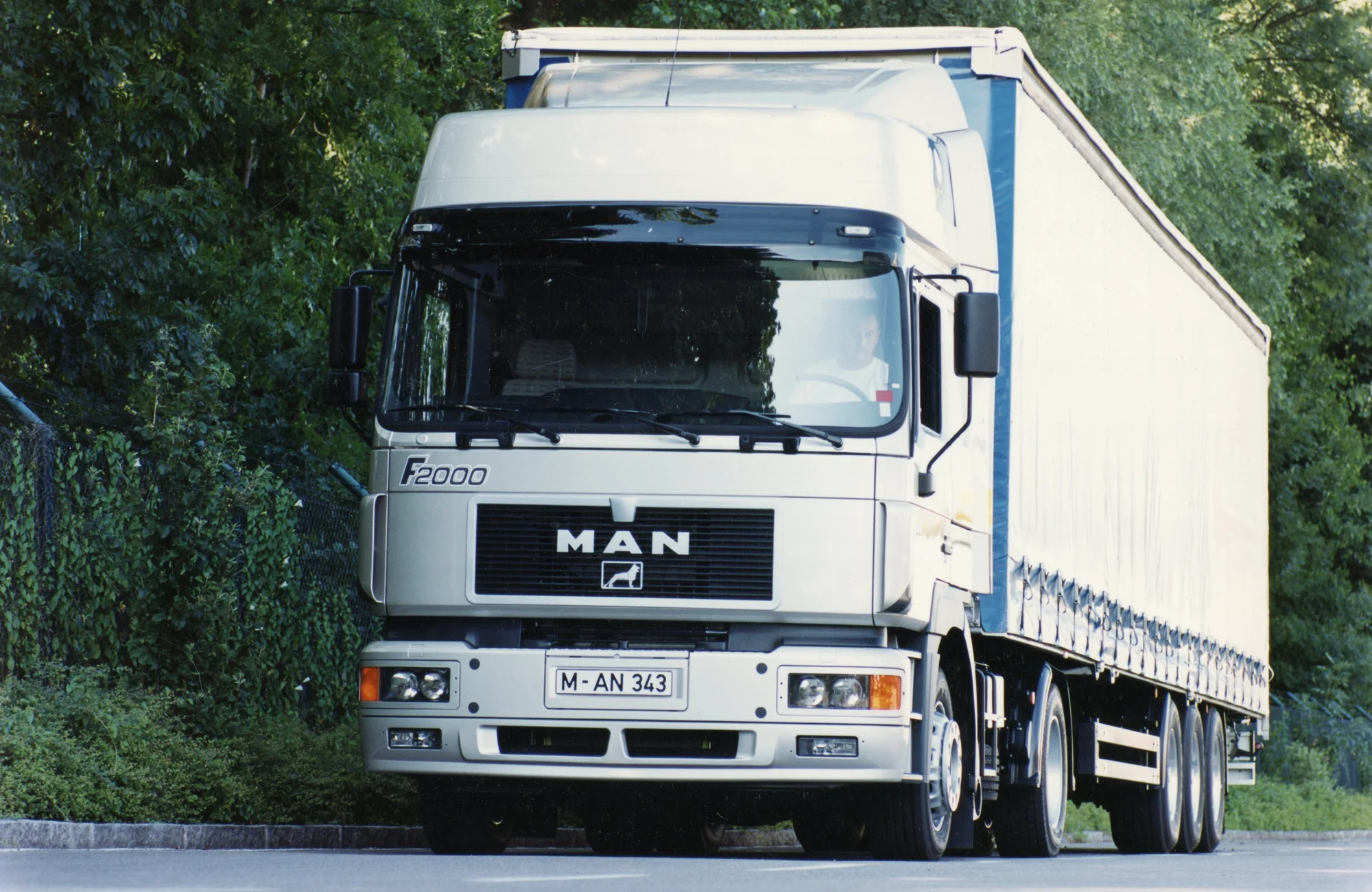
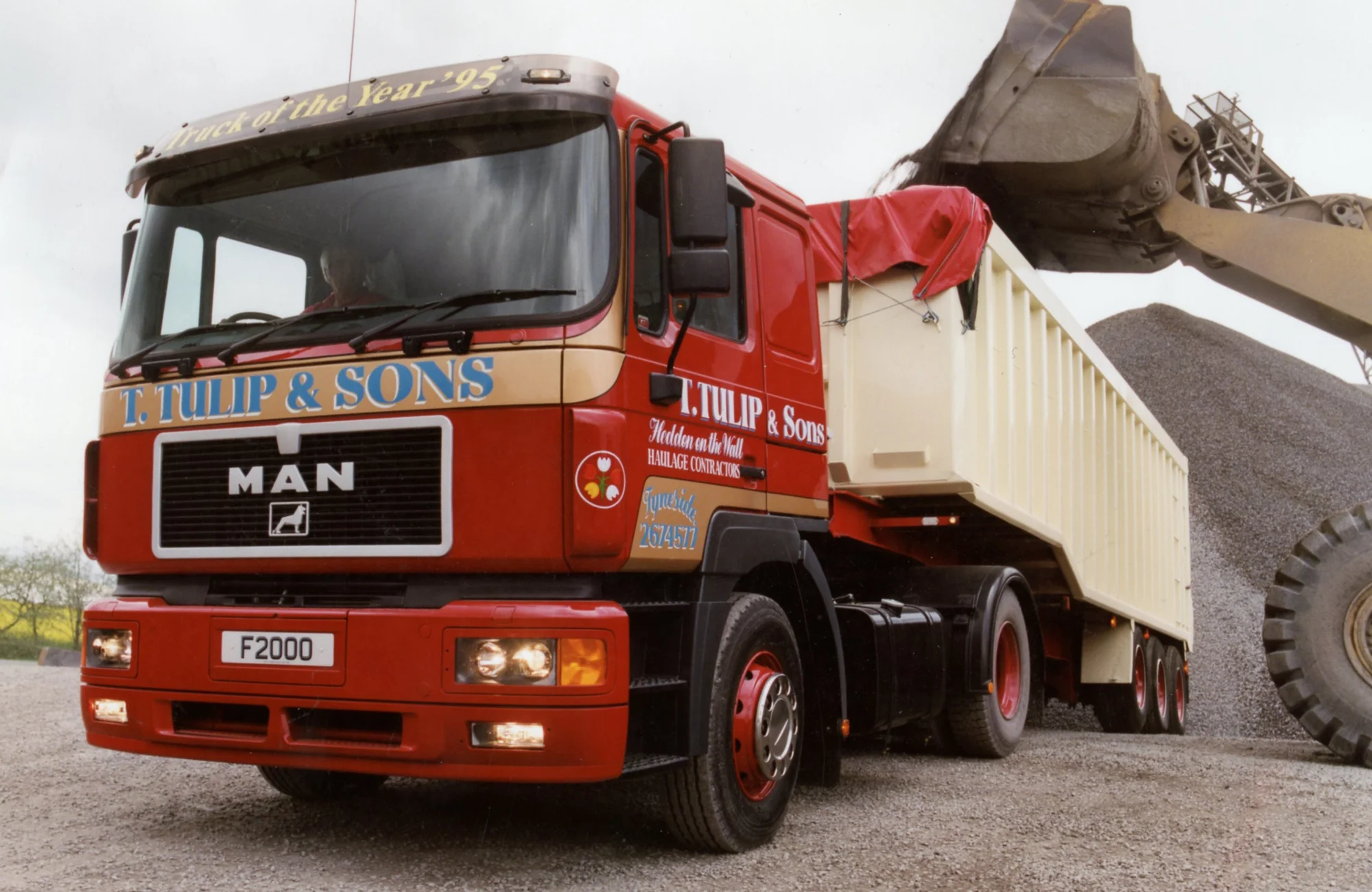
The IToY panel increased to 14 judges in 1995 following the inclusion of an Irish representative. MAN replicated Volvo’s fourth success, with the F2000 taking the top honours as the replacement for 1987’s winning F90 range. The 1995 triumph was overseen by Dr Klaus Schubert, the German manufacturer’s head of engineering, who had also been at the helm eight years earlier for MAN’s previous win with the F90.
Schubert outlined a very perceptive and insightful philosophy underpinning the F2000, which won by a two-point margin over the DAF 95.500 Super Space Cab. MAN’s offering was a comprehensive range of vehicles designed to meet all anticipated operational and legislative requirements, whereas the DAF was aimed squarely at the new super-long-distance work anticipated with the opening up of Eastern Europe.
While the external appearance of the F2000 was not radically different, the new vehicles were identifiable through an extra third step to the cab and twin halogen headlamps. Inside, a new dashboard featured an improved display for the driver, and new Isringhausen seating was installed. The most powerful models received new cab air suspension, with this offered as an alternative lower down the power range.
Chassis frames were pressed in “fine grain medium-yield steel” for the required strength and stiffness, while a new three-leaf parabolic-spring design was the standard option on the front axle. There was an air option for the front suspension, with air generally specified for the rear. An optional electronically modulated design was introduced for high centre-of-gravity applications.
The F2000 had improved front axles with disc brakes, with the rear axles carried forward from the joint venture with Eaton signed in 1986. These single-reduction units had replaced the MAN hub-reduction design originally used on early F90s and used three sizes of ring gears together with different carriers, ratios and housings to offer a wide variety of variants.
MAN’s close working arrangements with Eaton Truck Components were also evident, with the new Eaton 16-speed synchromesh gearbox offered as an alternative to the ZF Ecosplit 16-speed. Schubert remarked that a choice in synchromesh transmissions was a logical philosophy, and MAN also offered the Eaton SAMT B, which was a semi-automated version of the 16-speed unit. The cost of other advanced semi-automated transmissions was deemed prohibitive at the time.
With an eye on differing purchasing priorities across Europe, MAN simultaneously offered the F2000 with a choice of Euro 1 or Euro 2 engines. For conservative operators content to retain proven Euro 1 designs, engines from 270hp (201kW) to 420hp (313kW) were available, but for those seeking the latest engineering technology, Euro 2 versions were offered from 290hp (216kW) to 400hp (298kW) with Bosch pumps and EDC.
A brand-new 12.8-litre long-stroke version of the D28 – rated at 460hp (343kW) and 2,000Nm of torque at 800 to 1,500r/min – was the highest-power option available, but this was only offered at Euro 2, with a view to further development over the next decade.

1996: Scania 4-series L Class
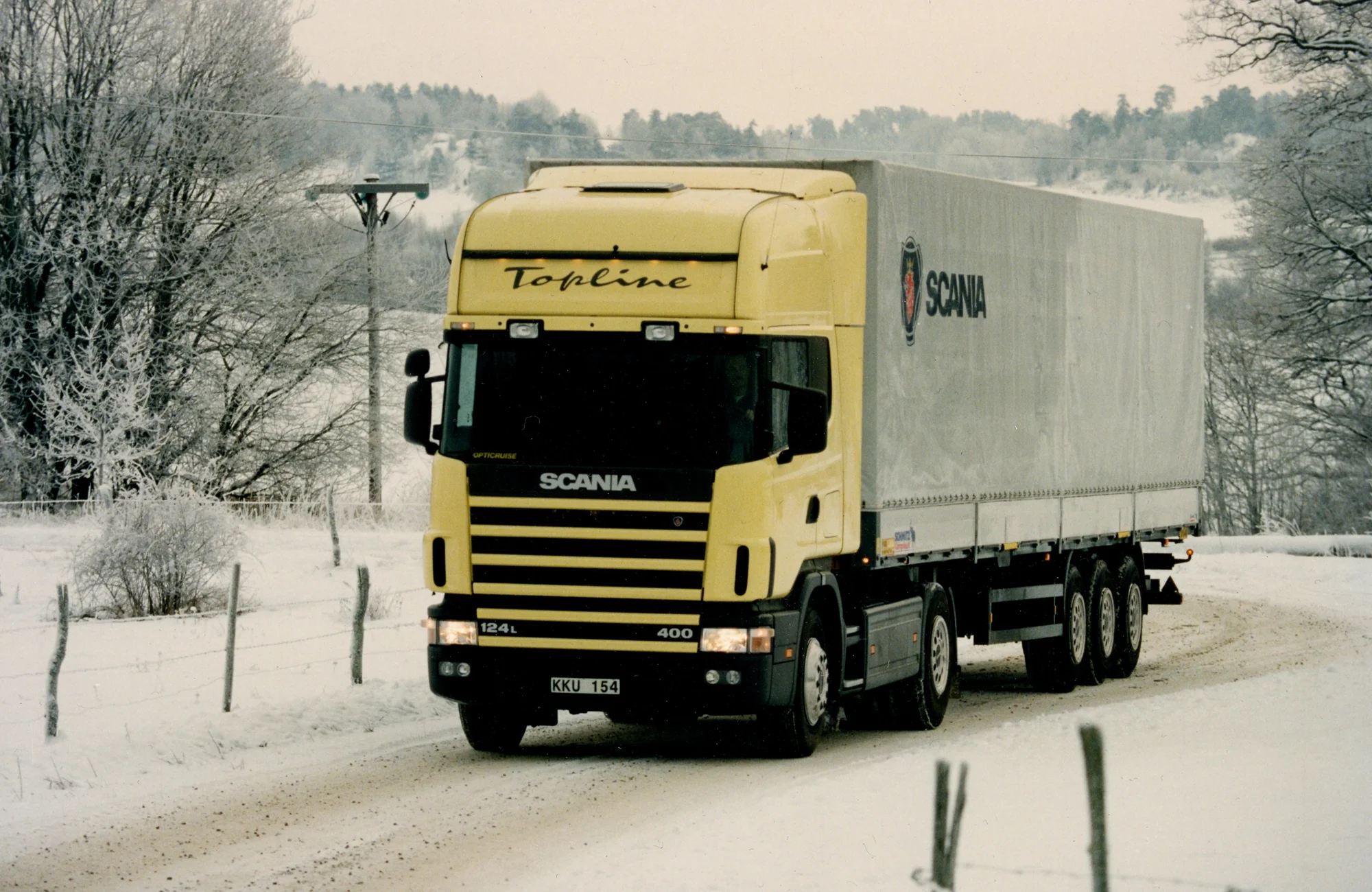
1996 saw a second IToY win for Scania with the highly anticipated 4-series. While the popular imagination remembers the 4-series as the runaway winner of the 1996 competition, the award was actually made in respect of the Long-Distance (L) Class of vehicles within the 4-series range. The L Class had only been formally announced in October 1995, and the other classes – Construction, Distribution and General – followed.
The new Scanias scored an impressive 72 points, with the DAF 55 Series in second place on 33, and its 85.400 stablemate in third with 17. The modular Scania concept contrasted with the Dutch manufacturer’s segment-based designs.
The 4-series was heralded as the biggest-ever change in the Scania range and came at a pivotal time in the company’s history, following the demerger with Saab and prior to a stock market listing in April 1996. The various classes of 4-series were based on their chassis and sector designations, and Scania paid particular attention to chassis development across the range, having encountered criticism that the 3-series chassis design had failed to recognise the growing degree of specialisation in the marketplace.
Scania’s trusty nine-litre engine received an increased capacity to a full nine litres with 310hp (231kW), and the 11-litre was available for Euro 2 with a 340-hp (254-kW) rating. A brand-new 12-litre engine was introduced for 360hp (268kW) and 400hp (298kW), featuring four valves per cylinder, individual cylinder heads and rear-mounted timing gears. The famous Scania V8 14-litre was equipped with a new generation of EDC and was rated at either 460hp (343kW) or 530hp (395kW).
Among the advanced features offered in the L Class were Scania’s semi-automated Opticruise transmission, standard ABS and a gearbox-integrated retarder, but the very first trucks were fitted with drum brakes until discs were introduced later in 1996.
The new cab design was quite a departure from traditional Scania styling and initially received a mixed reception (not least from staff at Södertälje, according to contemporary reports). Styled by the Italian design house Bertone, the cab featured an upright windscreen with large-radius curves to the corners, roof and under-bumper.
In keeping with the Scania modular-cab philosophy, there was a low-mounted P-cab in day or sleeper form, and a tall R-cab also in day or sleeper form, which was joined by the new CR19 Topline flagship design. A normal-control T-cab joined the line-up in due course.
The new Topline addressed the interior-space issue of the 3-series, affording 1.97m of standing room above the engine cover, and a 900mm-wide “home-sized” bed mounted above the windscreen at the front of the cab. Scania’s engineers resisted the temptation to have a high cab floor, like the Renault Magnum, to preserve accessibility and “feel for the road”.
- The original version of this article was published in Commercial Motor magazine and contains a number of references to the British market. We have not removed these references because we believe that our South African readers will find them interesting. We will continue this series in the next issue.
Published by

Focus on Transport

focusmagsa