MAN eTGX and eTGS: quiet confidence, big ambition
MAN eTGX and eTGS: quiet confidence, big ambition
MAN’s new heavy-duty electric trucks have arrived with a tailwind. The eTGX recently won the world’s first major comparison test for heavy-duty electric trucks (conducted by Trucker magazine). But these are the obvious questions: are these trucks any good, and do they truly deserve that first place? CHARLEEN CLARKE went to Munich to find out.
Back in 2018, we were invited to Austria by MAN. The occasion? Amidst much fanfare at its then-plant in Steyr (which has since been sold), MAN handed over nine eTGM electric trucks to various Austrian companies. It was “A Seriously Big Deal”. MAN was heading down electric avenue! It was leading the way when it came to e-mobility.
And then nothing happened. Zilch. Nada. MAN went very quiet on the e-mobility front. Numerous competitors started rolling out their electric trucks. For the time being, though, MAN appeared to have fallen out of love with e-mobility.
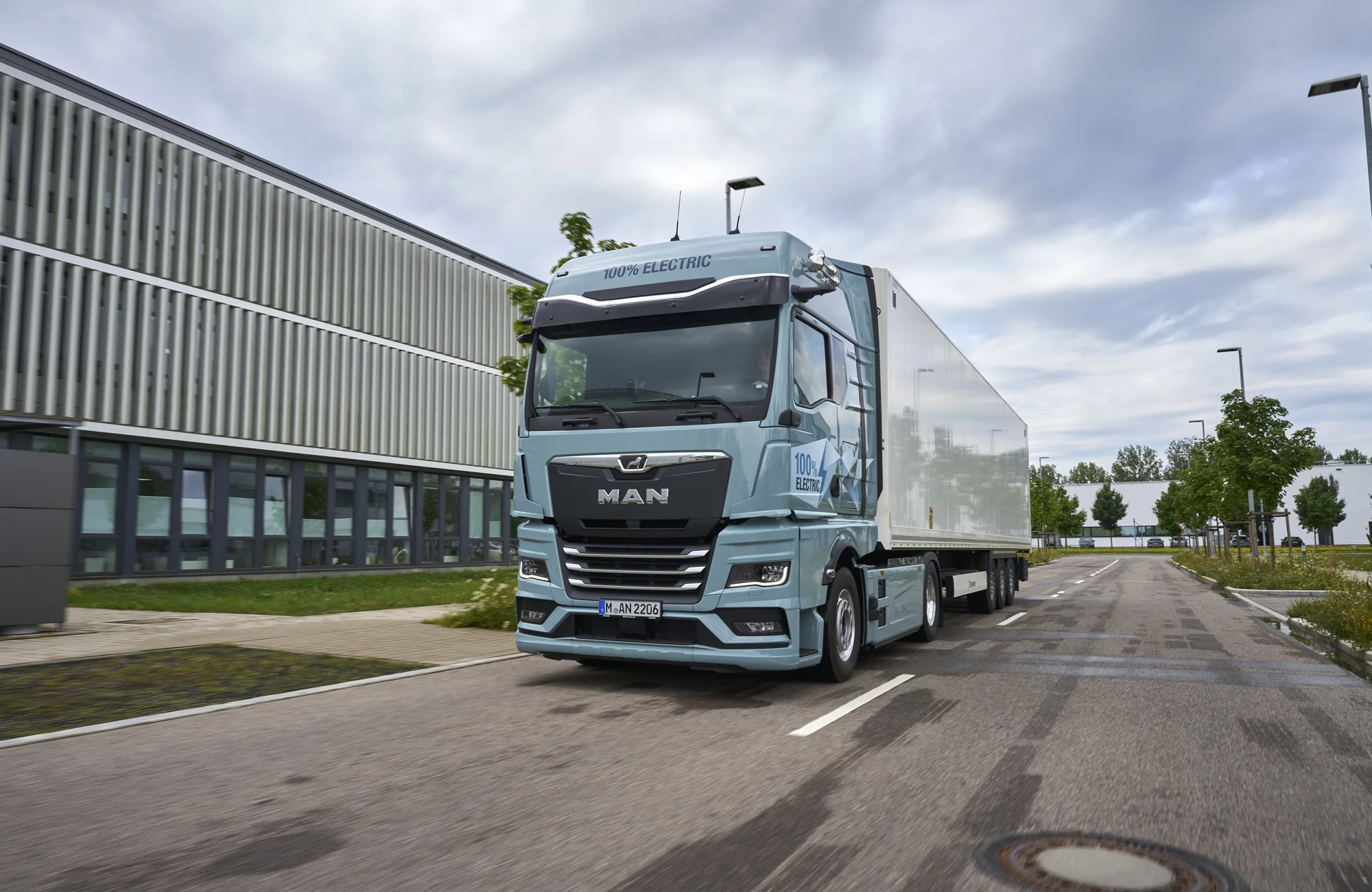
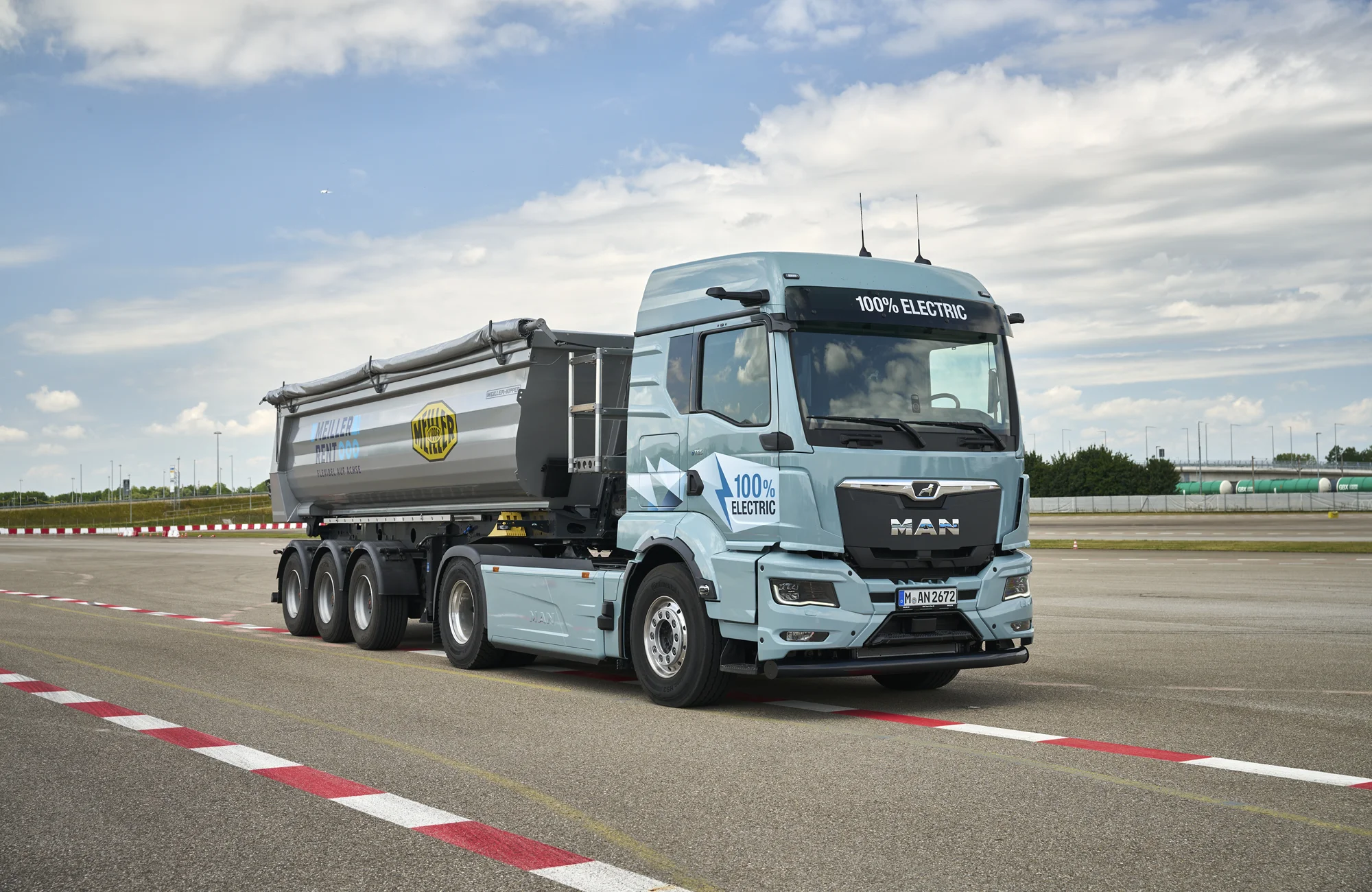
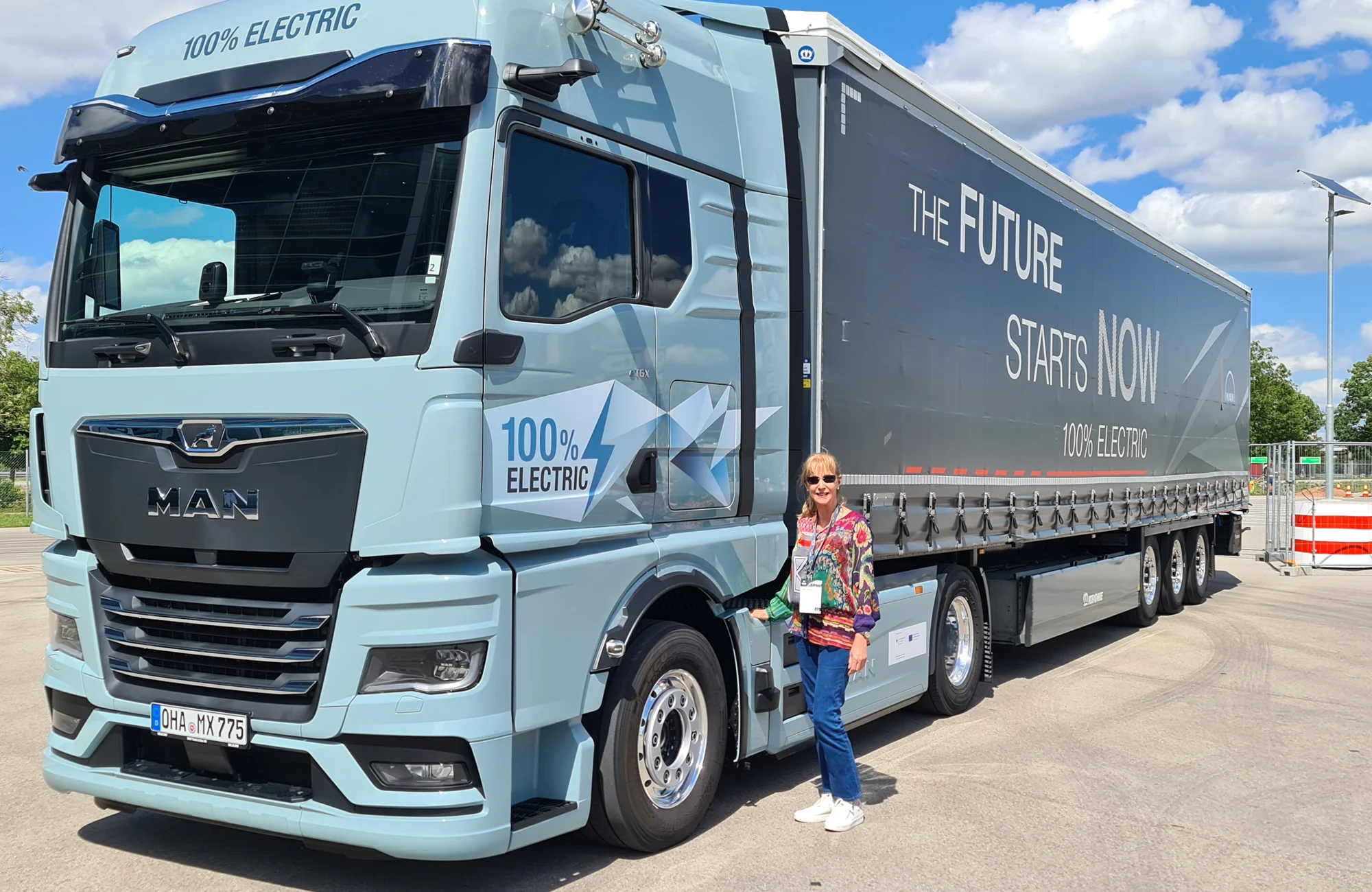
Of course, that all changed at the 2022 IAA Transportation, with a near-series prototype of the new MAN eTruck. Fast forward to 2025, and series production of the trucks has commenced in Munich, which is where we tested both the long-haul eTGX tractor and the regional eTGS rigid, and also found out a bit more about MAN’s electric offerings.
What MAN has actually built
Rather than a clean-sheet e-axle, MAN has opted for a central electric motor and a compact multi-ratio transmission mounted in the frame, driving the familiar hypoid drive axles via a prop shaft. Two battery packs live under the cab; up to four more hang on the chassis rails for a maximum of six. Usable energy tops out around 480kWh in that six-pack configuration, which translates – duty dependent – into roughly 500km between charges. The smallest configuration carries three packs (still north of 320kWh) for operators prioritising payload over range. In certain 6×2 chassis there’s provision for a seventh pack ex works to stretch the solo-vehicle range further.
The batteries are MAN’s own commercial vehicle (CV) units, assembled in Nuremberg with cell chemistry optimised for energy density and thermal robustness. Cooling and thermal integration are thorough: waste heat from the driveline helps warm the cab; battery temperature is tightly managed for performance and longevity. Depending on duty cycle, the company talks about battery life as being measured up to 1.6 million kilometres or 13 to 15 years.
Charging is available via CCS up to 375kW and, more interestingly, via the new Megawatt Charging System (MCS) at up to 750kW at launch, with headroom beyond 1MW later. On paper that means a 45-minute driver break can add roughly 350km, which is why MAN suggests total daily coverage “up to 800km” with an en-route top-up. The charging sockets can be positioned to suit a depot layout – an under-appreciated quality-of-life detail.
If this sounds modular, that’s deliberate. The electric trucks are built on the same line as their diesel siblings, using shared mounting points and identical build times. Wheelbases down to 3.75m are possible, and the under-cab motor keeps the frame clear for cranes, blowers, stabilisers, and the like. A mechanical PTO is still available, as is an electromechanical PTO – important for mixers, skips, tippers, refuse bodies, and anything else where the body often electrifies later than the chassis.
On the road: “point and go”
Climb in and there’s little to wrong-foot a diesel-trained driver. The cab architecture, switchgear, and driving position are pure TG series; the differences are the silence at idle, the calm at cruise, and the way the truck moves. Pull-away is smooth and immediate. Torque arrives without fuss and the calibration of the multi-ratio gearbox is unobtrusive, stepping through its shifts with a neat blend of performance and mechanical sympathy. Even at 42 tonnes, progress is brisk and unflustered; unladen, it’s keen without being skittish.
Regeneration is the star. Lift off and the truck decelerates progressively, harvesting energy, and the transition into the service brakes is clean. The retarder-stalk now controls regen, with multiple steps from shallow drag to assertive one-pedal driving. On hilly routes the stronger settings stand in for a conventional retarder and, because the battery mass sits low in the frame, the truck feels planted in crosswinds and predictable on cambered slip roads. In stop-start work the creep control and instant torque make docking, yards, and tight urban turns simpler than any manual or AMT.
The effect on driver workload is obvious. With no combustion clatter or gear hunting and minimal vibration, fatigue drops. You manage momentum rather than wrestle with it. A clear digital cluster shows power draw and recuperation; live efficiency screens nudge better habits. Several of MAN’s demonstrators noted that even average drivers quickly become range-aware when the “penalty” for poor technique is a charging stop, not a few extra litres of diesel. It makes for calmer, cleaner driving.
Numbers that matter – and what they don’t say
Pre-series trucks have already racked up more than 2.5 million kilometres with customers. MAN quotes average energy use of roughly 94kWh/100km across that pool – figures that will swing with weather, mass, speed, and route profile. The important point is consistency: with energy metered precisely and regen doing meaningful work, the trucks are predictable to plan around.
For South African readers, the temptation is to jump straight to range anxiety and grid constraints. Both of these are real considerations, but remember the operating patterns where battery-electric trucks thrive first: hub-and-spoke distribution, trucking routes with a depot charge at each end, municipal and regional rigid work, and back-to-base sectors with well-understood duty cycles. Those all exist in South Africa today.
Consulting, tools, and charging: the ecosystem matters
MAN is unusually forthright about the fact that a truck is only one part of an electric solution. The company leans heavily on its eMobility Consulting team to do the pre-work: route modelling, energy pricing, depot surveys, grid connection timelines, and the business case in cents per kilometre. Digital tools then cover daily life: eReadyCheck helps fleets test whether specific routes can be driven electrically; eManager gives managers a live picture of state-of-charge across the fleet; SmartRoute plans journeys including suggested charging points; Charge & Go provides access to a vetted network of truck-friendly public chargers with predictable tariffs.
The public piece is growing. MAN, via the TRATON Group, is part of the joint venture rolling out high-power charging with other manufacturers; separate agreements with utility partners are adding hundreds of additional sites along European corridors. The brand also works with depot-charging suppliers and even offers an interim solution – the Smart Charging Cube – using second-life electric vehicle (EV) batteries to provide buffer storage at depots awaiting grid upgrades.
Driving verdict: does it deserve the win?
On dynamic polish alone, the eTGX deserves its trophy. The calibration is mature; the steering is accurate; the brake blend is natural; the NVH is best-in-class. The operating concept is coherent: familiar enough for seasoned TG drivers, with electric-specific functions that make sense and add value. The low unladen weight helps payload, and the modular battery layout keeps the bodybuilders happy.
More subjective (but no less important) is how these trucks feel to live with. They are calm, predictable, and confidence-inspiring. The technology doesn’t shout; it supports. Because the platform shares so much with diesel siblings, there’s an aftersales comfort in knowing you can still spec a PTO, fit the body you know, and keep the wheelbase you need.
A South African reality check
South Africa is a 6×4 market for heavy work – mining, timber, tankers, side-tippers, and long-haul combinations regularly demand three-axle tractors for traction, axle loading, and durability. MAN says a 6×4 electric model is due next year, and that matters here. The current European-focused 4×2 and 6×2 offerings are a fine fit for regional rigids and certain trunk routes, but real penetration into our heaviest sectors will hinge on that 6×4.
Charging is the next question. Depot energy planning, grid connections, and backup strategies will make or break early deployments. Here, the consulting and the modular battery choice help: operators can start with fewer packs to preserve payload and charge overnight at modest power, then add packs or infrastructure as duty cycles evolve. Hopefully, one day, megawatt sites will land on the N1/N3/N4 corridors and at major logistics nodes.
Then there’s service. MAN has long experience in South African long-haul and vocational sectors, and the fact these eTrucks are built on the same line will ease the transition for dealers and bodybuilders. Predictive maintenance, high parts commonality, and remote diagnostics (Uptime-style) all count towards keeping wheels turning when every minute of downtime shows up in cost per kilometre (CPK).
Costs, payload, and specification
Electric heavy trucks remain capital-intensive, and the eTGX and eTGS are no exception. The counter-argument rests on total cost of ownership: lower “fuel” CPK when charging is managed sensibly; lower brake wear thanks to regeneration; fewer moving parts; longer service intervals; and improved driver attraction and retention thanks to a quieter, easier drive. The modular battery scheme gives operators a lever to claw back payload: dropping from six to, say, four packs saves roughly 1.6 tonnes, which can be compelling in distribution roles where a 250-km daily range is ample and back-to-base charging is straightforward.
Specification choice is wide. Power ratings span roughly 245 to 400kW (333 to 544hp) with matching torque levels; cab heights mirror diesel TGs; wheelbases are many; charging ports can be positioned to suit left- or right-hand depot layouts (we really love this clever feature); and both volume “low-liner” tractors and high-ground-clearance rigids are available. The idea is simple: every diesel role should find an electric counterpart, whether that’s a 4×2 line-haul tractor, a distribution 6×2, or – soon – a 6×4 heavy-duty spec relevant to South Africa.
Production has started – what this means for adoption
MAN has already handed over around 200 pre-series vehicles and moved into series build. That shift from pilot to production really matters for residual values, parts stocking, and driver training. It also means that fleets can stop treating eTrucks as science projects and start treating them as tools: transport managers can set the routes, plan the energy, put the vehicles to work, and measure the outcome.
If you operate hub-and-spoke distribution from Johannesburg, Durban, or Cape Town; if you move goods to a predictable schedule between two depots; if you run municipal or utility contracts with overnight parking at base… your use cases are at the front of the adoption curve. If you haul ore, timber, or fuel across remote passes at high GCM, you’ll want that 6×4 and you’ll want megawatt charging on your corridor. The good news is that both will come – eventually.
Earned confidence?
Do MAN’s electric trucks deserve that first-place ribbon? On the evidence of our drives and the way the product has been thought through, yes. They feel like MANs: solid, carefully set-up, quietly capable. The driving experience is a genuine upgrade on diesel in day-to-day calm and control. The platform is flexible, body-friendly, and future-proofed by MCS. The support ecosystem – consulting, digital tools, charging access – is not an afterthought.
None of that dissolves the hard questions about infrastructure, capital cost, or route selection. But it does mean that when the conditions are right, these trucks will deliver. For South Africa, the impending 6×4 is the piece that unlocks the heavy end of the market. Until then, there’s plenty of work the eTGS and eTGX can do today.
So, while MAN did dally a bit, it has finally arrived with a very fine e-mobility offering. Now, the job is to turn promising test scores into proven cents per kilometre on public roads.
Published by

Charleen Clarke

focusmagsa